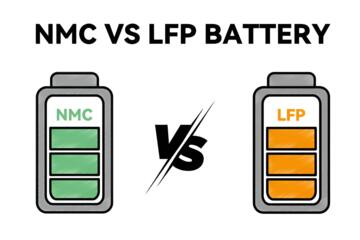
Two battery chemistries power nearly every EV sold in America, and they want to be treated differently. Nickel-based packs (NMC and NCA) prefer to live between 20 and 80 percent; lithium iron phosphate (LFP) packs are built to be filled to 100 percent, and their makers tell you to do exactly that. Get the chemistry wrong and you either shorten the life of a nickel pack or spend years driving an LFP car with a miscalibrated range display. This page explains the difference, lists which US models actually carry LFP in 2026 (the list shrank this year), and gives the charging rules each manufacturer prints in its manual.
The Chemistry in One Paragraph
Both are lithium-ion batteries; the difference is the cathode. NMC uses nickel, manganese and cobalt (Tesla’s NCA swaps aluminum for manganese), which stores a lot of energy per kilogram. LFP uses iron and phosphate, which stores about 30 percent less energy per kilogram but costs roughly 20 percent less to make, contains no cobalt or nickel, tolerates more charge cycles and resists overheating. The trade-offs land in predictable places.
| Property | LFP | NMC / NCA |
|---|---|---|
| Energy per kilogram | Lower, about 30% less | Higher; the long-range chemistry |
| Pack cost | About 20% cheaper | Higher; exposed to nickel and cobalt prices |
| Comfortable daily charge limit | 100% | 80–90% |
| Cycle life | Several thousand full cycles | Roughly 1,000–2,000 |
| Thermal stability | High; harder to push into thermal runaway | Lower; relies more on cooling and the BMS |
| Cold weather | Slower to charge and discharge below freezing | Better |
| Voltage curve | Flat, so the car struggles to estimate state of charge | Sloped, easy to read |
| Where it goes | Entry and standard-range trims | Long-range and performance trims |
That flat voltage curve is the detail that explains the charging rule. A nickel pack’s voltage falls steadily as it drains, so the battery computer always knows roughly where it is. An LFP pack holds almost the same voltage from 90 percent down to 20, and the computer loses track; the only reliable reference point is a full charge.
Which US EVs Use LFP in 2026
Tariffs on Chinese-made cells pushed LFP out of the US market faster than it arrived. Tesla dropped its only American LFP model, the Model 3 Standard Range RWD, in October 2024; Rivian dropped the LFP Standard pack after the 2025 model year; Ford announced an LFP F-150 Lightning and never shipped it. As of October 2026 the new-car list is short.
| Model and trim | Pack | EPA range | Status |
|---|---|---|---|
| Ford Mustang Mach-E, Standard Range (Select and Premium), 2023 on | 73 kWh usable LFP | 260 mi RWD, 240 mi AWD | On sale new |
| Chevrolet Bolt, 2027 model year | 65 kWh LFP | 262 mi | On sale new since early 2026 |
| Rivian Commercial Van, Standard pack | 100 kWh LFP | 161 mi | Fleet customers only |
| Tesla Model 3 Standard Range / RWD, 2022–2024 | About 60 kWh LFP (CATL) | 272 mi | Used only; discontinued October 2024 |
| Rivian R1S and R1T, Standard pack, 2024–2025 | 92.5 kWh LFP | About 270 mi | Used only; dropped for 2026 |
| Tesla Model Y RWD (US) | Nickel (NCA), 69.5 kWh on the 2026 car | 321 mi | Never sold with LFP in the US despite the standard-range badge |
| Every Model 3 and Model Y sold new in the US in 2026 | Nickel cells from Nevada | — | No LFP |
Everything else on American lots, from the Ioniq 5 and EV6 to the Equinox EV, ID.4, Prologue and every long-range Tesla, Ford and Rivian pack, is nickel-based. The list grows again from 2027: Ford’s Michigan plant is tooled for LFP cells for its low-cost pickup, and GM has said an LFP Silverado EV follows the Bolt.
How LFP Changes Daily Charging
The manufacturers are unusually direct. Ford’s Mach-E manual for the Standard Range pack reads: set the maximum charge level to 100% and charge to 100% at least once a month to maintain range accuracy; during regular use you can increase battery life by maintaining the state of charge at 100%. The car puts the same message on the screen. Tesla told LFP Model 3 owners to keep the limit at 100% even for daily use and to fully charge at least once a week, and its current manual defers to whatever the touchscreen shows for that car.
Two reasons sit behind the rule. The first is calibration: a periodic full charge gives the battery computer its reference point, and skipping it produces a range estimate that drifts, sometimes by dozens of miles, until the car suddenly corrects. The second is tolerance: LFP cells hold up far better at high state of charge than nickel cells, so the thing that ages an NMC pack, sitting full, does little to an LFP one. Recurrent, which tracks battery health across thousands of cars, found LFP owners charge to 90 and 100 percent routinely without the penalty nickel owners would see.
One caveat belongs here. A 2024 study in the Journal of the Electrochemical Society found that repeated charging to 100 percent can still form compounds that wear the negative electrode of LFP cells over time, while also noting that keeping LFP at low states of charge brings no benefit. The practical reading is the manufacturers’ one: use 100 percent as your normal limit, make sure you hit it at least weekly or monthly as your manual says, and don’t fear the top of the gauge.
For a nickel pack the rule is the familiar one: 80 to 90 percent daily, 100 percent only before a long drive and not left sitting there. Both chemistries dislike being parked for weeks near empty.
Fast Charging, Cold and Range
LFP does not make a car charge faster. The Mach-E’s Standard Range pack peaks at the same 150 kW as the Extended Range pack; the LFP Model 3 peaked around 170 kW against 250 for the long-range car. What LFP does is shrug off frequent fast charging better than nickel cells, which is one reason the chemistry suits commercial fleets.
Cold is the weak spot. Below freezing an LFP pack accepts charge slowly until it is warmed, and discharges with more loss, so winter range and winter charging times suffer more than in a nickel car. Preconditioning the battery on the way to a fast charger, by setting the charger as the navigation destination, matters more in an LFP car than in any other.
Range is the other cost. Because LFP stores less energy per kilogram, a pack of the same weight goes shorter, which is why every LFP trim is the standard-range trim: 260 miles for the Mach-E against 320 for the nickel-pack version, 272 for the LFP Model 3 against 333 and more for the long-range cars.
Longevity and Resale
This is where LFP pays back. Owner reports of LFP Model 3s past 100,000 miles show minimal degradation even with routine full charges, and the chemistry’s cycle life, several thousand full cycles, means a 260-mile pack would in theory outlast the car. Warranty terms do not reward this: Ford, GM and Tesla all guarantee 70 percent capacity for eight years and 100,000 or 120,000 miles regardless of chemistry.
For a used buyer LFP cars are the quiet bargain. They sit in the cheapest trims, the batteries tolerate neglectful charging, and the main thing to check is whether the previous owner ever charged to 100 percent. A car that has lived at 70 percent for two years will show an unreliable range estimate until you run it low and fill it; that is calibration, not damage.
How to Tell Which Battery You Have
- Ford Mach-E: if the eighth character of the VIN is 4 or 5, the pack is LFP; any other character means NMC. The window sticker’s Standard Range label says the same thing on 2023 and newer cars.
- Tesla: on the touchscreen under Controls, Software, Additional Vehicle Information, or on the charging screen, where LFP cars display a recommended limit of 100%.
- Rivian R1: the Standard pack of 2024–2025 is LFP; Large and Max packs are nickel. The pack name is on the build sheet and the Monroney.
- Chevrolet Bolt: 2017–2023 cars are nickel; every 2027 Bolt is LFP.
- Any car: an EPA range well below the model’s best trim, combined with a lower price, usually means the LFP pack; confirm with the manufacturer before relying on it.
FAQ
Should I charge an LFP battery to 100% every day?
Yes, if the manufacturer says so, and Ford and Tesla both do. Set 100 as the normal limit and make sure the car reaches it at least once a week (Tesla) or once a month (Ford). Avoid leaving it parked near empty for long periods.
Does LFP charge faster than NMC?
No. Peak fast-charging rates are set by the car’s design, not the cathode, and the LFP trims of the Mach-E and Model 3 peak at or below their nickel siblings. LFP tolerates frequent fast charging better; it does not do it quicker.
Which Teslas have LFP batteries?
In the US, only the Model 3 Standard Range / RWD built from 2022 until October 2024. No 2026 Model 3 or Model Y sold in the US uses LFP; the Model Y Standard’s 69.5 kWh pack is nickel.
Is LFP worse in winter?
Yes. It charges slowly when cold and loses more range below freezing than a nickel pack. Preconditioning before fast charging and a garage make most of the difference.
Which is better for a car I’ll keep ten years?
LFP, if the range fits your life. Its cycle life and tolerance of full charges suit high-mileage, long-term ownership; the nickel pack buys range you may not need and a charging routine you have to maintain.
Sources
- InsideEVs — Why LFP Mach-E and Tesla batteries should be charged to 100%: Ford manual wording, Tesla guidance, VIN check, JES study
- MotorWatt — LFP batteries and which US EVs use them, October 2026: Mach-E, 2027 Bolt, Rivian Standard, Model 3 RWD
- EV Seekers — Tesla dropped its only US LFP model in October 2024; all 2026 US Model 3 and Model Y use nickel cells
- The Charge Port — EV battery types: LFP, NMC and NCA, and where each is used
- Tesla Motors Club — Model Y was never delivered with LFP in the US
- Wikipedia — Tesla Model Y battery specifications
- Auto Edge View — LFP vs NMC vs NCA: cost per kWh, pack sizes and ranges, 2026
- Cars.com — 2026 Mach-E range by configuration
- Astro Ford — 2026 Mach-E: 150 kW peak on both packs