Three years after Ford signed up for Tesla’s plug, the American EV market is in the awkward middle of a connector change. Every major brand can now use Superchargers, but only some ship cars with the port built in; the rest hand you an adapter, free or for about $225, and keep the CCS1 socket for another model year or two. This page answers the practical questions brand by brand as of October 2026: does this car plug straight into a Supercharger, what does it need at an Electrify America station, and what does the adapter cost? Model-year details change monthly; the port on the car in front of you is the fact that counts.
What Changed and Why It Matters
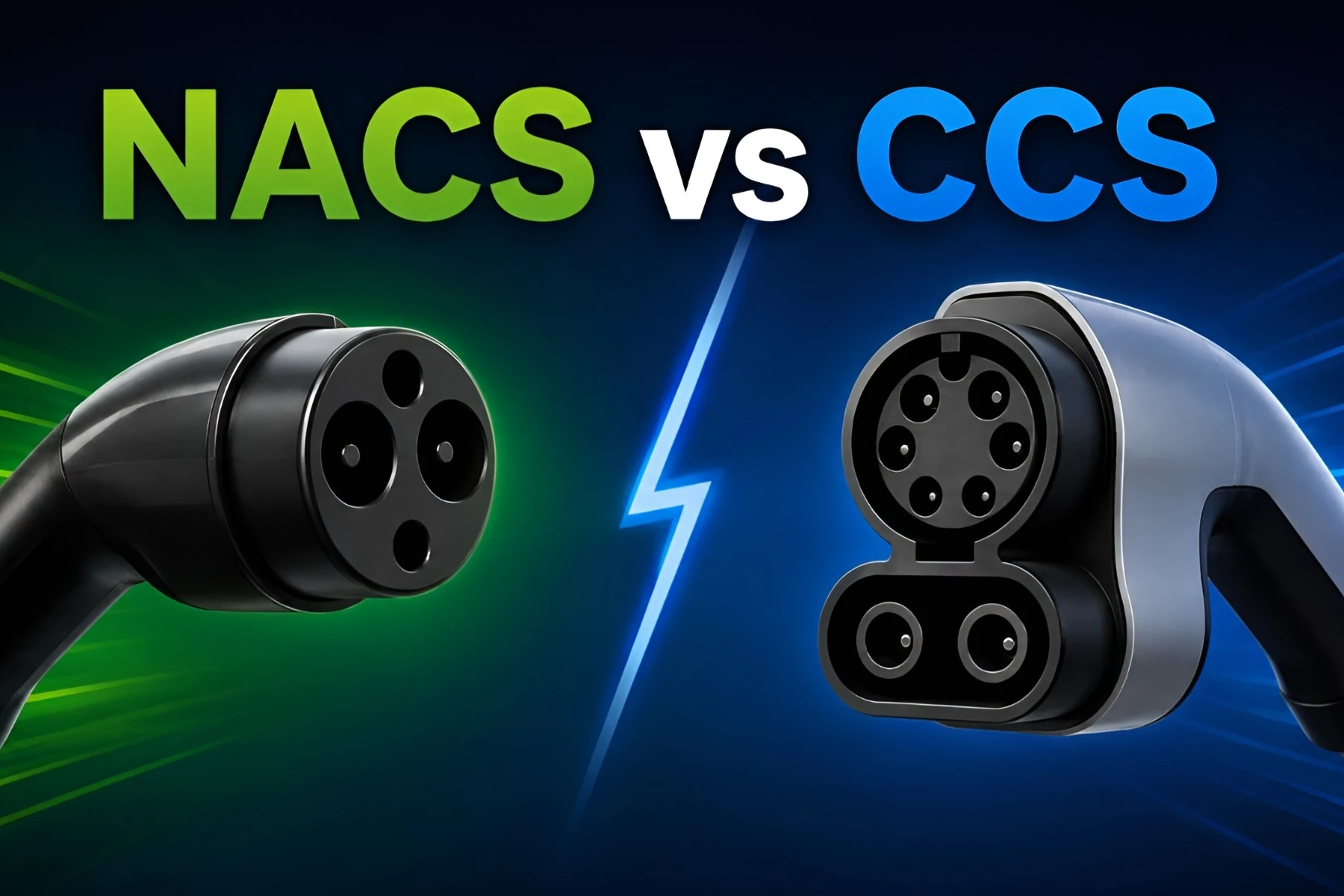
NACS is Tesla’s connector, standardized by SAE in December 2023 as J3400. It carries both AC and DC through one small plug, which is why Tesla cars never needed the bulky CCS1 combo socket. Between May 2023 and early 2024 every carmaker selling EVs in North America committed to adopt it, in two steps: adapter access to Superchargers first, then a native port on new cars. By the end of 2025 the first step was done for nearly every brand. The second is arriving model by model, not brand by brand, and that is the source of the confusion. A 2025 Ioniq 5 has the Tesla port; a 2025 Ariya from the same price bracket does not. A 2026 Cadillac Optiq has it; a 2026 Chevrolet Equinox EV built by the same company does not.
There are two adapters, and they point in opposite directions. A CCS-to-NACS adapter lets a CCS car use a Supercharger; it is what Ford, GM, Rivian and the others distribute. A NACS-to-CCS adapter lets a Tesla, or a new native-NACS car, use the CCS stations that still make up most of the non-Tesla network. Owners of the newest cars increasingly need the second one.
Native NACS Ports in 2026
Cars that plug into a Supercharger with nothing in between, with the model year the port arrived.
| Brand | Native NACS | Notes |
|---|---|---|
| Tesla | Every model | Needs the NACS-to-CCS adapter at CCS stations |
| Hyundai | Ioniq 5 from 2025; Ioniq 6 from the 2026 refresh; Ioniq 9 | First non-Tesla brand to ship the port; CCS adapter included |
| Kia | EV6 from 2025 (Georgia-built); EV9 from 2026 | Port moved to the driver’s side with the change; Niro EV stays CCS |
| Genesis | GV60 and Electrified GV70 from 2026 | CCS adapter available |
| Rivian | R1T and R1S from 2026; R2 | 2022–2025 R1 use the $225 Rivian adapter |
| GM | Cadillac Optiq and Optiq-V from 2026; 2027 Chevrolet Bolt | Everything else in the GM lineup is still CCS in 2026 |
| Mercedes-Benz | CLA with EQ Technology, 2026 | First in the lineup; EQ models stay CCS |
| Nissan | Leaf from 2026 | Dual ports: J1772 for Level 2 on one side, NACS for DC fast charging on the other |
| Lucid | Gravity | Air, including 2026, still needs the $220 adapter |
| Toyota, Lexus, Subaru | Toyota bZ, bZ Woodland and C-HR from 2026; Lexus RZ 2026; Subaru Solterra and Trailseeker 2026 | 2023–2025 bZ4X and Solterra are CCS |
Still CCS: Who Needs an Adapter
The majority of 2026 EVs on dealer lots still carry the CCS1 port. All of them have Supercharger access; the difference is who pays for the adapter and when the native port comes.
| Brand | 2026 models on CCS1 | Adapter | Native port |
|---|---|---|---|
| Ford | Mustang Mach-E, F-150 Lightning | Ford adapter; free for early owners, about $200 since mid-2025 | Future models; not announced for the current two |
| GM | Equinox EV, Blazer EV, Silverado and Sierra EV, Hummer EV, Lyriq, Vistiq, Escalade IQ; Honda Prologue and Acura ZDX | GM-approved adapter, about $225 through the brand app | Equinox EV for 2027; others to follow |
| Volkswagen, Audi, Porsche | ID.4, ID. Buzz, Q4, Q6, A6 and e-tron GT, Macan, Taycan | Adapter included with the 2026 ID.4; others sold by the brand | Porsche has signaled the Taycan for 2027 |
| BMW, Mini | i4, i5, i7, iX, Countryman E | Brand adapter | Neue Klasse models arriving from 2026; confirm at delivery |
| Volvo, Polestar | EX30, EX40, EX90, Polestar 2, 3, 4 | Brand adapter | Not yet on sale |
| Mercedes-Benz | EQB, EQE, EQS | Brand adapter | CLA only so far |
| Nissan | Ariya | Nissan adapter kit, $235 | Leaf only so far |
| Lucid | Air | $220 | Gravity only so far |
| Stellantis | Wagoneer S, Charger Daytona | Check current access status with the brand | Not announced |
Two older groups fall outside both tables. Teslas built before about 2021 need a retrofit before they can use the NACS-to-CCS adapter at all. And the 2011–2025 Nissan Leaf uses CHAdeMO for DC fast charging, for which no Supercharger adapter exists; those cars are limited to a shrinking number of CHAdeMO stations and Level 2.
Adapters: Which, How Much, Risks
CCS car at a Supercharger. You need a DC adapter rated for your car’s current, and the carmakers insist on their own: Ford, GM, Rivian, Nissan and Lucid sell or supplied units built by Tesla or Lectron, and several say an unapproved adapter can void charging-related warranty claims. Third-party units from A2Z, Lectron and others run $150 to $230 and work on most cars, but the car’s software and the Tesla app have to recognize the session, which is why access was switched on brand by brand rather than all at once.
Tesla or native-NACS car at a CCS station. Tesla’s CCS Combo 1 adapter, about $175 to $250, covers Teslas with the right hardware; Hyundai, Kia and Genesis include a CCS adapter with native-NACS cars, and Rivian supplies one with the 2026 R1. Without it, the new port locks you out of every Electrify America, EVgo and ChargePoint dispenser that has not yet grown a NACS cable.
Level 2. NACS carries AC as well, so a native-NACS car at a J1772 home or public charger needs a small J1772-to-NACS adapter, which most carmakers include and which costs $40 to $100 otherwise. The 2026 Leaf avoids this with its second, J1772 port.
What not to do. Never stack adapters, never use a DC adapter for AC or the reverse, and expect awkward parking: Supercharger cables were cut short for Teslas, so a CCS car with its port in a different corner often takes two spaces. Magic Dock sites, Superchargers with a built-in CCS adapter, avoid the hardware entirely but numbered only about 136 locations in early 2025.
Speed and Price at the Plug
Plugging in is not the same as charging fast. Most Superchargers are V3 units supplying 400 volts; an 800-volt car such as the Ioniq 5, EV6, EV9, Ioniq 9 or Lucid has to boost that on board and draws roughly 126 to 135 kW instead of 230 or more, so a native port on an 800-volt car buys convenience, not speed, until Tesla’s 1,000-volt V4 cabinets spread. Four-hundred-volt cars, which is most of the CCS list above, take their full rated power through an adapter. Our 800V guide covers the mechanics.
Price is the other asymmetry. Non-Tesla drivers pay a higher per-kWh rate at Superchargers, with a $12.99 monthly membership bringing it down to the Tesla rate; a driver who fast-charges weekly saves money with the membership and loses it otherwise. Meanwhile the CCS networks are adding NACS cables to new and refurbished stalls, Ionna has built with both from the start, and Electrify America, EVgo and ChargePoint all list dual-cable sites, so by 2027 a native-NACS car will find its plug at most new stations on either network.
What to Buy in 2026
- Buying new and keeping it five years or more: prefer a native NACS port. The 2026 Ioniq 5, EV6, EV9, Rivian R1, Optiq, CLA, Leaf, bZ and Solterra are the mainstream choices. CCS stations will exist for years, but new ones are being built for the other plug.
- Buying a CCS car anyway: get the brand’s adapter before delivery, confirm Supercharger access is live in the brand app, and treat the $200–$235 as part of the price. On an 800-volt car, remember the Supercharger speed limit.
- Buying a native-NACS car: make sure the CCS adapter is in the box. Most of the fast chargers you will pass this year still have the old plug.
- Buying used: the port is a model-year question, not a model question. A 2024 Ioniq 5, EV6, R1S or bZ4X is a CCS car; the 2025 or 2026 version of each is not. Factor an adapter or the newer year into the price.
- Home charger: buy a unit with a NACS cable if your car has the port, or a J1772 unit plus the adapter if you may own both kinds; several makers now sell interchangeable cables.
FAQ
Which EVs have a native NACS port in 2026?
Tesla; Hyundai Ioniq 5, 6 and 9; Kia EV6 and EV9; Genesis GV60 and Electrified GV70; 2026 Rivian R1T, R1S and R2; Cadillac Optiq; Mercedes CLA; 2026 Nissan Leaf; Lucid Gravity; Toyota bZ, bZ Woodland and C-HR; Lexus RZ; Subaru Solterra and Trailseeker; and the 2027 Chevrolet Bolt. Everything else sold new in 2026 uses CCS1 with an adapter.
Can any EV use Tesla Superchargers now?
Nearly any 2018 or newer EV with a CCS port, through the brand’s adapter and app, once that brand’s access is active; by late 2025 that covered every major brand from Ford and GM to Toyota, Subaru and Jaguar. CHAdeMO Leafs cannot.
Do I need an adapter for a Hyundai Ioniq 5?
A 2025 or newer Ioniq 5 plugs into Superchargers directly and needs the included CCS adapter at other fast chargers. A 2022–2024 Ioniq 5 is the reverse: native CCS, with Hyundai’s NACS adapter for Superchargers.
Does an adapter slow charging down?
A good DC adapter does not by itself. What slows an 800-volt car at a Supercharger is the 400-volt V3 cabinet, adapter or not. A 400-volt car through an approved adapter charges at its normal maximum.
Will CCS chargers disappear?
Not for years. Tens of thousands of CCS dispensers are in service and networks are adding NACS cables alongside them rather than replacing them. The shift is that new stations and new cars both default to NACS, so a CCS car bought in 2026 will spend its later years as the one needing the adapter.
Sources
- The Charge Port — NACS port and adapter checker, October 2026: native-NACS models and CCS holdouts by brand
- Tesla North America Guide — NACS adapter guide 2026: adapter types, costs, native-port list
- The Juice Index — NACS, CCS and J1772 adapter compatibility; native-port rollout by automaker
- Lectron — EVs with native NACS ports and Supercharger access status by brand, January 2026
- CarGurus — EVs using the NACS plug: Genesis, Kia, Lucid, Mercedes, Nissan, Rivian, Toyota details and adapter prices
- Wenstorm — J1772 vs NACS in 2026: native-NACS shipping list, Ford and GM status
- George Nunnally Chevrolet — 2026 Equinox EV: CCS1 port, $225 GM adapter, NACS for 2027
- Wikipedia — North American Charging Standard: SAE J3400, adoption timeline, Magic Dock site counts
- InsideEVs — 2025 Ioniq 5 on a V3 Supercharger: 126 kW measured
- Volkswagen of America — 2026 ID.4 includes a NACS DC adapter