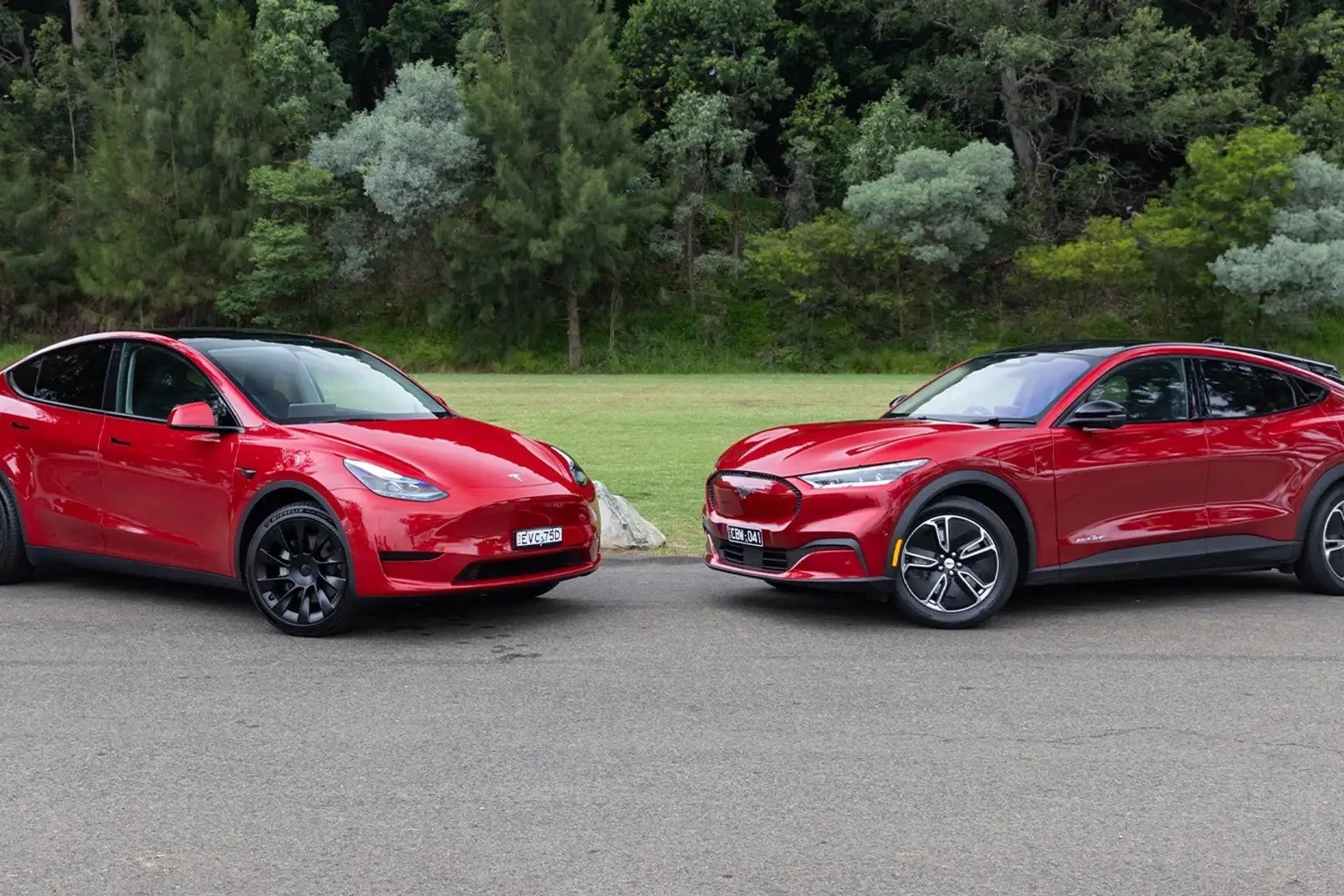
Sticker prices on the Ford Mustang Mach-E and Tesla Model Y sit within a few hundred dollars of each other at the trims most people buy, so the five-year answer comes from everything else: electricity, insurance, resale, charging time and the repair history each car carries. I worked the numbers below from EPA ratings, manufacturer warranty terms, iSeeCars depreciation data, published insurance analyses and NHTSA recall filings, using 12,000 miles a year and 17 cents per kWh. Prices are MSRPs as of October 2026 before destination charges ($2,045 on the Ford, about $1,640 on the Tesla with its order fee); no federal purchase credit applies to either car in 2026.
Prices and the Fair Pairings
Ford sells two batteries and two drive layouts under the Select and Premium badges; Tesla sells a small-pack RWD and AWD and a large-pack Premium. Line them up by battery and drive and three pairs fall out.
| Pair | Mach-E | Model Y |
|---|---|---|
| Entry rear-drive | Select RWD, standard range: $37,795, 260 mi, 107 MPGe | RWD: $39,990, 321 mi |
| Long-range rear-drive | Premium RWD, extended range: $45,345, 320 mi, 110 MPGe | Premium RWD: $45,990, 357 mi, 125 MPGe |
| Long-range all-wheel drive | Premium eAWD, extended range: $48,345, 300 mi, 104 MPGe | Premium AWD: $49,990, 327 mi, 117 MPGe |
| Performance | GT: $53,395, 280 mi, 90 MPGe | Performance: $57,990, 306 mi, 105 MPGe |
The middle pair is the one to study: $645 apart on paper, 37 miles apart on range. The Mach-E’s standard-range cars use an LFP battery (73 kWh usable) that tolerates daily 100% charging; the extended-range pack is 88 kWh, or 91 in the GT and Rally. Tesla’s Premium runs 78.4 kWh and goes further on less, which is the whole efficiency story in one line.
Energy: Small Gap, Clear Winner
The Model Y Premium RWD is EPA-rated at 27 kWh per 100 miles; the Mach-E Premium RWD extended range works out to about 31 from its 110 MPGe rating. Over 12,000 miles that is 3,240 kWh against roughly 3,720, or $551 against $632 a year at 17 cents. Five years: about $400 in Tesla’s favor. The gap widens on the all-wheel-drive pair (29 against about 32 kWh per 100 miles) and on the performance pair, where the GT’s 90 MPGe is the thirstiest number on either side. Real, but small next to the lines below.
Insurance: The Biggest Swing
MoneyGeek’s 2026 analyses put average full coverage at $2,089 a year for the Mach-E and $3,343 for the Model Y, a gap of about $1,250. Other published comparisons are narrower: one shows $1,950 against $2,510, another $2,520 against $2,900, and one quote aggregator has the Model Y cheaper. Three of four favor the Ford, by $400 to $1,250 a year. Over five years that is $2,000 to $6,300, which is five to fifteen times the electricity difference. Tesla’s repair costs and parts pricing are the usual explanation; the only number that matters is the quote on your address, so get both before you shop trims.
Depreciation and Discounts
iSeeCars puts five-year depreciation at about 61 percent for the Model Y; its two pages on the Mach-E disagree with each other, showing 59.5 percent on the model page and 65 percent in the head-to-head, so call it 60 to 65. At two years the gap is clearer: the Model Y retains about 64 percent of value against roughly 59 for the Mach-E, which matters if you plan to sell early.
What the percentages miss is the starting line. Tesla sells at list. Ford dealers do not: Edmunds’ suggested price on a 2026 Select is more than $4,000 under its $39,840 delivered MSRP, and TrueCar’s October 2026 transactions average below sticker. A Mach-E bought $4,000 under list and depreciating 62 percent loses fewer dollars than a Model Y bought at list and depreciating 61. Depreciation from the price you paid, not from the window label, is the figure to compare, and in 2026 it is roughly a wash.
Charging Access and Time Cost
Both cars use Superchargers; only one was built for them. The Model Y peaks at 250 kW and runs 10 to 80 percent in about 27 minutes. The Mach-E peaks at 150 kW and Ford quotes roughly 35 minutes for the same stop; independent guides put the extended-range pack at 36 to 41. The 2026 Mach-E still carries a CCS1 port, so Supercharger sessions go through the included NACS adapter and a Ford app, and non-Tesla drivers pay Tesla’s higher per-kWh rate unless they buy the monthly membership.
Translate that into a year: a driver who fast-charges weekly spends roughly eight to twelve extra minutes per stop in the Ford, seven to ten hours a year. At home the two are equal, 11 kW against 11.5 kW on a 48-amp circuit, and Ford has periodically bundled a complimentary home charger and standard installation with new EV purchases; check whether that offer is active when you buy, because installation alone runs several hundred dollars.
Warranty and Repair Risk
| Coverage | Ford Mustang Mach-E | Tesla Model Y |
|---|---|---|
| Basic | 3 years / 36,000 miles | 4 years / 50,000 miles |
| Battery and electric drive | 8 years / 100,000 miles, 70% capacity guarantee | 8 years / 100,000 miles (RWD, AWD) or 120,000 miles (Premium, Performance), 70% guarantee |
| Powertrain | 5 years / 60,000 miles | Within the battery and drive unit term |
| Hands-free driving | BlueCruise, extra-cost option or subscription | FSD (Supervised), $99 a month |
Tesla’s basic coverage is a year and 14,000 miles longer; Tesla’s Premium battery term is 20,000 miles longer. On the recall record, the Mach-E’s defining fault is the high-voltage battery junction box on 2021–2022 cars: a software recall in 2022 (22V-412), then hardware replacement from 2023 (23V-687) after NHTSA documented 107 power-loss failures on cars that had the software fix, with a further expansion in June 2025 (25V-441). Since then: a June 2025 recall of 197,432 cars from 2021–2025 whose electronic door latches can stay locked when the 12-volt battery runs low (25V-404, software), a July 2026 recall of 86,000-plus 2023–2025 cars for rear quarter-window trim that can detach (26V-487), and a July 2026 recall of 42,000-plus cars for a drive-unit pinion shaft. NHTSA also opened an engineering analysis into BlueCruise in January 2025 after crashes into stationary vehicles at night.
The Model Y’s open files are a NHTSA investigation into electronic door handles on 2021 cars, a July 2026 investigation into front lateral links on 2021–2023 cars, two FSD inquiries, and a front suspension clunk that owners of the 2025–2026 refresh report more than anything else. Full detail by year is on our Model Y problems page. On a new 2026 car neither record changes your warranty exposure; it changes what to listen for on the test drive and, for a used Mach-E, which service records to demand.
Five-Year Total, Line by Line
| Line, 5 years, 60,000 miles | Mach-E Premium RWD ER | Model Y Premium RWD |
|---|---|---|
| MSRP plus destination | $47,390 | $47,630 |
| Electricity at home, 17¢/kWh | about $3,160 | about $2,760 |
| Insurance, MoneyGeek averages | about $10,450 | about $16,700 |
| Depreciation, iSeeCars rate on MSRP | about $27,200 at 60% | about $28,100 at 61% |
| Scheduled maintenance | None included; tires, filters, fluids | None included; tires, filters, fluids |
| Running total of the lines that differ | about $40,800 | about $47,500 |
Read the total as a range, not a verdict. With the narrowest published insurance gap instead of MoneyGeek’s, the Mach-E’s advantage shrinks to roughly $2,000; with a dealer discount of $3,000 to $4,000 that Tesla will not match, it grows again. What stays constant across every scenario is the order of magnitude: insurance and purchase price decide this comparison, electricity is a rounding error, and the Model Y buys back some of the gap in resale and in time saved at chargers. If you keep cars eight years and charge at home, the Ford is cheaper. If you trade at three and road-trip monthly, the Tesla is closer than the table suggests.
FAQ
Which costs less to own, Mach-E or Model Y?
At the long-range rear-drive trims, the Mach-E, by somewhere between $2,000 and $7,000 over five years depending mainly on your insurance quotes. The Model Y is more efficient and holds value slightly better, but neither effect is large enough to offset a four-figure annual insurance gap.
Is the Mach-E cheaper to insure than the Model Y?
In three of four published 2026 comparisons, yes, by $400 to $1,250 a year. One quote aggregator shows the opposite. Your state and record move these numbers more than the car does, so quote both.
Does the 2026 Mach-E charge at Tesla Superchargers?
Yes, through the NACS adapter Ford includes; the port itself is still CCS1. Expect a 150 kW peak and about 35 minutes for 10 to 80 percent, against roughly 27 minutes for a Model Y, plus Tesla’s non-member rate unless you subscribe.
Which battery warranty is better?
Tesla’s on the Premium and Performance trims, at 120,000 miles against Ford’s 100,000; both run eight years with a 70 percent capacity floor. On the small-pack Model Y RWD the terms match Ford’s.
Which one should a used buyer prefer?
A 2023–2025 Mach-E with the door-latch and junction-box recalls documented as completed, or a 2024 Model Y, which sits after the hardware recalls and before the refresh. Avoid a 2021–2022 Mach-E without proof the junction box was replaced.
Sources
- U.S. News — 2026 Mustang Mach-E trims, MSRPs and EPA efficiency range
- Cars.com — 2026 Mustang Mach-E delivered prices by configuration and EPA range table
- Ed Martin Ford — 2026 Mach-E EPA range and MPGe by configuration; battery capacities
- Edmunds — 2026 Mach-E Select MSRP and suggested transaction price
- TrueCar — 2026 Mach-E average prices paid, October 2026
- U.S. News — 2026 Model Y trims, prices and EPA range
- EV Specifications — 2026 Model Y Premium RWD EPA figures: 125 MPGe, 27 kWh/100 mi
- MoneyGeek — Mustang Mach-E insurance cost, 2026
- MoneyGeek — EV insurance rates by model, 2026, including Model Y
- iEVChina — 2026 EV insurance comparison, national averages
- iSeeCars — Model Y vs Mustang Mach-E five-year depreciation
- iSeeCars — Mustang Mach-E resale value and depreciation by age
- The Charge Port — two-year value retention and insurance comparison
- Astro Ford — 2026 Mach-E Premium: CCS port with included NACS adapter, 150 kW peak, 35-minute 10–80%
- Consumer Reports — Recall 25V-404: 197,432 Mach-Es, door latches and the 12-volt battery
- Cars.com — 2022 Mach-E recalls, including 25V-441 junction box replacement
- Rerev — Mach-E HVBJB recall history, 22V-412 and 23V-687, post-remedy failures
- Tesla — Vehicle warranty terms