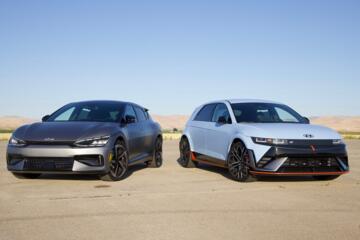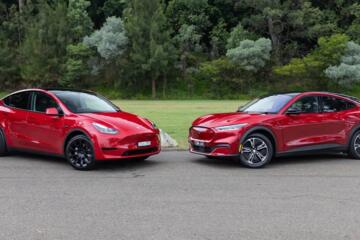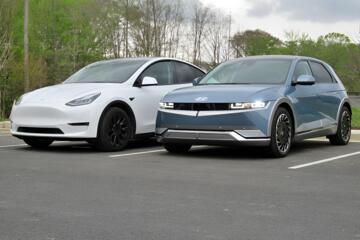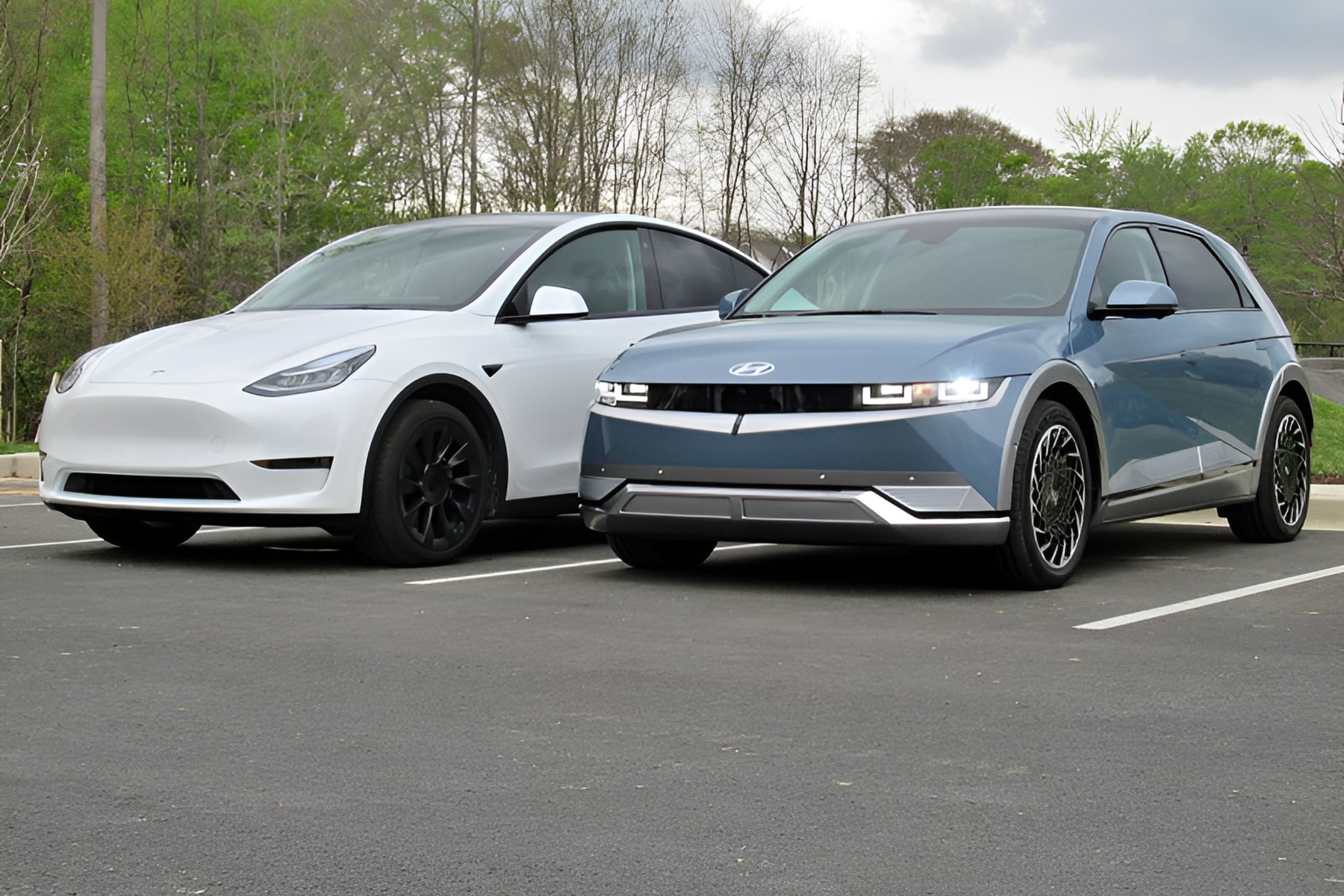
The Hyundai Ioniq 5 and Tesla Model Y are the two electric crossovers most Americans cross-shop, and in 2026 the decision is harder than it used to be: Hyundai cut Ioniq 5 prices by thousands after the federal tax credit ended, Tesla split the Model Y into a cheaper RWD and a longer-range Premium, and both cars now plug into Superchargers. Below are the numbers that decide the choice, from EPA ratings, manufacturer warranty terms, NHTSA filings and published charging tests. Prices are manufacturer MSRPs as of October 2026, before destination fees of roughly $1,600 on both; Tesla changes prices without notice, so treat them as a snapshot.
The Trims Worth Comparing
Ignore the badges and match the cars by battery and drive. The honest pairs are the long-range rear-drive versions, which sit within three miles of each other on range, and the all-wheel-drive versions, where the Model Y pulls ahead.
| Trim | MSRP | Battery | EPA range | EPA efficiency |
|---|---|---|---|---|
| Ioniq 5 SE Standard Range RWD | $35,000 | 63 kWh | 245 mi | 115 MPGe |
| Ioniq 5 SE RWD | $37,500 | 84 kWh | 318 mi | 114 MPGe, 30 kWh/100 mi |
| Ioniq 5 SEL RWD | $39,800 | 84 kWh | 318 mi | 114 MPGe, 30 kWh/100 mi |
| Ioniq 5 SEL AWD | $43,300 | 84 kWh | 290 mi | 106 MPGe |
| Model Y RWD | $39,990 | about 69 kWh | 321 mi | Edmunds test: 22.8 kWh/100 mi |
| Model Y Premium RWD | $45,990 | 78.4 kWh | 357 mi | 125 MPGe, 27 kWh/100 mi |
| Model Y Premium AWD | $49,990 | 78.4 kWh | 327 mi | 117 MPGe, 29 kWh/100 mi |
Tesla also sells an AWD on the small pack ($41,990, 294 mi), a Performance ($57,990) and a three-row L Premium ($61,990); Hyundai adds the XRT ($46,275, 259 mi) and the Limited. None changes the picture above.
Range and Efficiency
On paper the long-range rear-drive cars are a wash: 318 miles against 321 for the cheaper Model Y, or 357 for the Premium. The gap opens in how they get there. The Model Y Premium RWD does it on 27 kWh per 100 miles; the Ioniq 5 needs 30. In Edmunds’ standardized range test the Model Y RWD ran 337 miles, past its rating, at 22.8 kWh per 100 miles, while the dual-motor Ioniq 5 Edmunds tested used 30.9. Tesla’s advantage is efficiency, not battery size.
One detail matters in cold states. Every Model Y has a heat pump. On the Ioniq 5, the heat pump comes with all-wheel drive; the rear-drive trims that carry the 318-mile rating heat the cabin with a resistive heater, which costs range below freezing. If winter commuting is your use case, price the SEL AWD, not the SEL RWD.
Charging Curve and Networks
This is where the two cars are built differently. The Ioniq 5 runs an 800-volt architecture and holds a nearly flat charging curve; Hyundai quotes 10 to 80 percent in about 20 minutes on a 350 kW charger, with the 84 kWh pack rated for up to 257 kW. The Model Y is a 400-volt car that peaks at 250 kW early and tapers; 10 to 80 percent on a Supercharger takes roughly 27 minutes.
The catch is the plug. Since 2025 the Ioniq 5 ships with a native NACS port and a CCS adapter, so it uses Superchargers directly. But most Superchargers are V3 units that supply 400 volts, and an 800-volt car has to step that up on board. InsideEVs measured 126 kW; Hyundai’s own figure is a 135 kW peak and 29 to 30 minutes for 10 to 80 percent on the big pack. The Ioniq 5 only shows its 20-minute number on 350 kW CCS stations with the adapter, or on Supercharger sites with the newer 1,000-volt V4 cabinets.
| Where you plug in | Ioniq 5, 84 kWh | Model Y Premium |
|---|---|---|
| 350 kW CCS station | About 20 min 10–80%, peak up to 257 kW | Needs Tesla’s CCS adapter; 250 kW peak |
| Tesla V3 Supercharger | 126–135 kW peak, 29–30 min | 250 kW peak, about 27 min |
| Tesla V4 Supercharger, 1,000 V cabinet | Full 800 V speed | Same as V3 |
| Level 2 at home, 48 A circuit | 10.9 kW onboard charger | 11.5 kW onboard charger |
Two practical points. Non-Tesla drivers pay a higher per-kWh rate at Superchargers unless they buy Tesla’s monthly membership, which changes the road-trip math for frequent travelers. And the Ioniq 5 offers vehicle-to-load power on most trims; on the Model Y, two-way power is a Performance feature.
Warranty Side by Side
| Coverage | Hyundai Ioniq 5 | Tesla Model Y |
|---|---|---|
| Basic | 5 years / 60,000 miles | 4 years / 50,000 miles |
| Battery | 10 years / 100,000 miles, 70% capacity guarantee | 8 years / 100,000 miles (RWD, AWD) or 120,000 miles (Premium, Performance), 70% guarantee |
| Electric motors and powertrain | 10 years / 100,000 miles for the first owner; 5 years / 60,000 miles for the next | Covered under the 8-year battery and drive unit term |
| Scheduled maintenance | Complimentary for 3 years / 36,000 miles | None included |
| Transfer to second owner | Basic and battery coverage transfer; powertrain term shortens | Remaining coverage transfers |
Hyundai’s terms are longer on paper. Read the fine print on the powertrain line if you buy used: the headline 10-year coverage belongs to the first owner only. Tesla’s shorter basic warranty is the one that bites, because most owners pass 50,000 miles in year four.
Five-Year Cost: Where Money Goes
Energy is the line everyone calculates and the one that matters least. At 12,000 miles a year and 17 cents per kWh, roughly the national residential average, an Ioniq 5 RWD uses about 3,600 kWh ($612) and a Model Y Premium RWD about 3,240 kWh ($551). The Tesla saves about $60 a year, $300 over five.
Insurance is the line that moves. MoneyGeek’s 2026 model-by-model analysis puts full coverage at $1,962 a year for the Ioniq 5 and $3,343 for the Model Y; other published estimates put the gap between $600 and $1,400 a year depending on state and driver. Even at the low end that is $3,000 over five years in the Ioniq 5’s favor, ten times the energy difference.
Depreciation is close in percentage terms. iSeeCars puts five-year loss at about 59 percent for the Ioniq 5 and 61 percent for the Model Y, which means the cheaper car loses fewer dollars. On the long-range rear-drive pair the purchase gap is $6,190 before incentives, and Hyundai dealers have been discounting while Tesla does not negotiate.
Put together for the SEL RWD against the Premium RWD: the Ioniq 5 starts about $6,200 cheaper, saves $3,000 to $7,000 on insurance, gives up $300 in electricity and roughly 39 miles of rated range. The Model Y buys efficiency, faster charging on the network it will actually use, and a heat pump at every trim.
Known Issues on Each Side
The Ioniq 5’s record is dominated by the ICCU, the charging unit that failed on 2022–2024 cars and produced two recalls, a 15-year warranty extension and a class action. The 2025–2026 cars built in Georgia are not in those recalls, though ICCU complaints on 2025 models exist in NHTSA’s database. The full history is on our Ioniq 5 known issues page.
The Model Y’s open files are a NHTSA investigation into electronic door handles on 2021 cars, a July 2026 investigation into front lateral links on 2021–2023 cars, and two FSD inquiries that apply only to cars using the software. On the 2025–2026 refresh, the most reported complaint is a front suspension clunk. Details by year are on our Model Y problems page. Neither history touches a new car’s warranty, but both tell you what to listen for on a test drive.
Which One Fits Which Driver
- Mostly home charging, moderate commute, warm climate: Ioniq 5 SE or SEL RWD. Same range as the base Model Y for less money and far less insurance.
- Cold winters: Ioniq 5 SEL AWD or any Model Y. The heat pump decides this one.
- Frequent road trips today: Model Y Premium RWD. More range, full speed on the existing Supercharger network, no membership surcharge.
- Frequent road trips on 350 kW CCS corridors: Ioniq 5. Its 20-minute stop is real where the chargers are.
- You want CarPlay, physical controls and a dealer: Ioniq 5. You want the software stack and the app-first ownership: Model Y.
- Buying used, 2022–2024: read the ICCU page first; on the Tesla side, prioritize 2024 over 2021–2023.
FAQ
Which has more real-world range, Ioniq 5 or Model Y?
The Model Y, trim for trim. EPA ratings are close on the rear-drive cars, but the Tesla is more efficient, beat its rating in Edmunds’ test, and the rear-drive Ioniq 5 lacks a heat pump for winter.
Can the Ioniq 5 charge at Tesla Superchargers?
Yes, 2025 and newer cars plug in directly. Expect 126–135 kW and about 30 minutes for 10 to 80 percent on V3 sites, not the 20 minutes Hyundai advertises; that figure needs a 350 kW CCS charger or a V4 Supercharger with 1,000-volt cabinets.
Which is cheaper to insure?
The Ioniq 5, in every published comparison we found. MoneyGeek’s 2026 figures show a gap of about $1,380 a year for full coverage; others show $600 to $1,000. Get both quoted before you decide.
Which warranty is better?
Hyundai’s for a first owner: 10 years on the battery against 8, and 5 years basic against 4. For a second owner the gap narrows because Hyundai’s powertrain term drops to 5 years / 60,000 miles while the battery term stays.
Is the ICCU problem fixed on the 2026 Ioniq 5?
The 2025–2026 cars are outside both ICCU recalls and the warranty extension, which covers 2022–2024. Complaints on 2025 cars exist but are few, and nobody outside Hyundai can say whether the component changed. Buy it on the 10-year warranty, not on an assumption.
Sources
- Edmunds — 2026 Ioniq 5 trims and pricing; heat pump on AWD versions
- Kelley Blue Book — 2026 Ioniq 5 SE specifications: 114 MPGe, 318 miles, warranty terms
- EV Specifications — 2026 Ioniq 5 SE RWD EPA figures: 30 kWh/100 mi, 84 kWh
- U.S. News — 2026 Model Y trims, prices and EPA range, August 2026
- EV Specifications — 2026 Model Y Premium RWD EPA figures: 125 MPGe, 27 kWh/100 mi
- EV Specifications — 2026 Model Y Premium AWD EPA figures: 117 MPGe, 29 kWh/100 mi
- Edmunds — 2026 Model Y Standard range test: 337 miles, 22.8 kWh/100 mi
- InsideEVs — Hyundai’s Supercharger figures for the 2025 Ioniq 5: 135 kW, 24 and 29 minutes
- InsideEVs — 2025 Ioniq 5 on a V3 Supercharger: 126 kW measured
- Wikipedia — Ioniq 5 charging specifications: 11 kW AC, up to 257 kW DC on the 84 kWh pack
- Tesla — Vehicle warranty: 4/50 basic, 8-year battery and drive unit terms, 70% retention
- Tesla North America Guide — Model Y battery warranty by trim, checked October 2026
- MoneyGeek — EV insurance rates by model, 2026: Ioniq 5 $1,962, Model Y $3,343
- iSeeCars — Ioniq 5 vs Model Y five-year depreciation
- Recharged — Ioniq 5 depreciation in 2026 and comparison with Model Y resale