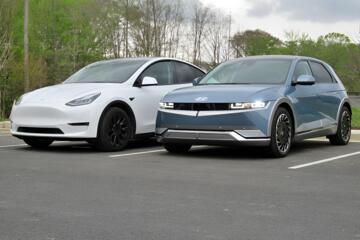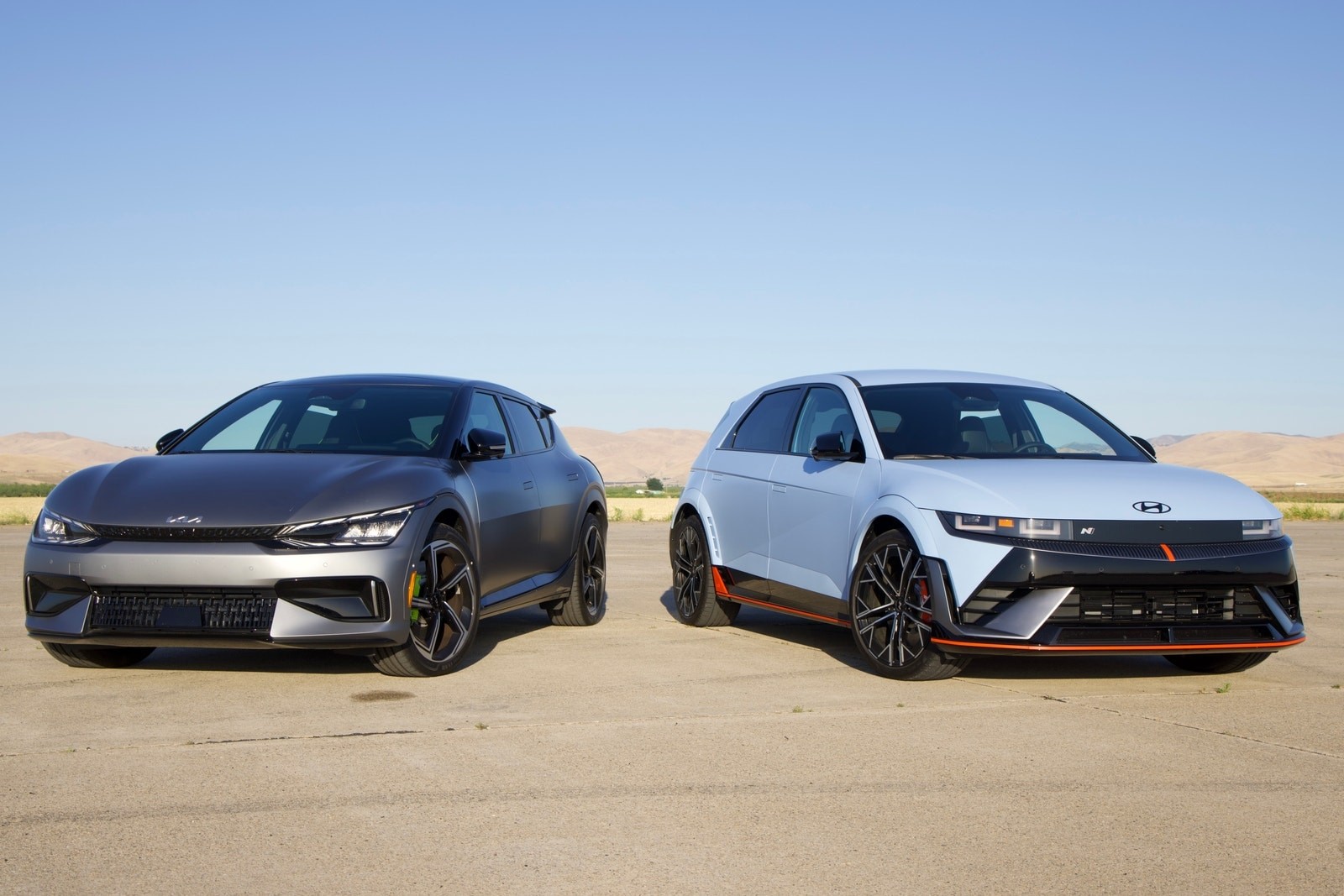
The Kia EV6 and Hyundai Ioniq 5 come off the same E-GMP platform with the same batteries, the same motors, the same 800-volt charging and, since 2024, the same recalls. Reviews treat the choice as taste. It is not quite that: the two cars have different wheelbases, a four-inch gap in cargo volume, a consistent price difference at every matching trim, and in 2026 a real difference in what the dealer throws in. This page lays out where they are the same car and where they are not, using manufacturer pricing, EPA ratings, published dimensions and NHTSA recall records. Prices are MSRPs as of October 2026 before destination ($1,545 Kia, $1,600 Hyundai).
Where They Are the Same Car
| Item | Kia EV6 | Hyundai Ioniq 5 |
|---|---|---|
| Batteries | 63 kWh or 84 kWh | 63 kWh or 84 kWh |
| Motors | 167 hp RWD (small pack), 225 hp RWD, 320 hp AWD | 168 hp RWD (small pack), 225 hp RWD, 320 hp AWD |
| Long-range RWD rating | 319 mi, 114 MPGe | 318 mi, 114 MPGe |
| Charging | 800 V, about 18–20 min 10–80% on a 350 kW charger; native NACS port since 2025 | Same architecture and times; native NACS port since 2025 |
| Supercharger speed | About 126–135 kW on V3 sites, roughly 30 min 10–80% | Same |
| Warranty | 5 yr/60,000 basic; 10 yr/100,000 powertrain and battery, 70% floor | Same terms |
| Assembly | West Point, Georgia (since 2025) | Ellabell, Georgia (since late 2024) |
| ICCU | Same part, same recalls, same 15-year extension | Same |
Everything that determines how far the car goes and how fast it refills is shared. The heat pump is the same story on both: it comes with all-wheel drive, and the rear-drive long-range trims that post the 318- and 319-mile ratings heat the cabin resistively. If you live where it freezes, that pushes both cars toward the AWD column before you compare anything else.
Price by Matching Trim
Hyundai cut Ioniq 5 prices by an average of more than $9,000 for 2026; Kia lowered the EV6 too, but less. Matched by battery, drive and position in the lineup, the Kia costs more at every rung.
| Configuration | Kia EV6 | Hyundai Ioniq 5 | Kia premium |
|---|---|---|---|
| Small pack, RWD | Light, $37,900, 237 mi | SE Standard Range, $35,000, 245 mi | $2,900 |
| Long range RWD, entry | Light Long Range, $41,200, 319 mi | SE, $37,500, 318 mi | $3,700 |
| Long range RWD, mid | Wind, $44,800, 319 mi | SEL, $39,800, 318 mi | $5,000 |
| Long range RWD, top | GT-Line, $48,700, 319 mi | Limited, $45,075, 318 mi | $3,625 |
| Long range AWD, mid | Wind AWD, $48,800, 295 mi | SEL AWD, $43,300, 290 mi | $5,500 |
| Long range AWD, top | GT-Line AWD, $53,000, 270 mi | Limited AWD, $48,975, 269 mi | $4,025 |
Two qualifications. Trim names do not line up perfectly, so a Wind carries some equipment an SEL lacks and the reverse; the gap at identical equipment is probably closer to $3,000 than $5,000. And the sticker is not the transaction: Edmunds’ suggested price on a 2026 EV6 Light in October 2026 sat more than $6,000 under its delivered MSRP, which means Kia dealers are currently closing much of this gap themselves. Quote both before deciding the Hyundai is cheaper.
Space: Four Inches Make the Gap
Here is the fact most comparisons skip. The EV6 rides on a 114.2-inch wheelbase; the Ioniq 5 on 118.1. Same platform, different stretch, and the Hyundai spends its extra four inches on the cabin and the cargo floor while the Kia spends its longer overhangs on a lower, longer body.
| Measurement | Kia EV6 | Hyundai Ioniq 5 |
|---|---|---|
| Wheelbase | 114.2 in | 118.1 in |
| Length / height | 184.8 in / 60.8 in | 183.3 in / 63.0 in |
| Passenger volume | 103.0 cu ft | 106.5 cu ft |
| Rear legroom / headroom | 39.0 in / 38.0 in | 39.4 in / 38.7 in |
| Cargo, seats up | 24.4 cu ft | 26.3 cu ft (27.2 before the 2025 rear wiper) |
| Cargo, seats folded | About 50 cu ft | About 58–59 cu ft |
| Turning circle | 19.1 ft radius | 19.7 ft radius |
The seats-up numbers are close; the seats-folded numbers are not, because the EV6’s roofline drops away behind the rear doors. For bikes, dogs and flat-pack furniture the Hyundai carries roughly a sixth more. The Kia’s shorter wheelbase buys it a tighter turning circle and the more planted feel reviewers keep praising; it is a hatchback that happens to be tall, where the Ioniq 5 is a small wagon that happens to be sleek.
Driving, Cabin and Equipment
Kia tunes the EV6 firmer and quicker to turn in, with a lower seating position and a cockpit built around a fixed floating console. Hyundai tunes the Ioniq 5 softer, seats you higher, and gives the front row a flat floor with a center console that slides rearward and front seats that recline nearly flat; the rear bench slides fore and aft to trade legroom for cargo. Which cabin is better is a question of what you do in it. The Kia feels like a driver’s car. The Hyundai feels like a room.
Equipment differences that affect money rather than taste:
- Scheduled maintenance. Hyundai includes complimentary maintenance for 3 years or 36,000 miles. Kia does not. On an EV that is tire rotations, cabin filters and inspections, worth a few hundred dollars.
- Rear wiper. The EV6 has always had one; the Ioniq 5 only gained it in the 2025 refresh. On used examples from 2022–2024 this is a real daily-use difference.
- Vehicle-to-load. Both offer it on most trims, from the charge port and from an interior outlet on mid-level trims and up.
- Lineup breadth. Hyundai sells a cheaper entry car ($35,000 SE Standard Range) and the XRT with all-terrain tires and more clearance; both brands sell a performance halo (EV6 GT, Ioniq 5 N) that belongs in a separate comparison.
Shared Recalls, Separate Counts
The Integrated Charging Control Unit that stranded Ioniq 5 owners is the same component in the EV6, and the recall history runs in parallel. Kia issued 24V-200 in April 2024 for 48,232 EV6s from 2022–2024, then replaced it with 24V-867 in November 2024 covering 62,872 cars, the same week Hyundai expanded its own campaign to 145,235 vehicles. Both remedies are a software update plus inspection, with ICCU and fuse replacement where the diagnostic code appears. Kia extended ICCU coverage to 15 years or 180,000 miles in 2025, and Hyundai followed in April 2026. The April 2026 federal class action names Kia, Hyundai and Genesis together and alleges replacement units share the defect; one plaintiff drives a 2025 EV6, a model year outside the recall.
The same goes for smaller campaigns: both cars had a 2022 software recall for park-system rollaway and a 2023–2024 recall for an improperly heat-treated rear driveshaft. What differs is the count. NHTSA aggregators list roughly 415 to 540 EV6 complaints across 2022–2026 against about 1,300 for the 2022–2025 Ioniq 5. The Hyundai sold roughly one and a half to two times as many cars in the US over those years, so even adjusted for fleet size it draws somewhat more complaints per car; both lists are dominated by the same ICCU failure. Full ICCU history, symptoms and buying checks are on our Ioniq 5 known issues page; everything there applies to a 2022–2024 EV6 with the Kia recall numbers swapped in.
Which Trade-off Is Yours
- Cargo, rear passengers, car seats: Ioniq 5. The extra wheelbase shows up exactly where families notice it.
- Handling and a lower driving position: EV6. Same hardware, firmer tune, shorter wheelbase.
- Lowest price into an 84 kWh car: Ioniq 5 SE at $37,500, unless the Kia dealer’s discount erases the $3,700.
- Cold climate: either, but only in AWD form, where both add the heat pump.
- Used, 2022–2024: both carry ICCU risk; demand the completed recall and the ICCU replacement record. The EV6 has the rear wiper; the Ioniq 5 has the room.
- Three-year ownership math: Ioniq 5, on included maintenance alone; the warranty terms are otherwise identical.
FAQ
Are the EV6 and Ioniq 5 the same car?
Mechanically close to it: same platform, batteries, motors, 800-volt charging, warranty and recalls. The bodies differ. The EV6 has a 3.9-inch shorter wheelbase, a lower roof and about a sixth less cargo volume with the seats folded.
Which has more range?
A rounding error apart: 319 miles for the long-range rear-drive EV6, 318 for the Ioniq 5, both at 114 MPGe. With all-wheel drive the EV6 is rated 295 against 290, and the top AWD trims land at 270 and 269.
Which is cheaper?
On MSRP, the Ioniq 5 at every matching trim, by $2,900 to $5,500. On the lot, it depends on the week; Kia dealers were discounting the EV6 heavily in autumn 2026.
Do both have the ICCU problem?
Yes. Same part, parallel recalls in 2024, matching 15-year warranty extensions (Kia in 2025, Hyundai in 2026), and the same lawsuit. 2025 and newer cars of both brands are outside the recalls, though complaints on them exist.
Which one holds value better?
Average used listing prices tracked in mid-2026 sat within a few hundred dollars of each other, so there is no meaningful resale edge either way.
Sources
- Kia Media — 2026 EV6 pricing by trim and drivetrain
- Emich Kia — 2026 EV6 battery, power and EPA range by configuration; destination charge
- Edmunds — 2026 EV6 trims, suggested transaction price, October 2026
- Edmunds — 2026 Ioniq 5 trims and pricing; heat pump on AWD versions
- Tulsa Hyundai — 2026 Ioniq 5 price cuts and trim MSRPs
- Kelley Blue Book — 2026 Ioniq 5 SE and EV6 EPA figures, warranty terms
- CarsDirect — 2026 EV6 vs Ioniq 5 dimensions and cargo volumes
- TrueCar — Ioniq 5 vs EV6 size comparison
- U.S. News — EV6 vs Ioniq 5 head to head: cargo and cabin measurements
- Autoblog — EV6 vs Ioniq 5 comparison, 2026
- Kia of Bedford — heat pump standard on EV6 AWD configurations
- Kia America — Owner notification, Recall 24V-867 / SC327, ICCU (PDF)
- Destination Charged — Recall 24V-867 population: 62,872 EV6
- Lemon Law Experts — Kia 24V-200 population: 48,232 EV6
- Kia EV Forums — owner report of Kia’s ICCU warranty extension letter, 15 years / 180,000 miles
- Recall Explained — EV6 recalls and complaints by model year, NHTSA data
- Outpost EV — used Ioniq 5 vs EV6 prices, June 2026