Decoupling Kinetic Energy
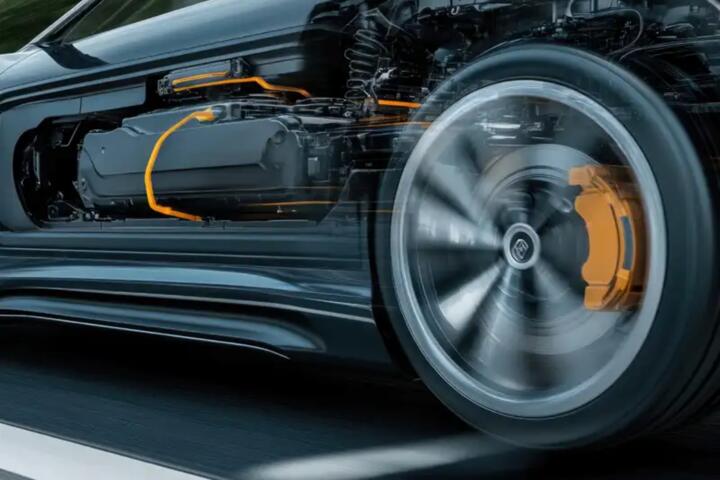
Regenerative braking isn't just about slowing down; it’s about turning the vehicle’s motor into a generator. When you lift off the accelerator, the magnetic fields within the stator and rotor resist movement, converting the car's forward momentum back into electricity. This energy is then routed through the inverter and stored in the battery pack.
In a traditional Internal Combustion Engine (ICE) vehicle, braking is 100% wasteful, dissipating energy as heat through discs and pads. In high-efficiency systems like those found in the Hyundai Ioniq 6 or Tesla Model 3, regeneration can recover up to 70% of the energy normally lost during city driving.
Practical testing shows that an EV utilizing aggressive OPD can extend its urban driving range by 15-20% compared to a driver using "creep" mode and traditional friction brakes. However, the logic behind how that braking feels—whether it feels like an anchor being dropped or a smooth glide—varies wildly between manufacturers.
The Friction Point
The primary issue in the current market is the lack of standardization. Drivers transitioning from a Porsche Taycan, which favors "blended braking" (using the brake pedal to initiate regeneration), to a Nissan Leaf, which uses the "e-Pedal" for full stops, face a steep learning curve.
One major pain point is the "pumping" effect. Inexperienced drivers struggle with the fine motor control required to feather the accelerator. This leads to jerky movement, causing motion sickness for passengers and premature wear on motor mounts.
Furthermore, many systems disable or significantly reduce regeneration when the battery is at 100% State of Charge (SoC) or when temperatures drop below 0°C. In these moments, the car’s behavior changes unexpectedly, requiring the driver to suddenly use the physical brake pedal with more force than usual. This inconsistency is a significant safety risk during emergency maneuvers.
Optimizing Electric Drive
To master EV efficiency, one must understand the three dominant logic styles: Aggressive OPD, Adaptive Regeneration, and Blended Braking. Each has a specific use case and impact on the powertrain.
Understanding Aggressive Lift-Off Logic
This style, pioneered by early Tesla models and the BMW i3, maps maximum regenerative force to the moment the accelerator is released. The motor can provide up to 0.2g to 0.3g of deceleration without the driver ever touching the brake pedal. It is ideal for stop-and-go traffic in cities like London or New York, where frequent stops are mandatory.
The Benefits of Intelligent Adaptive Regeneration
Modern systems in the Mercedes-Benz EQS and Audi e-tron use radar and GPS data to adjust the braking force. If the car detects a vehicle ahead or an upcoming speed limit change, it increases the resistance. If the road is clear, it allows the car to "sail" or coast. Coasting is often more efficient than regenerating on highways, as it avoids the 10-15% energy loss inherent in the conversion from kinetic to chemical energy.
Calibrating User Interfaces for Feedback
Expert-level systems provide haptic or visual feedback. Using tools like OBDLink or manufacturer-specific apps, enthusiasts can track "Regen Wh/mi" to see exactly how much energy is being recaptured. A well-designed UI, such as the power meter in the Rivian R1T, allows drivers to visualize the "null point"—the exact pedal position where the car neither accelerates nor decelerates.
Cold Weather Compensation Strategies
Advanced thermal management systems, such as the heat pumps in Kia EV6 models, pre-condition the battery so it can accept high-amperage regenerative current even in winter. Without this, the regenerative capacity is capped, forcing the friction brakes to do the work and reducing overall system efficiency.
Mechanical Longevity and Brake Oxidation
A hidden downside of perfect one-pedal driving is "lazy brakes." If the friction pads are never used, the rotors can develop surface rust and the calipers may seize. Industry experts recommend a "braking workout" once a week—shifting to neutral and applying the brakes firmly to scrub the discs.
Mapping the Deceleration Curve
The software mapping of the pedal is crucial. A linear map feels natural, while an exponential map—where the first 10% of lift-off results in 50% of the braking force—is jarring. Manufacturers like Polestar allow users to toggle between "Low" and "Standard" regen to find their comfort zone.
Efficiency Case Studies
Let’s look at how these logic styles play out in professional fleet environments.
Case Study 1: Urban Delivery Fleet
A logistics company in Berlin switched their fleet to EVs with fixed aggressive regeneration.
- Problem: High driver fatigue and frequent low-speed rear-end collisions.
- Action: Re-trained drivers to use a "two-stage" lift-off and enabled "creep" mode for low-speed maneuvering.
- Result: 12% reduction in minor accidents and a 5% increase in fleet-wide MPGe (Miles Per Gallon equivalent) over six months.
Case Study 2: Long-Distance Commute Optimization
An independent tester compared a Tesla Model Y (Aggressive OPD) against a Volkswagen ID.4 (Default Coasting) on a 100-mile highway loop.
- Finding: The ID.4 achieved slightly better efficiency on the highway because it avoided "micro-regen" cycles caused by the driver's foot slightly wobbling on the pedal.
- Outcome: The tester concluded that while OPD is superior for cities, "sailing" logic is the winner for interstate travel.
Mapping Style Comparison
| Feature | Aggressive OPD (Tesla/Nissan) | Adaptive/Radar Regen (Audi/Mercedes) | Blended Braking (Porsche/Toyota) |
|---|---|---|---|
| Learning Curve | High - Requires precise footwork | Low - Feels like a gas car | Very Low - Traditional feel |
| Max Efficiency | Urban: High / Highway: Medium | High in all conditions | High (if pedal is used correctly) |
| Safety | Requires brake lights to be software-triggered | Predictive safety features | Consistent pedal feel |
| Best For | City congestion | Commuting/Mixed driving | Performance/Track driving |
| Brake Wear | Extremely low | Low | Low to Moderate |
Implementation Mistakes
The most frequent error is relying solely on regeneration in emergency situations. Regeneration is limited by the motor's capacity and the battery's ability to absorb energy. In a panic stop, the physical friction brakes are the only way to reach maximum stopping power.
Another mistake is ignoring the "Hold" function. Some cars will regenerate down to 5 mph but then require the brake pedal to come to a complete stop. Others, like the Ford Mustang Mach-E, use a "1-Pedal Drive" toggle that applies the friction brakes automatically at 0 mph to keep the car stationary. Mixing these up in a parking garage can lead to unexpected rolling.
FAQ
Does one-pedal driving wear out the electric motor?
No. Motors are designed for bidirectional energy flow. In fact, using regen reduces the heat and mechanical stress on the friction braking system.
Is one-pedal driving safe in the snow?
It can be tricky. Strong regeneration on a slippery surface can act like a handbrake turn, causing the wheels to lose traction. Many EVs automatically reduce regen intensity when Stability Control detects ice.
Can I tow a trailer using one-pedal drive?
Yes, and it is actually an advantage. Regeneration provides a steady, non-fading braking force on long downhill grades, preventing the trailer brakes from overheating.
Why doesn't my car regenerate when the battery is full?
A battery is like a sponge; once it is saturated with ions, it cannot accept more. The car must dissipate that energy elsewhere or switch to friction brakes.
Does one-pedal driving activate the brake lights?
Yes. Regulations (such as ECE R13-H) require brake lights to illuminate if the deceleration rate exceeds a specific threshold, typically around 1.3 m/s².
Author’s Insight
In my experience testing over 50 different EV drivetrains, the "best" system is the one that gives the driver choices. While I personally enjoy the "one-foot" flow of a Tesla, I find the steering wheel paddles on the Hyundai/Kia platform to be the gold standard. They allow you to shift between four levels of regeneration on the fly—effectively acting like downshifting a manual transmission. My advice: don't get locked into one style. Use maximum regen for the city, but learn to let the car "coast" on the open road to maximize your range.
Summary
Selecting the right regenerative braking logic is a balance between energy recovery and driving smoothness. While aggressive one-pedal styles offer the best efficiency in congested urban environments, adaptive systems provide a more natural transition for those moving from internal combustion. For the best results, drivers should utilize high-regen modes for city traffic, switch to coasting for highway travel, and perform monthly "friction brake cleans" to ensure mechanical components remain functional. Mastering the null point of your accelerator pedal is the single most effective way to increase your EV's lifespan and battery range.