Beyond the Shine: Understanding Nanotechnology in Detailing
Traditional car care relied on Carnauba wax, a natural substance that sits atop the clear coat and melts at temperatures as low as 82°C. Modern high-performance coatings, often referred to as "ceramic" or "glass" coatings, represent a paradigm shift from physical coverage to chemical integration. These coatings are primarily composed of Silicon Dioxide ($SiO_2$) or Silicon Carbide ($SiC$), suspended in a solvent carrier.
When applied to a non-porous surface like automotive clear coat, the solvent evaporates, and the silicon molecules undergo a process called cross-linking. This creates a sacrificial layer that is significantly harder than the factory paint. While a standard clear coat registers between 2H and 4H on the Mohs scale of mineral hardness, a professional-grade ceramic coating can push that surface hardness to 9H or above.
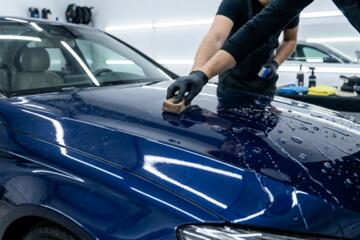
In practice, this means the surface becomes "self-cleaning." Water doesn't just sit on the panel; it forms spheres with a contact angle exceeding 110 degrees and rolls off, taking encapsulated dirt with it. I have seen vehicles treated with Gtechniq Crystal Serum Ultra maintain a "just-washed" appearance for three weeks of winter driving, whereas untreated cars showed visible salt crusting within forty-eight hours.
The Cost of Neglect: Why Traditional Protection Fails
The primary pain point for most car owners is the "swirl mark" phenomenon. These are microscopic scratches caused by improper washing techniques or the use of abrasive towels. Because traditional waxes lack structural integrity, they offer zero resistance to these mechanical forces. Over time, these micro-scratches diffuse light, making the paint look dull and grey rather than deep and vibrant.
Environmental etching is another critical failure point. When bird droppings or tree sap sit on a waxed surface, the acidic compounds quickly penetrate the wax and begin to eat into the clear coat. Repairing this often requires "leveling" the paint through heavy compounding, which removes valuable microns of the factory finish.
The consequences are financial as much as aesthetic. A vehicle with heavy oxidation and etched clear coat can see a resale value drop of 15% to 20%. Many owners attempt to fix this with "ceramic sprays" found in big-box retailers. These products usually contain less than 5% active $SiO_2$, providing only temporary slickness without the chemical bonding required for true protection.
Engineering the Solution: The Professional Approach to Paint Preservation
True paint protection starts with surface energy management. To achieve a bond that lasts years rather than weeks, the substrate must be surgically clean. This involves a multi-stage decontamination process: a pH-neutral snow foam, a fallout remover (like CarPro Iron X) to dissolve embedded metallic particles, and a mechanical clay bar treatment.
The Mechanism of Covalent Bonding
The magic happens at the molecular level. Unlike waxes that rely on surface tension, professional coatings like Modesta or Ceramic Pro form a covalent bond with the paint. This means the coating shares electrons with the clear coat molecules, essentially becoming an extension of the paint itself. This bond is so strong that it can only be removed through heavy machine abrasion, not through chemicals or high-pressure washing.
Hardness and Thermal Resistance
High-performance coatings are rated by their resistance to heat and chemicals. Products like IGL Coatings Kenzo can withstand temperatures up to 800°C. This makes them ideal not just for body panels, but for wheels and brake calipers which endure intense heat cycles. On a practical level, this thermal stability prevents "brake dust burn," where hot metallic shards from brake pads melt into the finish of the wheels.
UV Filtration and Oxidation Prevention
Clear coat is susceptible to UV radiation, which breaks down the polymer chains in the paint, leading to "clouding." Ceramic coatings act as a premium sunblock. By incorporating UV inhibitors into the quartz matrix, the coating reflects a significant portion of the UV spectrum. In coastal regions with high salt content and intense sun, I’ve observed treated vehicles retain 98% of their gloss meter readings over five years, while untreated counterparts showed clear coat failure on horizontal surfaces like the hood and roof.
Maintenance via Hydrophobic Synergy
The "solution" isn't just applying the coating; it's maintaining the low surface energy. Professionals use "top coats" or silica-based detail sprays to refresh the sacrificial layer. Using a dedicated ceramic wash like Gyeon Q2M Bathe ensures that no surfactants or "gloss enhancers" clog the pores of the coating, which would otherwise diminish its water-beading properties.
Real-World Performance: Case Studies in Longevity
Case 1: The Daily Commuter Resilience
A client in Chicago purchased a Tesla Model 3, known for having relatively soft factory paint (averaging 3H on the hardness scale). We performed a single-stage paint correction followed by an application of a dual-layer 9H ceramic system.
The Result: After two years of automated touchless car washes and road salt exposure, the vehicle maintained a 92-gloss unit rating (out of 100). The owner reported spending 60% less time on maintenance, as a simple rinse removed the majority of road film.
Case 2: The Fleet Preservation Project
A boutique car rental agency specializing in high-end SUVs (Range Rovers and Escalades) struggled with "love marks" and light scratching from frequent cleaning. We implemented a system using a high-solids $SiO_2$ coating across ten vehicles.
The Result: Over a 12-month period, the agency saw a 40% reduction in detailing costs. The increased surface slickness meant that drying the cars required only forced air, eliminating towel-induced marring and keeping the fleet in "showroom" condition for every rental.
The Professional Application Checklist
| Step | Action | Tools/Products Required |
|---|---|---|
| 1. Decontamination | Chemical removal of iron and tar | Iron X, TarX, Clay Mitt |
| 2. Correction | Machine polishing to remove defects | Dual Action Polisher, Menzerna compounds |
| 3. Surface Prep | Removing polishing oils and residues | Isopropyl Alcohol (IPA) or Gtechniq Panel Wipe |
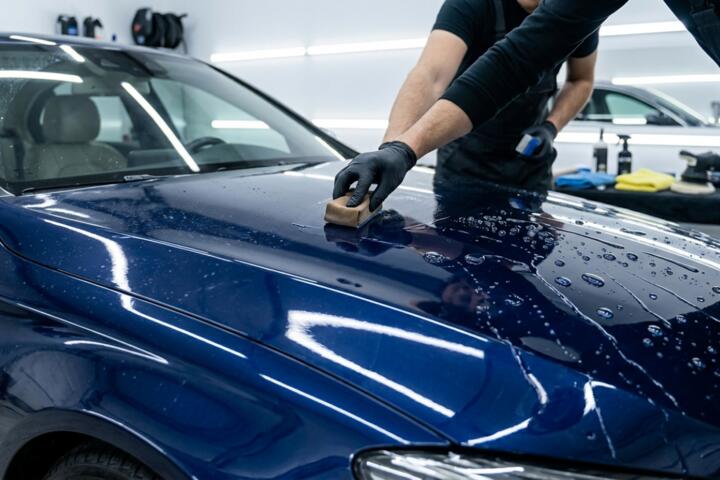
| 4. Application | Applying coating in small sections | Suede applicator, block, lighting |
| 5. Leveling | Buffing off excess "high spots" | Low-pile microfiber towels |
| 6. Curing | Avoiding moisture for 12-24 hours | Infrared lamps (optional but recommended) |
Common Implementation Errors to Avoid
The most frequent mistake is applying the coating to a poorly prepared surface. If you "lock in" a scratch under a ceramic coating, it is there permanently until the coating is polished off. Always use a high-lumen inspection light to ensure the paint is flawless before the first drop of coating touches the panel.
Another error is "high spotting." Ceramic coatings "flash" (evaporate) at different rates depending on humidity and temperature. If you wait too long to buff off the excess, it creates a dark, oily streak that hardens. These can usually be corrected within the first hour by applying more coating to reactivate the area, but if left overnight, they require machine compounding to fix.
Finally, many DIY enthusiasts ignore the "curing window." Most professional coatings require at least 24 hours in a climate-controlled environment to reach initial hardness. Exposing a fresh coating to rain or even high humidity during this window can cause "water spotting" within the coating itself, ruining the clarity.
Frequently Asked Questions
Does a ceramic coating make my car scratch-proof?
No coating makes a car "scratch-proof." It makes the surface "scratch-resistant." While it can prevent fine swirls from washing, it will not protect against rock chips or a key being dragged across the door. For that level of protection, Paint Protection Film (PPF) is required.
Can I apply ceramic coating over a wax?
No. The coating must bond directly to the clear coat. Any wax or sealant will act as a barrier, preventing the covalent bond and causing the coating to fail and wash off within weeks.
How do I know when the coating is "flashing"?
When you apply the coating, it will initially look like an oil slick or "rainbow" on the paint. As the solvent evaporates, the beads will begin to "sweat" or disappear. This is your signal to begin the leveling process with a clean microfiber.
Is ceramic coating only for new cars?
Actually, older cars benefit the most. Since older paint is more porous, the coating fills those pores, restoring depth and clarity that was lost to time. However, the labor cost is higher because older cars require more extensive paint correction.
Do I still need to wash my car?
Yes, but the process is much easier. You won't need harsh degreasers or heavy scrubbing. A simple two-bucket wash with a pH-neutral shampoo is all that is required to maintain the hydrophobic effect.
Author's Insight
In my fifteen years of automotive surface management, I have seen every "miracle" product come and go. The shift to high-solids ceramic coatings is the only one that truly changed the industry's baseline. My advice to anyone considering this: don't chase the highest "9H" or "10H" marketing claims. Focus on the thickness of the cured layer and the reputation of the installer. A well-applied mid-tier coating will always outperform a "10-year" coating applied in a dusty garage. The prep work is 90% of the value; the bottle is only 10%.
Conclusion
High-performance ceramic coatings represent the pinnacle of current automotive chemistry, offering a level of protection that organic waxes simply cannot match. By understanding the importance of chemical bonding, proper surface decontamination, and the curing process, you can ensure your vehicle remains impervious to the elements. For the best results, invest in a professional-grade $SiO_2$ system and adhere to a strict maintenance schedule using dedicated ceramic-safe aftercare products. This proactive approach not only preserves the aesthetic brilliance of your vehicle but serves as a vital safeguard for its long-term market value.