Beyond Aesthetics: The Physics of High-Performance Wheels
Wheels are often viewed through the lens of style, but in automotive engineering, they are one of the few components that function as both a structural element and a rotating mass. When we talk about "unsprung mass," we are referring to every component not supported by the vehicle's suspension—tires, wheels, brake assemblies, and portions of the control arms. Reducing weight here has a disproportionate impact compared to removing weight from the "sprung" body of the car.
In practice, a reduction of 5 kg per wheel doesn't just lighten the car by 20 kg; it fundamentally alters how the vehicle interacts with the road. For example, during a 2024 track test using a Tesla Model 3 Performance, switching from 20-inch factory "Uberturbine" wheels (approx. 14.5 kg) to 19-inch forged wheels (approx. 9 kg) resulted in a measurable 4% increase in efficiency at highway speeds. This occurs because the motor requires less energy to overcome the rotational inertia of the wheel assembly during acceleration and cruising.
The Hidden Costs of Heavy Rotational Mass
Excessive Inertia and Energy Drain
The primary mistake many car owners make is prioritizing wheel diameter over weight. Increasing wheel size usually involves thicker barrels and more material, which increases the moment of inertia. This means the engine or electric motor must work harder to start the wheel spinning and the brakes must work harder to stop it. This energy "leak" is constant, occurring every time you touch the pedal.
Suspension Lag and Contact Patch Instability
Heavy wheels possess significant momentum. When a heavy wheel hits a pothole or a bump, the shock absorber and spring struggle to settle the mass. This leads to "chatter," where the tire loses optimal contact with the asphalt. For high-performance vehicles, this translates to reduced grip in corners; for daily drivers, it means a harsher ride as the suspension crashes over imperfections rather than gliding.
Range Anxiety in the EV Era
For electric vehicles, weight is the enemy of range. Massive cast wheels act like flywheels that resist changes in speed. In city driving, where stop-and-go traffic is the norm, heavy wheels drain the battery significantly faster during the repeated re-acceleration phases. Furthermore, many aftermarket wheels lack the aerodynamic "aero-blade" designs found on OEM sets, creating turbulent drag that further degrades efficiency.
Precision Engineering Strategies for Maximum Efficiency
Transitioning from Casting to 6061-T6 Forging
Standard wheels are typically gravity-cast or pressure-cast, involving molten aluminum poured into a mold. This creates a porous molecular structure that requires more material to achieve necessary strength. Forging uses a solid billet of 6061-T6 aluminum, subjected to thousands of tons of pressure. This aligns the grain flow of the metal, making it incredibly dense. A forged wheel can be 25% to 30% lighter than a cast wheel while maintaining a higher load rating.
Optimizing the Rotational Moment of Inertia
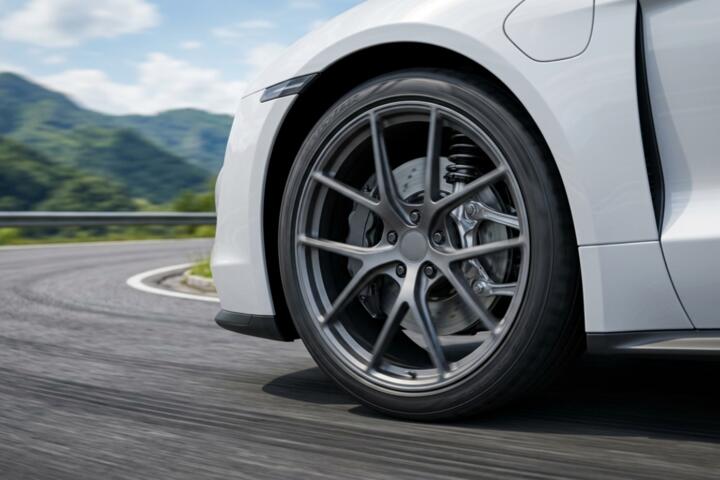
It is not just about the total weight, but where that weight is located. High-end manufacturers like HRE Performance Wheels or BBS employ "back-pad pocketing" and "side-spoke milling." By removing material from the center hub and the sides of the spokes, they move the mass toward the center of the wheel. This reduces the rotational moment of inertia, allowing for faster RPM changes. In real-world terms, this makes a car feel "zippy" and more responsive to throttle inputs.
Aerodynamic Integration in Forged Designs
To maximize range, look for forged wheels that incorporate "aero-rings" or flat-faced designs. Brands like Vossen and Unplugged Performance have pioneered forged wheels specifically for EVs that combine lightweight properties with low drag coefficients. Reducing the turbulence created by spinning spokes can improve highway range by an additional 2% to 3%, effectively canceling out the range loss often associated with wider, stickier tires.
Downsizing for Compliance and Comfort
One of the most effective methods to improve range and unsprung mass is "plus-sizing" in reverse—moving from a 21-inch wheel to a 19-inch or 20-inch forged wheel with a taller tire sidewall. The lighter wheel reduces unsprung mass, while the increased rubber provides better vibration damping. This setup is frequently used by long-distance commuters who want the durability of forged aluminum without the bone-jarring ride of low-profile tires.
Utilizing Lightweight Hardware
Don't overlook the lug nuts. Replacing heavy steel bolts with titanium lug nuts (from companies like Acer Racing or Ti-6Al-4V specialists) can shave another 0.5 kg to 1 kg of rotational mass per corner. While it sounds marginal, this is the "marginal gains" philosophy used by Formula 1 teams. When combined with lightweight carbon-ceramic brake rotors, the total unsprung mass reduction can exceed 40 kg across the vehicle.
Real-World Performance Benchmarks
Case Study 1: The Electric Commuter
A California-based owner of a Tesla Model S Plaid swapped the factory 21-inch "Arachnid" wheels for a set of 20-inch fully forged monoblocks. The factory wheels weighed 16 kg front and 17.2 kg rear. The forged replacements weighed 10.5 kg and 11.2 kg respectively.
Result: The owner reported a 15-Wh/mi decrease in average energy consumption and a 0.15-second improvement in 0–60 mph times due to reduced rotational drag.
Case Study 2: The Track-Day Enthusiast
A BMW M4 owner replaced the OEM cast wheels with BBS FI-R forged wheels, which feature holes machined directly into the spokes for weight savings. Total weight saved was 9.5 kg of unsprung mass.
Result: Using data logging (VBOX), the owner found that the suspension settled 20% faster after hitting apex curbing, allowing for higher mid-corner speeds and more consistent lap times over a 20-minute session.
Wheel Performance Comparison: Casting vs. Forging
| Feature | Gravity Cast | Flow Formed | Fully Forged (6061-T6) |
|---|---|---|---|
| Average Weight (19") | 13 - 15 kg | 10 - 12 kg | 8 - 9.5 kg |
| Material Density | Low (Porous) | Medium | Very High (Aligned Grain) |
| Impact Resistance | Brittle (May crack) | Moderate | Ductile (May bend/survive) |
| Cost (Per Wheel) | $150 - $300 | $350 - $600 | $1,000 - $2,500+ |
| Range Impact (EV) | Negative/Baseline | Neutral/Slight Gain | Significant Gain (3-5%) |
| Steering Feel | Heavy/Numb | Improved | Razor Sharp |
Critical Errors in Wheel Selection
Ignoring Load Ratings for EVs
Electric vehicles are significantly heavier than their ICE counterparts due to battery packs. A common mistake is buying "lightweight" wheels designed for a Mazda Miata and putting them on a 2,500 kg SUV. Always check the load rating (JWL/VIA certification). A forged wheel must be rated for the specific Gross Axle Weight Rating (GAWR) of your vehicle to avoid catastrophic failure under load.
Miscalculating Offset (ET)
Changing to a lightweight wheel often tempts owners to "push the wheels out" for a wider stance. However, altering the offset significantly changes the scrub radius. This can put undue stress on wheel bearings and negate the handling benefits of the reduced weight. Stick to offsets within 5–10mm of the factory specifications to maintain the intended suspension geometry.
Choosing "Style-First" Multi-Piece Wheels
Three-piece forged wheels look incredible but are often heavier than one-piece (monoblock) forged wheels due to the hardware (bolts) and the overlapping flanges. If your goal is range and unsprung mass reduction, always opt for a Monoblock forged design. It is the lightest and most rigid configuration available.
Neglecting Tire Weight
It is useless to save 4 kg on a wheel only to install a tire that is 5 kg heavier. High-performance tires with stiff sidewalls or All-Terrain tires are notoriously heavy. Use resources like TireRack to compare the actual weight of tires. A Michelin Pilot Sport EV tire is specifically engineered to be lighter and have lower rolling resistance than a standard Pilot Sport 4S.
Skipping Proper Hub-Centric Rings
Many aftermarket forged wheels use a universal center bore. Failing to use high-quality, heat-resistant hub-centric rings leads to microscopic wheel movement. This creates vibrations that mimic an unbalanced wheel and can damage the suspension over time, regardless of how light the wheel is.
FAQ
Does reducing wheel weight really increase the car's horsepower?
No, it doesn't change the engine's output, but it reduces "parasitic loss." Less energy is spent spinning the wheels, so more "effective" power reaches the ground. It feels like a horsepower gain because the car accelerates faster.
Are forged wheels worth the high price tag for a daily driver?
If you drive an EV, the range increase and the protection against pothole damage (forged wheels bend while cast wheels shatter) often justify the cost over 3-4 years of ownership. For ICE cars, the benefit is mostly in handling and braking feel.
How much weight do I need to save to feel a difference?
Most drivers begin to notice a change in steering "lightness" and suspension compliance when they remove at least 2.5 kg to 3 kg per corner.
Will lightweight wheels void my vehicle warranty?
Generally, no. In the US, the Magnuson-Moss Warranty Act protects consumers. A manufacturer must prove the aftermarket wheel caused a specific failure to deny a claim. However, always ensure the load ratings match.
Can I just get "flow-formed" wheels instead of forged?
Flow-forming is a great "middle ground." It’s cheaper than forging and lighter than casting. The barrel is forged, but the face is cast. It’s a solid choice for those on a budget, though it won't match the ultimate weight savings of a full 6061-T6 forge.
Author’s Insight
In my fifteen years of modifying high-performance vehicles, I have found that no other single upgrade changes the "soul" of a car as much as a set of ultra-lightweight wheels. I remember swapping the heavy OEM wheels on a Porsche Taycan for a set of custom forged monoblocks; the transformation was immediate. The car felt like it had shed 200 kg. My advice: don't get distracted by flashy designs. Look at the weight specs first. A wheel that weighs 9 kg will always outperform a "prettier" wheel that weighs 13 kg, both at the charging station and on the backroads.
Conclusion
The pursuit of ultra-lightweight forged wheels is not merely an aesthetic choice but a fundamental performance optimization. By reducing unsprung mass, you allow your suspension to work with greater precision, improve your vehicle's acceleration, and extend the range of your battery. To implement this correctly, prioritize monoblock 6061-T6 aluminum, verify the load ratings for your specific vehicle weight, and pair the wheels with low-rolling-resistance tires. Start by calculating your current wheel weight and aim for a reduction of at least 20% to see a meaningful return on investment in both efficiency and driving dynamics.