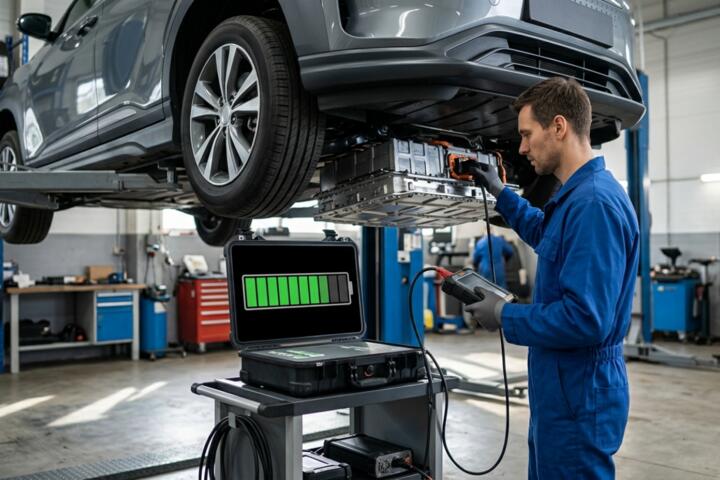
The Science Behind Battery Longevity Metrics
The State of Health (SOH) is a "percentage of original capacity" metric that compares the current condition of a battery to its factory-new state. Unlike the State of Charge (SOC), which tells you how much "fuel" is in the tank right now, SOH tells you how much the tank has shrunk over time. In a professional automotive context, SOH is calculated through complex algorithms that track internal resistance, voltage sag under load, and coulombic efficiency.
For instance, a Tesla Model 3 with 100,000 miles might show an SOH of 91%. This means the battery can only hold 91% of the energy it could when it rolled off the assembly line. In the industry, a battery is typically considered "end-of-life" for automotive use when it hits the 70% to 80% threshold, often referred to as the "knee" of the degradation curve.
Recent data from Recurrent Auto, which monitors over 15,000 EVs, indicates that most modern liquid-cooled packs lose only 1.5% to 2% of their capacity per year. However, this varies wildly based on thermal management and charging habits. Knowing your SOH is the difference between buying a reliable vehicle and a $15,000 repair bill.
Critical Pain Points in Capacity Management
The primary issue in the current market is the lack of transparency in "dashboard" SOH readings. Manufacturers often include a "buffer"—a hidden portion of the battery that isn't used—which can mask initial degradation. Users often rely on the dashboard range estimator, colloquially known as the "Guess-O-Meter," which fluctuates based on driving style and weather, rather than the actual physical state of the lithium-ion cells.
A common mistake is assuming that a "100% charge" means the battery is healthy. In reality, a battery with an SOH of 75% will still show 100% SOC when fully charged, but it will provide 25% less range than a new unit. This leads to "range anxiety" and unexpected stranding when the voltage drops sharply under heavy acceleration or in cold climates.
Failure to monitor SOH also impacts resale value. A used EV with a documented SOH certificate can command a premium of $2,000 to $4,000 over an identical model with unknown battery health. Without this data, the secondary market becomes a gamble, leading to a "race to the bottom" in pricing for older EV models.
Strategic Recommendations for Accurate Monitoring
Utilize Advanced OBD-II Diagnostic Interfaces
Standard dashboard displays are often overly optimistic. To get the "raw" data, experts use OBD-II dongles like the OBDLink LX combined with specialized software. Tools like ScanMyTesla or LeafSpy Pro allow you to see the millivolt variance between individual cell groups.
Monitor Internal Resistance Trends
Internal resistance is the true indicator of "wear." As a battery ages, chemical changes (like SEI layer growth) make it harder for electrons to move. A healthy pack should show uniform resistance across all modules. If one module shows a spike in resistance, it indicates a localized failure that could eventually take down the entire pack.
Implement Regular Depth of Discharge (DoD) Calibration
The Battery Management System (BMS) can "drift" over time, leading to inaccurate SOH reporting. To fix this, professionals perform a calibration: discharge the battery to below 10%, let it "rest" for an hour so the voltages stabilize, and then charge it to 100%. This allows the BMS to re-map the upper and lower voltage limits.
Leverage Cloud-Based Fleet Analytics
For those managing multiple vehicles, platforms like Geotab or ViriCiti provide predictive SOH analytics. These services compare your battery's degradation rate against thousands of similar vehicles in their database, alerting you if your pack is degrading faster than the fleet average.
Evaluate Thermal History Logs
Heat is the enemy of lithium-ion longevity. Professional diagnostic tools can pull "thermal histograms" showing how many hours the battery has spent above 40°C. A vehicle that spent its life in Arizona without active cooling will almost always have a lower SOH than a vehicle from a temperate climate like the Pacific Northwest.
Conduct Periodic Capacity Tests
While software readings are convenient, a physical capacity test is the gold standard. This involves a controlled discharge at a steady current from 100% to 0%. If your 60 kWh pack only yields 48 kWh during this test, your real-world SOH is 80%, regardless of what the software claims.
Performance Analysis: Real-World Scenarios
Scenario 1: The Commercial Delivery Fleet
A logistics company in London operated 20 electric vans. After three years, they noticed the range of two vans had dropped by 30%. Using Geotab analytics, they discovered these specific drivers were using high-speed DC fast chargers (Level 3) exclusively. By shifting to overnight AC charging (Level 2) and limiting the SOC to 80%, they stabilized the SOH of the remaining fleet, preventing an estimated $120,000 in early battery replacement costs.
Scenario 2: The Used Market Acquisition
An individual looking at a 2017 Nissan Leaf used LeafSpy during the test drive. The dashboard showed 11 out of 12 "health bars," suggesting high health. However, the tool revealed a high "Hx" (internal conductance) value and significant cell imbalance. This allowed the buyer to negotiate $3,000 off the price, anticipating that the battery would need a module replacement within 18 months.
Diagnostic Tool Comparison and Selection
| Tool / Method | Best For | Data Depth | Cost Level |
|---|---|---|---|
| Manufacturer Dashboard | Casual monitoring | Basic (Bar graphs) | Included |
| OBD-II + LeafSpy/ScanMyTesla | Enthusiasts / DIY | High (Cell voltages, Temps) | Low ($20 - $100) |
| Recurrent Auto Reports | Used Car Buyers | Comparative (Market data) | Free / Low |
| Aviloo Flash Test | Professional Grading | Expert (Independent Cert) | High ($100+) |
| Dealer Diagnostic Tool | Warranty Claims | Proprietary (Full Access) | High (Service fee) |
Common Mistakes in Battery Assessment
One frequent error is checking SOH immediately after a fast-charging session. The heat generated during DC charging temporarily increases internal resistance and alters voltage readings, often resulting in a "false low" SOH. Always measure SOH when the battery is at an ambient temperature between 15°C and 25°C.
Another mistake is ignoring the "Cycle Count." SOH is a measure of capacity, but cycle count measures usage. A battery with a high SOH but a very high cycle count is likely near its "cliff"—a point where degradation accelerates rapidly. Think of SOH as the depth of the tread on a tire, and cycles as the mileage; you need both to see the full picture.
Finally, many owners believe that "Babying" the battery by never charging above 50% is best. This actually prevents the BMS from performing "Cell Balancing." Most BMS systems only balance cells when the battery is near 100%. Without occasional full charges, cell voltages can diverge, causing the BMS to artificially lower the reported SOH to protect the weakest cell.
FAQ
How often should I check my SOH?
For personal vehicles, a deep dive every six months is sufficient. For commercial fleets or high-mileage users, quarterly checks help identify rapid degradation early enough to adjust charging behavior.
Does DC fast charging actually ruin SOH?
Occasional use is fine. However, studies show that vehicles relying solely on DC fast charging can see 4% to 7% more degradation over five years compared to those using AC charging, primarily due to the thermal stress on the cells.
Can a low SOH be reversed?
Physical degradation of the lithium-ion chemistry is permanent. However, if the "low SOH" is caused by a BMS calibration error or cell imbalance, a professional "top balance" or a deep calibration cycle can sometimes "recover" 3% to 5% of the reported capacity.
Is SOH covered under my vehicle warranty?
Most manufacturers (like BMW, Hyundai, and Tesla) guarantee the battery will maintain at least 70% SOH for 8 years or 100,000 miles. An official SOH report is required to trigger a warranty replacement.
What is the difference between SOH and SOP?
SOH is State of Health (capacity). SOP is State of Power, which measures how much burst energy the battery can provide for acceleration. A battery can have good SOH but poor SOP in cold weather.
Author's Insight
In my years of evaluating high-voltage systems, I have found that the most overlooked factor in SOH is time spent at a high State of Charge in hot weather. I’ve seen batteries with only 20,000 miles show more degradation than those with 60,000 miles simply because the former was parked at 100% charge in a sun-baked driveway every day. My best advice: if you aren't using the car today, keep it at 50%. Your future resale value will thank you.
Conclusion
Monitoring State of Health is the most critical aspect of modern vehicle maintenance. By moving beyond the basic dashboard range estimate and utilizing tools like OBD-II scanners and fleet analytics, you gain an objective view of your battery's lifespan. Focus on maintaining a stable thermal environment and avoiding extreme SOC levels for prolonged periods. Consistent data logging not only protects your investment but ensures that the transition to electric mobility remains economically viable and operationally reliable.