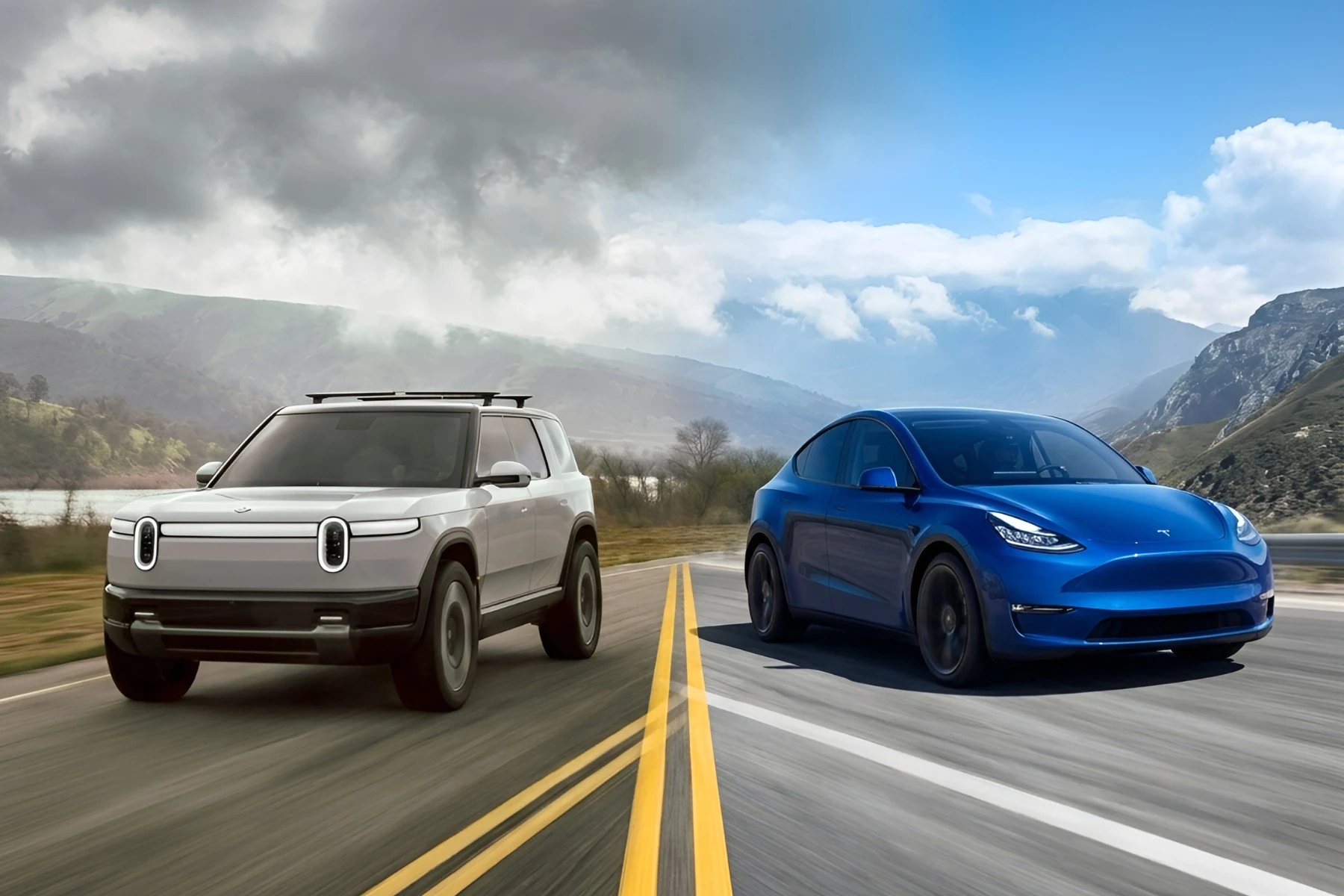
The Chevrolet Equinox EV is the cheapest long-range electric crossover in America: $34,995 before destination for 319 miles of EPA range. The Tesla Model Y RWD, the car it is most often cross-shopped against, costs $39,990 for 321 miles. Five thousand dollars is a real number, and this page checks whether it survives five years of electricity, insurance, charging stops, resale and recalls. The figures come from manufacturer pricing, EPA ratings, published insurance and depreciation data and NHTSA records; prices are MSRPs as of October 2026 before destination charges, which run $1,800 on the Chevrolet and about $1,640 on the Tesla with its order fee.
Sticker Prices, Trim by Trim
| Pairing | Chevrolet Equinox EV | Tesla Model Y | Gap |
|---|---|---|---|
| Entry, single motor | LT 1 FWD, $34,995, 319 mi, 108 MPGe | RWD, $39,990, 321 mi | $4,995 |
| Entry, all-wheel drive | LT 1 AWD, $40,295, 307 mi | AWD, $41,990, 294 mi | $1,695 |
| Better equipped, single motor | LT 2 FWD, $41,795, 319 mi | Premium RWD, $45,990, 357 mi, 125 MPGe | $4,195 |
| Top, all-wheel drive | RS AWD, $47,395, 307 mi | Premium AWD, $49,990, 327 mi, 117 MPGe | $2,595 |
Two things narrow the gap before anyone drives. Chevrolet’s LT 1 is deliberately sparse, no heated seats or wireless phone charging, so the trim most buyers actually choose is the LT 2, which lands $4,195 under a Model Y Premium RWD that carries 38 more miles of range. And the Equinox needs a $225 GM-approved adapter to use Superchargers, because the 2026 car still has a CCS1 port; native NACS arrives with the 2027 model. Dealer discounts cut the other way: TrueCar buyers paid about 4 percent under sticker in autumn 2026, and Tesla does not negotiate.
Where the Equinox Gives Back
Charging speed. The Equinox EV peaks at 150 kW and takes 34 to 40 minutes for 10 to 80 percent on its 85 kWh pack. The Model Y peaks at 250 kW and does it in about 27 minutes. On a road trip that is ten extra minutes per stop in the Chevrolet, through an adapter, at Tesla’s higher non-member rate unless you buy the monthly membership. At home they are equal: 11.5 kW onboard chargers on both, with a 19.2 kW option on upper Equinox trims that few home circuits can feed.
Efficiency. The front-drive Equinox is rated 108 MPGe, about 31 kWh per 100 miles; the Model Y Premium RWD is rated 125 MPGe, 27 kWh. The Tesla goes the same distance on 13 percent less electricity.
Software and driver assistance. Neither car offers Apple CarPlay or Android Auto; Chevrolet runs Google built-in, Tesla its own system. Hands-free driving is optional on both: Super Cruise on the Equinox is an extra-cost package with a subscription after the included period, and Tesla’s FSD (Supervised) is $99 a month. GM’s system is hands-free on mapped highways; Tesla’s works more places and is the subject of two open NHTSA investigations.
Resale. The Equinox EV has no five-year history; it went on sale in mid-2024, and first-year GM EVs have so far depreciated hard. The Model Y’s five-year loss is about 61 percent on iSeeCars data and its two-year retention is among the better EV records. Two cars of the same price would not be worth the same at trade-in, and the Tesla would be worth more.
Five-Year Lines That Differ
| Line, 5 years, 60,000 miles | Equinox EV LT 2 FWD | Model Y Premium RWD |
|---|---|---|
| MSRP plus destination | $43,595 | $47,630 |
| Electricity at home, 17¢ per kWh | About $3,180 at 31 kWh/100 mi | About $2,750 at 27 kWh/100 mi |
| Insurance | No model-specific national analysis yet; mainstream GM crossovers insure near segment averages | MoneyGeek 2026 average $3,343 a year, among the highest of any mainstream EV |
| Supercharger access | $225 adapter; non-member rates or $12.99-a-month membership | Included |
| Depreciation | Unknown; first-year GM EVs have fallen fast | About 61% over five years |
| Maintenance | Tires, filters, fluids; no complimentary plan | Same |
Read it as a direction, not a sum. The Chevrolet starts about $4,000 cheaper and loses $430 of that to electricity over five years. If its insurance comes in even $500 a year under the Model Y’s, which would be unremarkable for a Chevrolet against a Tesla, it stays ahead by roughly $6,000 before resale. Resale is the unknown that can swallow that: a Model Y worth 39 percent of sticker at five years returns about $18,000; an Equinox that follows the Blazer EV’s first-year curve could return less in dollars despite starting lower. The cheaper car is cheaper to buy and to run. Whether it is cheaper to own depends on what it is worth when you sell, and nobody knows that yet.
Reliability: Two Different Risks
The Equinox EV has seven NHTSA recall campaigns across 2024–2026 and about 170 owner complaints, a short list because the car is young. Four of the seven are software: the pedestrian alert sound on 2024 and 2025 cars (25V-639, 24V-925, with a December 2025 follow-up, 25V-878), and adaptive cruise control that could fail to brake on 2,890 early 2025 all-wheel-drive cars (25V-012). One is a batch of door strikers caught in dealer inventory (24V-737), one is Continental 21-inch tires that can shed tread on 2025–2026 cars (25V-704), and one from February 2026 covers 5,861 vehicles (26V-114). Outside the recalls, owners report two patterns worth knowing: DC fast-charging sessions that start slowly or stall at some stations, and a small number of cars whose displayed charge dropped suddenly to zero and shut down, which GM addressed with a vehicle-wide Ultium software update in 2024. No NHTSA investigation is open on the model.
The Model Y’s record is longer and heavier: about 43 recall campaigns, most of them over-the-air software, roughly 4,000 complaints, and four open NHTSA investigations, into door handles on 2021 cars, front suspension links on 2021–2023 cars, and FSD behavior in two separate files. On a new 2026 car the relevant history is the refresh: small assembly recalls, a 12,963-vehicle battery contactor campaign shared with the Model 3, and the front suspension noise owners report most. Year-by-year detail is on our Model Y problems page.
Warranty favors the Tesla on paper, 4 years or 50,000 miles basic against Chevrolet’s 3 years or 36,000, with batteries covered 8 years or 100,000 miles on the Equinox and 8 years or 120,000 on the Model Y Premium. Chevrolet adds a 5-year, 60,000-mile powertrain term the Tesla folds into its battery coverage.
Space and Daily Use
| Measurement | Chevrolet Equinox EV | Tesla Model Y |
|---|---|---|
| Wheelbase / length | 116.3 in / 190.4 in | 113.8 in / 187.2 in |
| Cargo, seats up / folded | 26.4 / 57.2 cu ft | About 29 / 76 cu ft including the frunk |
| Rear legroom | 38.0 in | 40.5 in |
| Heat pump | Standard, GM Ultium energy recovery system | Standard |
| Charge port | CCS1 and J1772; NACS by adapter | NACS native |
| Towing | 1,500 lb | 3,500 lb with the tow package |
The Equinox is the longer car with the shorter cabin: a conventional dashboard, a 17.7-inch screen, physical climate controls, and a back seat that is adequate rather than generous. The Model Y’s packaging puts more room behind the front seats and a second trunk under the hood. Both have heat pumps, so neither takes an outsized winter penalty, and both ride on 19- to 21-inch wheels that cost real money to replace.
Which One for Whom
- Home charging, suburban miles, keeping the car eight years: Equinox EV LT 2. The purchase gap is real, the running-cost gap is small, and resale matters least to a long holder.
- Road trips every month: Model Y. Faster stops, no adapter, no membership question, 38 more rated miles on the Premium.
- Trading in at three years: Model Y, on resale evidence the Chevrolet does not have.
- Physical buttons and a dealer down the street: Equinox EV, and Super Cruise if the package fits the budget.
- Insurance quotes decide it: get both before choosing; a four-figure annual gap in the Chevrolet’s favor would settle the question on its own.
FAQ
Is the Equinox EV really cheaper than a Model Y?
To buy, yes: $4,995 at the entry trims and $4,195 at the trims most people choose, before destination and discounts. To run, slightly: it uses about 13 percent more electricity and charges slower. To own over five years: probably, if its insurance is lower and you keep it long enough that resale matters less, but the Equinox has no resale history yet.
Can the Equinox EV use Tesla Superchargers?
Yes, with the GM-approved NACS adapter ordered through the myChevrolet app for about $225. The 2026 car’s port is still CCS1; Chevrolet moves to a native NACS port for 2027. Expect a 150 kW peak and the non-Tesla rate unless you pay for membership.
Which has more range?
Entry for entry they match: 319 miles against 321. Up the range the Tesla pulls ahead, 357 for the Premium RWD against 319 for any front-drive Equinox, and 327 against 307 with all-wheel drive.
Does either car have Apple CarPlay?
No. Chevrolet uses Google built-in with Maps and Assistant; Tesla uses its own software. If projection matters, neither is the car.
Which is more reliable so far?
The Equinox EV’s record is short and mostly software recalls, with no open investigation; the Model Y’s is long, with four open investigations, three of them on older cars. For a new 2026 purchase the realistic risks are a slow-charging session in the Chevrolet and a suspension clunk in the Tesla.
Sources
- U.S. News — 2026 Equinox EV trims, MSRPs, AWD pricing and range
- Kelley Blue Book — 2026 Equinox EV: 108 MPGe combined, pricing with destination, warranty
- Craig and Landreth Chevrolet — 2026 Equinox EV destination charge and AWD price additions by trim
- George Nunnally Chevrolet — 2026 Equinox EV: CCS1 port, $225 GM NACS adapter, native NACS for 2027
- The Charge Port — 2026 Equinox EV: 85 kWh pack, 150 kW peak, 10–80% time, recall count
- TrueCar — 2026 Equinox EV average transaction price
- VIN Check Engine — Equinox EV: seven NHTSA recall campaigns and complaint count
- Margarian Law — Equinox EV recall summaries, 25V-012 population, GM TSB 24-NA-143
- U.S. News — 2026 Model Y trims, prices and EPA range
- EV Specifications — 2026 Model Y Premium RWD EPA figures: 125 MPGe, 27 kWh/100 mi
- MoneyGeek — EV insurance rates by model, 2026
- iSeeCars — Model Y five-year depreciation
- Tesla — Vehicle warranty terms