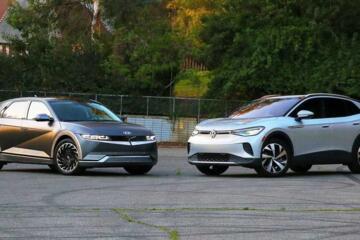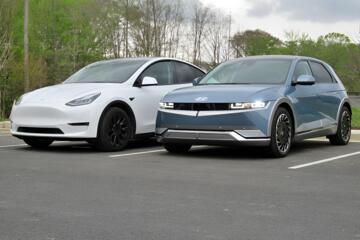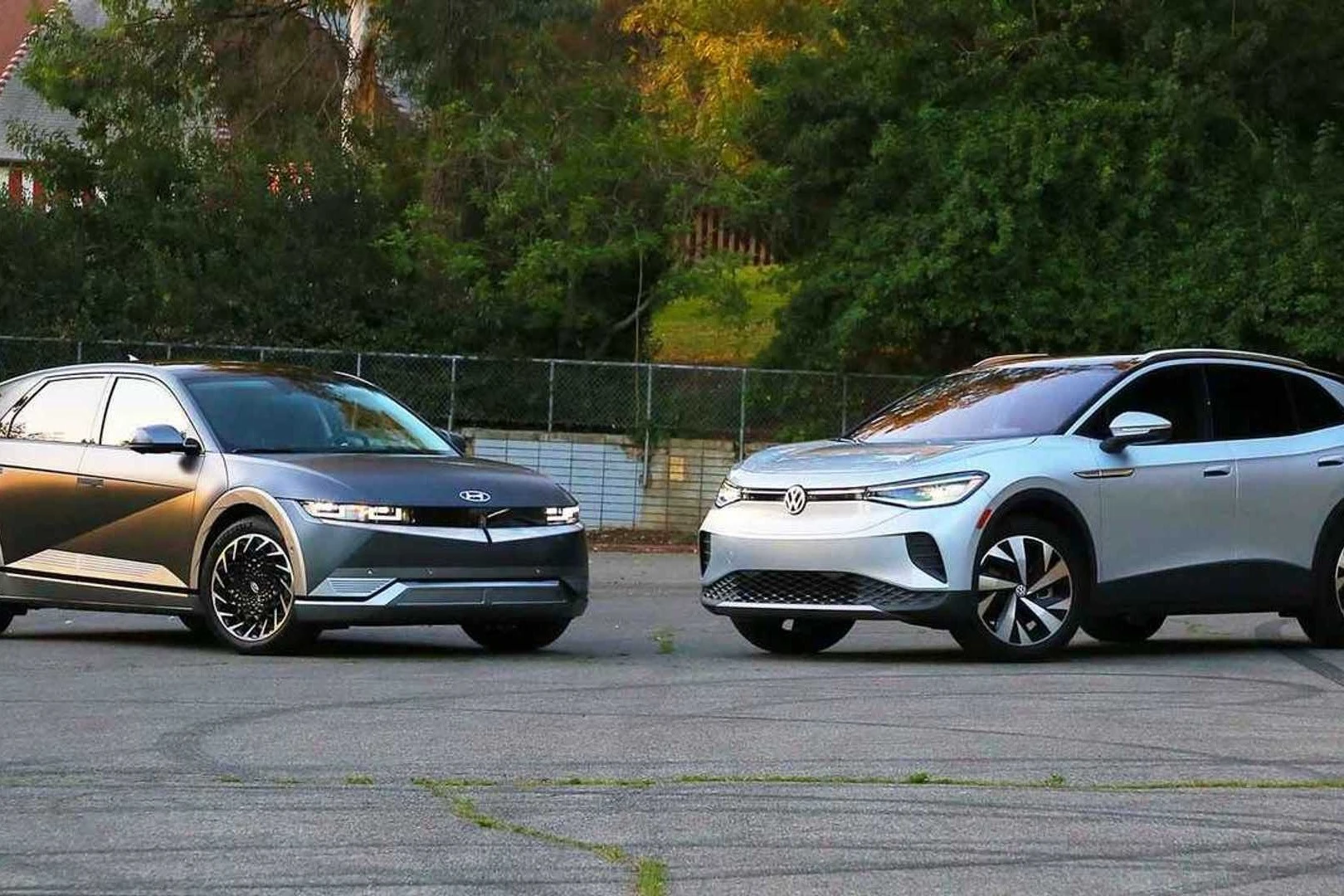
The Volkswagen ID.4 and Hyundai Ioniq 5 are the two compact electric crossovers built in the American South by legacy automakers, priced in the same bracket and bought by the same families. They are also very different machines under the skin: a 400-volt car with a conventional cabin and the bigger trunk against an 800-volt car with a longer wheelbase, more passenger room and a cheaper entry price. In 2026 the reliability record separates them further. This comparison uses manufacturer pricing, EPA ratings, published dimensions and NHTSA recall and complaint data; prices are MSRPs as of October 2026 before destination ($1,475 VW, $1,600 Hyundai).
Prices and Matching Trims
Volkswagen dropped the 62 kWh battery for 2026, so every ID.4 now carries the 82 kWh pack and starts at $45,095. Hyundai cut Ioniq 5 prices by an average of more than $9,000 for 2026, so its 84 kWh long-range car starts at $37,500. The matching trims are not equal on equipment, but the gap survives any adjustment.
| Pairing | Volkswagen ID.4 | Hyundai Ioniq 5 | Gap |
|---|---|---|---|
| Long-range RWD, entry | Pro, $45,095, 291 mi | SE, $37,500, 318 mi | $7,595 |
| Long-range RWD, well equipped | Pro S, $50,195, 291 mi | Limited, $45,075, 318 mi | $5,120 |
| AWD, entry | AWD Pro, $48,995, 263 mi | SEL AWD, $43,300, 290 mi | $5,695 |
| AWD, top | AWD Pro S Plus, $57,655, 263 mi | Limited AWD, $48,975, 269 mi | $8,680 |
Transaction prices narrow this. Edmunds’ suggested price on a 2026 ID.4 Pro in August 2026 was about $5,700 under its delivered MSRP, and TrueCar’s buyers paid 6 percent below sticker; Hyundai dealers discount too, but from a lower base. The Ioniq 5 also sells a $35,000 small-battery SE Standard Range (245 miles) that the ID.4 no longer answers. Volkswagen’s counter is included charging: two years of Electrify America Pass+ membership with Plug&Charge, which is discounted rates rather than free electricity.
Charging: 800V vs 175 kW
The Ioniq 5 runs an 800-volt system rated to 257 kW; Hyundai quotes 10 to 80 percent in about 20 minutes on a 350 kW charger. The ID.4 is a 400-volt car that peaks at 175 kW and takes about 30 minutes for the same stop. That is the headline, and it is true only at the right charger.
| Where you plug in | ID.4, 82 kWh | Ioniq 5, 84 kWh |
|---|---|---|
| 350 kW CCS station (Electrify America, EVgo, Ionna) | 175 kW peak, about 30 min 10–80%, native CCS port | Up to 257 kW, about 20 min, through the included CCS adapter |
| Tesla V3 Supercharger | Included NACS adapter; up to its full 175 kW on a 400 V cabinet | Native NACS port; limited to about 126–135 kW, roughly 30 min |
| Tesla V4 Supercharger, 1,000 V cabinet | Same as V3 | Full 800 V speed |
| Level 2 at home | 11 kW onboard charger, about 8 hours | 10.9 kW onboard charger, about 7 hours |
On today’s Supercharger network the two cars charge in roughly the same half hour, because the Hyundai has to boost 400 volts on board and the ID.4 does not. On 350 kW CCS corridors the Ioniq 5 saves about ten minutes a stop. Owners who road-trip on Electrify America, which both cars favor for different reasons, get the Hyundai’s advantage in full; Supercharger-dependent owners get none of it until V4 cabinets spread.
Space: Cargo vs Cabin
Here the two cars trade places. The ID.4 has the bigger trunk by a wide margin; the Ioniq 5, on a wheelbase more than nine inches longer, has the bigger cabin.
| Measurement | Volkswagen ID.4 | Hyundai Ioniq 5 |
|---|---|---|
| Wheelbase | 108.9 in | 118.1 in |
| Length / height | 180.5 in / 64.4 in | 183.3 in / 63.0 in |
| Cargo, seats up | 30.3 cu ft | 26.3 cu ft |
| Cargo, seats folded | 64.2 cu ft | About 58.5 cu ft |
| Rear legroom | 37.6 in | 39.4 in |
| Passenger volume | About 100 cu ft | 106.5 cu ft |
| Curb weight, RWD | 4,575 lb | About 4,300 lb |
Four cubic feet behind the seats is a stroller or a week of groceries; the ID.4’s squared-off hatch and Pro S ski pass-through make it the better cargo car. The Ioniq 5 answers with a flat floor, a center console that slides rearward, front seats that recline nearly flat and a rear bench that slides, so the people in it have more options than the luggage behind them. Families with car seats tend to pick the Hyundai; owners who haul tend to pick the Volkswagen.
Range and Efficiency
EPA efficiency is identical: 113 MPGe combined for the rear-drive ID.4, 114 for the rear-drive Ioniq 5, both about 30 kWh per 100 miles, so the electricity bill is the same. The range gap comes from the Hyundai’s slightly larger usable pack: 318 miles against 291 rear-drive, 290 against 263 with all-wheel drive.
Winter is where the ratings mislead. Volkswagen does not offer a heat pump on the US ID.4; the cabin is heated resistively on every trim. Hyundai fits a heat pump only with all-wheel drive, so the 318-mile rear-drive Ioniq 5 heats the same way. In a cold climate the honest comparison is the ID.4 against the Ioniq 5 SEL AWD, and there the Hyundai keeps a 27-mile rating advantage plus the heat pump for $5,700 less than the AWD Pro.
Reliability Data Side by Side
| NHTSA record, October 2026 | Volkswagen ID.4 (2021–2026) | Hyundai Ioniq 5 (2022–2026) |
|---|---|---|
| Recall campaigns | 25 | 15 |
| Owner complaints | About 1,000; 13 fire reports | About 1,300 on a larger fleet |
| Defining fault | Door handles that could open while driving, five campaigns 2023–2024; early software that cut power or rebooted screens | ICCU charging unit failures on 2022–2024 cars, two recalls, a 15-year warranty extension and a class action |
| Open risk on new cars | 26V-630: battery may fail and cause a fire on 2023–2026 cars, 22,524 vehicles, no remedy yet, charge capped at 80% | Only assembly campaigns on the 2025–2026 Georgia-built cars (battery bus bars, suspension fasteners, seat belts), each with a remedy available |
| Best used years | 2024–2025, with the battery recalls closed | 2025 on; or 2022–2024 with the ICCU replaced and 15-year coverage confirmed |
Per car sold the complaint rates are close, roughly one filing per hundred vehicles for each. The difference is where the risk sits today. The Ioniq 5’s big problem belongs to cars built before October 2024; the 2025–2026 cars are outside both ICCU recalls, and Hyundai now covers the part for 15 years or 180,000 miles on the older ones. The ID.4’s big problem is current: four battery fire campaigns filed between December 2025 and September 2026 cover every Chattanooga-built car, and the latest, 26V-630, had no repair at this writing. A buyer of a new 2026 ID.4 takes delivery of an open fire-risk recall. Our full breakdowns by model year are on the ID.4 problems page and the Ioniq 5 known issues page.
Warranty follows the same direction: Volkswagen gives 4 years or 50,000 miles basic and powertrain and 8 years or 100,000 on the battery; Hyundai gives 5 years or 60,000 basic, 10 years or 100,000 on battery and powertrain for the first owner, and three years of complimentary scheduled maintenance.
Which One for Which Buyer
- Cargo first, people second: ID.4. Thirty cubic feet behind the seats and 64 folded beat anything in the Hyundai’s lineup.
- Rear-seat passengers, car seats, a lounge-like cabin: Ioniq 5, on nine inches of wheelbase.
- Road trips on 350 kW CCS routes: Ioniq 5, ten minutes faster per stop. On Superchargers: a draw.
- Lowest price into a long-range car: Ioniq 5 SE at $37,500, $7,600 under the cheapest ID.4, before either dealer discounts.
- Cold climate: Ioniq 5 SEL AWD. No US ID.4 has a heat pump.
- Buying new in 2026 and allergic to open recalls: Ioniq 5. The ID.4’s battery campaign has no remedy date.
- Buying used under $25,000: a 2024 ID.4 with its recalls closed, or a 2022–2024 Ioniq 5 only with a replaced ICCU on paper. Read both model pages before either.
FAQ
Which charges faster, ID.4 or Ioniq 5?
The Ioniq 5 on a 350 kW CCS charger: about 20 minutes for 10 to 80 percent against about 30. On a Tesla V3 Supercharger they are roughly equal at around 30 minutes, because the 800-volt Hyundai is limited to 126–135 kW there while the ID.4 draws its full 175 kW.
Which has more cargo space?
The ID.4: 30.3 cubic feet behind the rear seats and 64.2 folded, against 26.3 and about 58.5 for the Ioniq 5. The Hyundai wins the opposite measurement, passenger room, by a similar margin.
Which is more reliable?
Complaint rates per car are similar. The difference is timing: the Ioniq 5’s ICCU fault is confined to 2022–2024 cars and now carries a 15-year warranty, while the ID.4 has an open battery fire recall covering every 2023–2026 car with no remedy as of October 2026.
Does the ID.4 have a heat pump?
Not in the United States. Volkswagen fits one in other markets, including Canada, but every US ID.4 uses a resistive heater. The Ioniq 5 includes a heat pump only on all-wheel-drive trims.
Which costs less to own?
The Ioniq 5 at MSRP by $5,000 to $8,700 at matching trims, with identical energy costs, a longer warranty and included maintenance. Dealer discounts on the ID.4 can close much of the purchase gap in a given month; the warranty and maintenance gap does not move.
Sources
- Volkswagen of America — 2026 ID.4: pricing, EPA range by trim, Electrify America Pass+ membership
- Edmunds — 2026 ID.4: 30 kWh/100 mi, 113 MPGe, cargo volumes, warranty, suggested price
- Autoblog — 2026 ID.4 efficiency by drivetrain and cargo figures
- Wikipedia — ID.4 dimensions; heat pump offered in markets such as Canada
- Edmunds — 2026 Ioniq 5 trims and pricing; heat pump on AWD versions
- Kelley Blue Book — 2026 Ioniq 5 SE: 114 MPGe, 318 miles, warranty terms
- CarsDirect — 2026 Ioniq 5 dimensions and cargo volumes
- InsideEVs — 2025 Ioniq 5 on a V3 Supercharger: 126 kW measured
- The Weekly Driver — ID.4 NHTSA record: 25 recalls, 1,009 complaints, battery recall populations
- Cars.com — Hyundai Ioniq 5 recall list, NHTSA data (15 campaigns)
- Electrek — Hyundai ICCU warranty extension, April 2026