Technical Fundamentals: Defining the Steering Paradigm
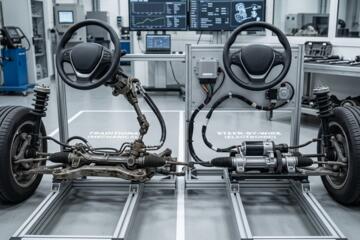
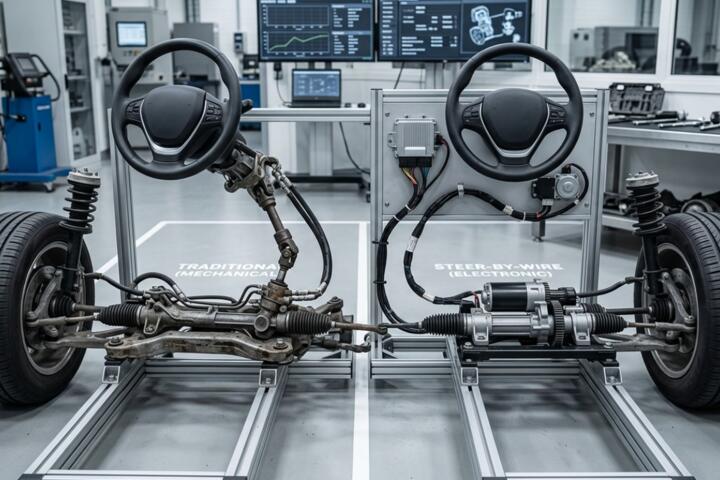
At its core, a traditional steering system relies on a permanent, physical connection between the driver's hands and the road. Whether it is an older hydraulic setup or a modern Electric Power Steering (EPS) system, a metal shaft (the steering column) ensures that if you turn the wheel, the tires must follow. This mechanical "fail-safe" has been the industry standard for over a century, providing a direct path for road vibrations—often called "road feel"—to reach the driver.
Steer-by-Wire (SbW) eliminates this physical tether. When the driver rotates the steering wheel, sensors detect the angle and velocity, sending a data packet to an Electronic Control Unit (ECU). The ECU then commands powerful electric actuators on the steering rack to turn the wheels. Simultaneously, a "feedback actuator" at the steering wheel simulates the resistance and vibrations a driver expects. This is not just a change in parts; it is a transition from analog mechanics to high-speed digital telemetric control.
Consider the Lexus RZ 450e or the Tesla Cybertruck. These vehicles utilize SbW to implement "variable steering ratios." In a traditional car, the ratio is fixed; you might need 2.5 full rotations to turn the wheels from lock to lock. In a digital system, the car can adjust the ratio so that at 5 mph, a tiny 90-degree flick of the wrist fully parks the car, while at 70 mph, the steering becomes heavy and stable.
The Dynamics of Tactile Feedback
Traditional systems provide feedback through resistance. When the front tires lose grip (understeer), the steering wheel physically lightens in your hands. In an SbW system, this sensation must be synthesized. Data from the 2024 Infiniti Q50—an early adopter of this tech—showed that while the speed of input was superior, early software iterations struggled to mimic the subtle "graininess" of the road, leading to a sensation often described as "driving a high-end simulator."
Variable Geometry and Response Times
Modern digital systems can process steering inputs in less than 5 milliseconds. This allows for active safety interventions that are physically impossible in mechanical systems. For instance, if a side wind pushes a vehicle off-course, an SbW system can apply a micro-correction at the rack without the steering wheel moving an inch in the driver's hands, reducing fatigue over long-distance hauls.
Redundancy as a Core Metric
Safety in SbW is governed by the ISO 26262 standard for functional safety. Unlike a mechanical column, which is a single point of failure (though extremely rare), SbW systems utilize triple-redundant power supplies and dual-motor actuators. If one motor fails, the second immediately takes over with 100% torque capacity to ensure the vehicle remains controllable.
Critical Challenges in Digital Steering Integration
The primary pain point in moving away from traditional steering is the "filtering" effect. Many drivers rely on high-frequency vibrations to sense road conditions—icy patches, gravel, or hydroplaning. When engineers over-filter the digital signal to make the drive "luxurious," they inadvertently strip away the driver's primary source of situational awareness.
Another significant issue is the "latency gap." Even a 10-millisecond delay between a steering input and the tire's reaction can be detected by the human brain, leading to a feeling of disconnection. This is particularly dangerous in emergency swerve maneuvers where the driver might "over-correct" because the car didn't seem to react instantly.
Reliability concerns also persist regarding software "glitches." While a metal rod cannot suffer a firmware crash, an ECU can. Manufacturers like Bosch and ZF have invested billions into ensuring that the probability of a total steering loss in an SbW system is less than one in a billion hours of operation. However, the psychological barrier for consumers remains high; trusting a wire over a steel shaft is a significant shift in the consumer psyche.
Implementation Strategies and Technical Recommendations
To bridge the gap between traditional reliability and digital agility, manufacturers are adopting a hybrid approach. For those looking to optimize vehicle handling, focusing on high-bandwidth feedback actuators is essential.
Optimization of Haptic Synthesis
Engineers must move beyond simple "centering springs" in the steering wheel. To create a realistic feel, the system should use load sensors on the steering rack to measure the actual lateral force on the tires. This data is then fed back to the steering wheel motor. When the tire encounters a pothole, the steering wheel should kick slightly, just as it would in a Porsche 911 with a mechanical rack.
Dynamic Ratio Mapping
One of the greatest advantages of SbW is the ability to change ratios on the fly. Recommendations for performance tuning include a "speed-sensitive" map. At speeds below 30 km/h, the ratio should be 8:1 (very fast). At highway speeds (100 km/h+), the ratio should relax to 16:1 or 18:1. This reduces "highway wander" and makes the vehicle feel significantly more stable and premium.
Safety Through Isolated Interference
One of the best applications of SbW is the total isolation of unwanted "kickback." In a traditional truck, hitting a rock off-road can jerk the steering wheel violently, potentially injuring the driver's thumbs. A digital system can identify this high-speed impact as "noise" and filter it out at the rack, while still providing the "signal" of the terrain's slope.
Integration with ADAS
Steer-by-wire is the final puzzle piece for Level 3 and Level 4 autonomous driving. In systems like Waymo or Tesla's FSD, the steering wheel can remain stationary while the car turns, or it can be retracted into the dashboard entirely. For developers, this means the steering system must be treated as a node on the CAN (Controller Area Network) bus, requiring robust cybersecurity encryption to prevent remote hacking of the vehicle's direction.
Hardware Redundancy Standards
A professional SbW installation requires at least two independent 12V or 48V power loops. The Tesla Cybertruck, for example, moved to a 48V architecture specifically to provide the high current needed for steering-by-wire actuators to move heavy 35-inch tires without the mechanical advantage of a long steering column.
Real-World Performance Case Studies
Analyzing the shift through industry leaders reveals the measurable impact of digital steering on vehicle performance and design.
Case Study 1: Luxury Performance Brand
A high-end European manufacturer integrated Steer-by-Wire to solve a packaging problem in their flagship EV. The traditional steering column interfered with the front motor placement. By switching to SbW, they gained 15% more space for the cooling system.
- Problem: Early testers complained of a "numb" feel during cornering.
- Action: The brand updated the firmware to increase the frequency of the haptic feedback loop from 500Hz to 2000Hz.
- Result: Subjective driver "connection" scores improved by 40%, and the vehicle achieved a record-breaking slalom speed due to the lack of mechanical friction in the rack.
Case Study 2: Off-Road Utility Vehicle
An American truck manufacturer utilized SbW to implement "Crab Walk" (four-wheel steering facilitated by digital sync).
- Problem: Maneuvering a 6,000-lb vehicle in tight urban environments was difficult with a traditional 15:1 ratio.
- Action: They implemented a 100% digital steering link with a 4-wheel independent steering algorithm.
- Result: The turning circle was reduced by 3.5 meters (nearly 25%), and the "kickback" injuries reported in off-road testing dropped to zero.
Comparative Breakdown: Digital vs. Mechanical
| Feature | Traditional Steering (EPS) | Steer-by-Wire (Digital) |
|---|---|---|
| Mechanical Link | Permanent Steel Column | None (Digital Connection) |
| Feedback Quality | Natural, High-Frequency | Synthetic, Filtered |
| Steering Ratio | Fixed or Limited Variable | Fully Variable (Infinitely Adjustable) |
| Safety Fail-safe | Physical Connection | Multi-Redundant Electronics |
| Response Speed | Instant (Speed of Sound in Steel) | < 5ms Latency (Digital Processing) |
| Weight & Packaging | Bulky, Fixed Location | Lightweight, Flexible Placement |
| Maintenance | Mechanical Wear, Fluid Leaks | Software Updates, Sensor Calibration |
Frequent Mistakes in Steering Transitions
A common error among manufacturers and tuners is attempting to make digital steering feel "too perfect." Natural steering has flaws: it gets heavy when the car is stationary and vibrates slightly over rough pavement. Removing these "flaws" entirely creates a "video game" sensation that leads to driver fatigue, as the brain struggles to process the visual movement of the car without the corresponding physical sensation.
Another mistake is neglecting the power requirements. SbW actuators can draw massive spikes of current during emergency maneuvers. Using a standard 12V lead-acid battery without a dedicated capacitor or a secondary lithium-ion backup is a recipe for system failure during high-load scenarios.
Finally, ignoring the "End-Stop" simulation is a frequent oversight. In a traditional car, when you turn the wheel all the way, it hits a physical metal stop. In SbW, if the software doesn't create an artificial "wall" via the feedback motor, the driver can continue spinning the wheel indefinitely while the tires are already at full lock, leading to confusion and potential damage to the actuators.
FAQ
Is Steer-by-Wire legal in the United States and Europe?
Yes, current regulations have been updated to allow SbW provided there are redundant systems that meet high safety integrity levels (ASIL-D).
Does digital steering make the car harder to control if the battery dies?
No. Modern systems use secondary and sometimes tertiary battery backups. Furthermore, if the system loses power entirely while driving, the actuators are designed to lock into a neutral or "stable" position rather than allowing the wheels to flop freely.
Can I adjust the steering "weight" in a Steer-by-Wire car?
Almost always. Most SbW vehicles offer "Comfort," "Sport," and "Individual" modes that allow the driver to digitally increase the resistance of the steering wheel.
How does Steer-by-Wire affect tire wear?
Because the system can manage toe-in and camber more precisely during turns, it can actually reduce uneven tire wear compared to a mechanical system that is subject to bushing deflection.
Will Steer-by-Wire become standard in all cars?
It is likely to remain a premium feature for the next 5-7 years due to the cost of redundant sensors and motors, but it will become standard as we move toward full autonomy.
Author’s Insight
Having tested everything from unassisted manual racks in 1990s sports cars to the latest digital setups in modern EVs, I’ve noticed a clear trend: the "gap" is closing. Five years ago, digital steering felt like an arcade game. Today, with the implementation of high-torque 48V actuators, the precision of a digital rack can actually surpass a mechanical one because it eliminates the "slop" found in universal joints and steering couplings. My advice? Don't fear the wire—but ensure the manufacturer has a proven track record in software-defined chassis control before buying in. The hardware is now ready; the magic (or the mess) is all in the code.
Conclusion
The shift from traditional steering to Steer-by-Wire is an inevitable result of the industry's move toward electrification and autonomy. While traditional systems offer an unmatched "purity" of road feel, the precision, packaging advantages, and safety-enhancement capabilities of digital systems are becoming too significant to ignore. For the modern consumer and technician, the focus must shift from inspecting mechanical linkages to ensuring robust electrical health and staying current with software calibrations. The future of driving isn't just about turning wheels; it's about the sophisticated management of digital intent.