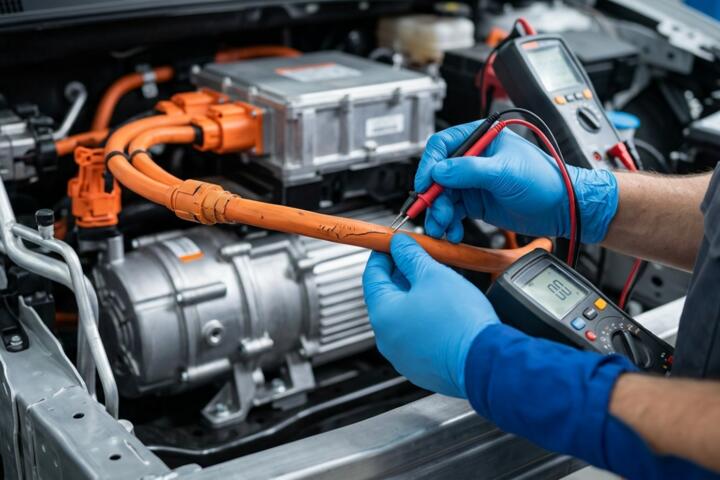
Electrical Integrity
High-voltage cables in modern EVs—typically identifiable by their bright orange shielding—are the arteries of the powertrain. They carry currents often exceeding 400V or 800V from the battery pack to the inverter and onto the traction motors. Unlike standard 12V automotive wiring, HV insulation is a multi-layered composite designed to withstand extreme thermal cycling, electromagnetic interference (EMI), and mechanical vibration.
In a professional workshop setting, we don't just look for "wear"; we look for dielectric breakdown. This is the point where the insulating material loses its ability to prevent current leakage. For example, in a Tesla Model 3 or a Hyundai Ioniq 5, the cables are subjected to temperatures ranging from -30°C to over 100°C during rapid DC charging. Over five to seven years, this thermal expansion and contraction can create microscopic fissures in the XLPE (Cross-linked Polyethylene) or silicone rubber jackets.
Real-world data suggests that insulation resistance should ideally remain above 500 MΩ (Megaohms) for a healthy system. When this value drops below 100 MΩ, the vehicle’s On-Board Diagnostics (OBD) system will often trigger an isolation fault code (such as P0AA6). A study of high-mileage electric taxis in London showed that 12% of cables exhibited significant outer sheath degradation after 150,000 miles due to road debris and salt spray.
HV Distribution Risks
Environmental Stress and Chemical Exposure
The primary enemy of high-voltage insulation is the environment. While the orange outer layer is tough, it is not invincible. Ethylene glycol leaks from the thermal management system or even common brake fluid can act as solvents on certain polymer jackets. If a technician spills fluid during a routine service on a Ford Mustang Mach-E, and it isn't neutralized, the chemical can wick into the cable connectors, causing the insulation to swell and eventually crack.
Mechanical Abrasions from Improper Routing
Cable ties and mounting brackets are often overlooked points of failure. If a bracket becomes loose due to chassis vibration, the cable vibrates against the metal frame. At 400V, even a pinhole-sized breach in the insulation can lead to "arcing," where electricity jumps to the chassis. This doesn't always blow a fuse immediately but creates localized heat that carbonizes the insulation, making it more conductive over time.
Thermal Aging and Peak Load Stress
During fast charging at stations like Electrify America or Tesla Superchargers, cables handle hundreds of amps. This generates internal heat via $I^2R$ losses. While cables are liquid-cooled in some high-end chargers, the vehicle's internal cables rely on material heat resistance. Constant cycling between ambient temperature and 60°C+ during heavy acceleration or regenerative braking gradually "bakes" the plasticizers out of the insulation, making it brittle.
Advanced Diagnostics
Utilizing Insulation Resistance Testing (IRT)
Visual inspection is only 20% of the job. To truly verify insulation health, you must use a specialized Megohmmeter (insulation tester) like the Fluke 1587 FC or the Megger MIT400. This involves "stress testing" the insulation by applying a high DC voltage (usually 500V or 1000V) and measuring the resistance.
In practice, a technician disconnects the HV battery (following LOTO—Lock Out Tag Out—procedures) and tests between the conductor and the chassis ground. If the resistance is high, the "wall" between the electricity and the car body is solid. If it’s low, the cable is compromised.
Ultrasonic Detection of Partial Discharge
Advanced shops are now using ultrasonic acoustic sensors to "hear" insulation failure before it becomes a short circuit. When insulation begins to fail, it often emits a high-frequency hiss caused by partial discharges—tiny sparks within the material. Using a tool like the UE Systems Ultraprobe, a technician can scan along the length of the cable while the system is under load to pinpoint internal degradation that is invisible to the naked eye.
Integrity Checks of Electromagnetic Shielding
HV cables are shielded with a copper or aluminum braid to prevent EMI from interfering with the car’s low-voltage sensors. If this braid is corroded by road salt, the car might experience ghost faults in the ADAS (Advanced Driver Assistance Systems) or infotainment lag. Testing the continuity of the shield to the connector housing is a vital step during the 60,000-mile major service.
Monitoring Connector Seal Integrity
Insulation degradation often starts at the termination points. Moisture ingress into the high-voltage interlock loop (HVIL) connectors is a common failure point in older Nissan Leaf models. Using an infrared thermal camera (like a FLIR TG267) after a drive can reveal "hot spots" at connectors. A temperature delta of more than 10°C between similar connectors usually indicates high resistance and impending insulation failure.
Physical Sheath Restoration and Protection
If the outer orange corrugated tubing (the conduit) is damaged but the inner cable is intact, it must be replaced immediately to prevent further UV or mechanical damage. We recommend using high-temperature, flame-retardant split loom tubing rated for automotive use. Applying a dielectric silicone grease to the external seals of the connectors can also prevent the "drying out" of rubber gaskets that leads to moisture wicking.
HV Failure Case Studies
Case 1: The Commercial Delivery Van
A fleet of electric delivery vans in a coastal city began experiencing "Isolation Fault" warnings during rainstorms. Upon inspection by a specialized EV service center, it was found that the rear motor cables had been sandblasted by road grit.
- The Problem: Micro-pitting in the insulation allowed salty moisture to create a conductive path to the frame.
- The Fix: Technicians performed IRT testing, identified three compromised cables, and replaced them with double-shielded variants. They also installed custom mudguards to protect the HV entry points.
- Result: The fleet’s "Isolation Fault" rate dropped from 15% to 0%, saving an estimated $12,000 per month in downtime and towing fees.
Case 2: The Performance Sedan Overheating
A high-performance EV owner reported a loss of power and a "Performance Restricted" light after heavy track use.
- The Problem: A thermal camera scan revealed a connector reaching 115°C. The insulation around the crimp terminal had charred due to a loose connection causing high resistance.
- The Fix: The cable was shortened, re-crimped using a calibrated hydraulic tool, and new heat-shrink insulation was applied.
- Result: Resistance dropped from 1.2 Ohms to 0.003 Ohms, and the thermal signature returned to normal operating parameters.
Maintenance Checklist
| Task Item | Frequency | Tools Required | Success Metric |
|---|---|---|---|
| Visual Inspection | Every 12,000 miles | High-lumen LED Flashlight | No orange sheath cracks or fluid stains |
| Connector Integrity | Annually | Tactile Check / Visual | Seals are pliable, no green corrosion |
| Isolation Resistance | Every 50,000 miles | Megohmmeter (500V DC) | Resistance > 500 MΩ |
| Thermal Mapping | Post-Fast Charge | FLIR / Infrared Camera | No localized hot spots > 60°C |
| Shielding Continuity | Every 50,000 miles | Multimeter (Low Ohms) | Continuity < 0.5 Ohms to ground |
| HVIL Loop Test | During Diagnostics | OBDII Scanner | Zero "Interlock Circuit Open" codes |
Common Pitfalls
One of the most dangerous mistakes is using standard "hardware store" electrical tape to repair orange HV insulation. This tape is not rated for the voltage or the thermal environment of an EV engine bay. It will peel off within weeks, creating a fire hazard.
Another frequent error is pressure washing the underside of an EV. While the connectors are rated (usually IP67 or IP69K), high-pressure water can force its way past aging seals and sit inside the connector. This leads to "slow-burn" insulation degradation where the water causes electrolysis, eating away at the copper conductors from the inside out.
Lastly, never perform insulation tests without first verifying the HV battery is disconnected and the "Zero Voltage" state is confirmed with a CAT III or CAT IV rated meter. Capacitors in the inverter can hold a lethal charge for several minutes even after the battery is removed.
FAQ
Why are the cables orange?
The orange color is an industry-standard safety convention (SAE J1127) to warn emergency responders and technicians that the cable carries lethal voltage. Never cut or touch these without proper training and PPE.
Can I drive with an "Isolation Fault" light on?
No. While the car might still move, an isolation fault means the "safety barrier" between the high voltage and the car's body is compromised. A second fault could electrify the entire chassis or cause a fire.
How much does it cost to replace a main HV cable?
Depending on the vehicle, a main battery-to-inverter cable can cost between $400 and $1,200 for the part alone, with labor adding another 3–6 hours of specialized work.
Does cold weather affect insulation?
Extreme cold makes polymer insulation more brittle. If cables are moved or vibrated excessively in sub-zero temperatures, they are more prone to cracking than in temperate climates.
Are aftermarket cables safe?
Only if they meet the exact OEM specifications for gauge, shielding, and temperature rating. Cheap, unshielded cables can cause massive electromagnetic interference, potentially disabling the vehicle's power steering or braking computers.
Author’s Insight
In my years working on high-voltage powertrains, I’ve seen that the most expensive repairs always start with a "minor" ignores vibration. I once saw a $100,000 luxury EV written off because a $5 plastic clip broke, allowing an HV cable to rub against a CV axle for six months. My best advice: during every tire rotation, take two minutes to look at the orange conduits. If you see "whitening" of the plastic or road-rash on the shielding, fix it then. Waiting for a warning light on the dash usually means the damage has already migrated to the expensive inverter electronics.
Summary
Effective maintenance of high-voltage cables is not a "set and forget" task; it requires a proactive blend of visual scrutiny and precision electrical testing. By monitoring insulation resistance, ensuring connector seals remain watertight, and protecting cables from mechanical wear, owners and technicians can prevent the vast majority of HV system failures. Always prioritize safety by using rated tools and following manufacturer-specific de-energization protocols. Consistent vigilance is the only way to ensure the high-power heart of an electric vehicle remains safe, efficient, and reliable for the long haul.