The Evolution of Silence
In a traditional internal combustion engine (ICE) vehicle, the engine acts as a primary noise source that masks secondary sounds. When you remove the 150-250 Hz thrum of a four-cylinder engine, you uncover a chaotic spectrum of high-frequency irritants. Electric Vehicles (EVs) operate in a frequency range where human hearing is particularly sensitive, often highlighting road hiss, wind turbulence, and the high-pitched whine of inverter switching frequencies.
Achieving a premium cabin feel in an EV isn't just about adding mass; it is about managing the "noise floor." In a standard Tesla Model 3 or Hyundai Ioniq 5, the ambient noise at 65 mph typically hovers around 67-69 dB. Through strategic acoustic layering, professional installers aim to drop this to 62-64 dB. While a 5 dB drop might sound small, remember that the decibel scale is logarithmic; a 3 dB reduction represents a 50% decrease in sound energy.
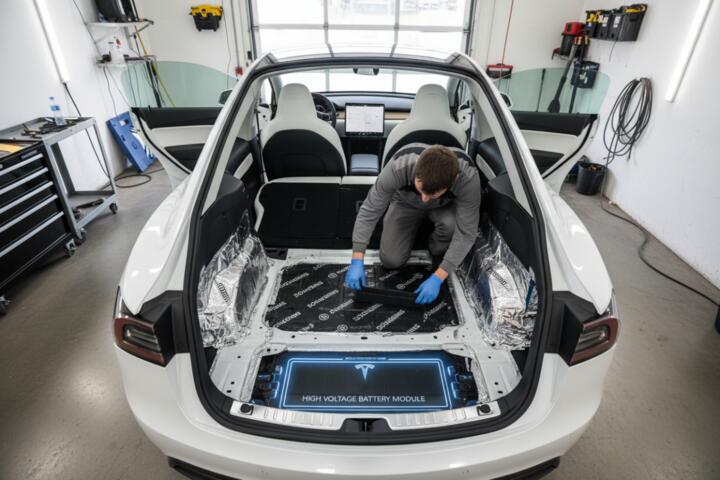
Practical experience shows that the "perceived" quietness is often more about removing specific peaks in the 2 kHz to 5 kHz range. This is where tire "slap" on concrete joints becomes unbearable. Real-world testing with Class 1 sound level meters proves that targeted treatment of the wheel arches and the trunk floor yields the highest Return on Investment (ROI) for EV owners.
EV Acoustic Failures
The most common mistake in EV soundproofing is the "carpet bombing" approach—covering every square inch of the floor with heavy Butyl rubber. This adds unnecessary weight to a vehicle that is already heavy due to battery packs, negatively impacting range and suspension longevity. More importantly, it fails to address airborne noise.
Weight management is critical in EVs. Adding 100 lbs of sound deadener can reduce range by 1-2%, which is a significant trade-off. Furthermore, many DIY enthusiasts ignore the "leakage" points. An unsealed door grommet or a thin plastic wheel well liner can negate $500 worth of premium floor matting.
The consequences of poor acoustic management are "listener fatigue." In an EV, the absence of engine vibration makes the high-pitched resonance of the electric motor more prominent. This 8 kHz to 12 kHz whine can cause headaches and irritability during long commutes. Professional shops now use spectrum analyzers to identify these specific frequencies rather than guessing where to apply material.
Decibel Mitigation
Precision Vibration Damping at Source Points
The first step is neutralizing the structural resonance of the thin aluminum panels common in modern EVs like the Tesla Model Y or Lucid Air. Instead of 100% coverage, apply constrained layer damping (CLD) to approximately 30-40% of the panel's center. This shifts the resonant frequency of the metal. Use high-performance materials like Dynamat Xtreme or Sound Deadener Showdown CLD tiles. This specifically targets the low-frequency "booming" caused by road impact.
Decoupling and Mass Loading
To block airborne noise—such as the sound of a passing semi-truck—you need a Mass Loaded Vinyl (MLV) barrier. However, MLV must be "decoupled" from the car's body using a layer of Closed Cell Foam (CCF). The CCF acts as a spring, and the MLV acts as a heavy curtain. This "sandwich" technique is the only effective way to stop the 500 Hz to 4 kHz range. For EVs, using lightweight composites like Resonix Fiber Mat can provide similar results to heavy MLV with 60% less weight.
Strategic Absorption in the "Void" Areas
EVs have massive open cavities, particularly in the rear quarter panels and trunk wells. These act as echo chambers. Filling these voids with hydrophobic melamine foam or Thinsulate SM600L is essential. Unlike traditional fiberglass, Thinsulate is lightweight, flame-retardant, and specifically engineered for automotive thermal and acoustic insulation. Installing this in the door cavities of a Ford Mustang Mach-E can reduce mid-range wind noise by up to 3 dB.
Wheel Arch Sealing and Exterior Treatment
The most direct path for road noise is through the wheel wells. Most EVs use plastic or felt liners that do little to stop gravel flick or tire roar. Applying a sprayable dampener like Lizardskin or a specialized "sandwich" of Butyl and foil on the exterior side of the inner fender (behind the liner) provides an immediate reduction in tire-to-pavement noise. This is particularly effective for EVs equipped with low-rolling-resistance tires, which tend to be noisier than standard rubber.
Glass and Seal Optimization
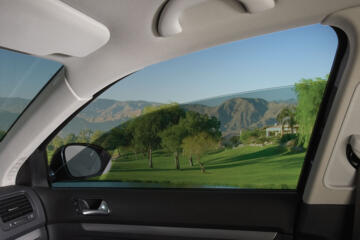
Even with perfect floor treatment, the "greenhouse" (the windows) remains a weakness. While many EVs now come with "acoustic glass" (dual-pane with a PVB interlayer), the seals are often the culprit. Using a silicone-based lubricant like Krytox GPL 205 on weather stripping ensures a tight vacuum seal, preventing high-frequency wind whistles at highway speeds.
Treating the High-Voltage Inverter Whine
The electric motor's electromagnetic whine is a high-frequency challenge. Traditional sound deadening doesn't always work here. The solution involves wrapping the motor housing (where accessible and safe) with specialized high-heat acoustic blankets or applying heavy-duty acoustic foam to the underside of the rear seat bench. This targets the 10 kHz peak common in high-performance EV drivetrains.
Real-World Data
Case Study 1: The Commuter Sedan
A client with a 2023 Tesla Model 3 complained of excessive "road roar" on concrete highways. Baseline testing showed a 71 dB peak at 70 mph. We performed a "Level 2" treatment: wheel arches, trunk floor, and front doors using a mix of 80 mil Butyl and 35mm Thinsulate.
Result: The noise floor dropped to 64.5 dB. The owner reported that they no longer had to raise their voice to talk to passengers, and the audio system's clarity improved by an estimated 25% due to a lower noise floor.
Case Study 2: Luxury SUV Transformation
A Rivian R1S owner sought a "vault-like" cabin. We focused on the massive floor pan and the hollow pillars. We used a triple-layer approach: CLD tiles, followed by a 1/8" CCF layer, topped with a custom-cut MLV barrier.
Result: Total weight added was 85 lbs. The 60 mph decibel reading moved from 66 dB to 61 dB. More importantly, the "impulse noise" (hitting a pothole) was dampened so significantly that it registered as a dull thud rather than a sharp metallic crack.
Acoustic Tool Comparison
| Tool Type | Recommended Brand/Model | Primary Use Case | Accuracy Level |
|---|---|---|---|
| Class 1 SPL Meter | Reed Instruments R8080 | Legal-grade DB measurements | Professional |
| RTA Software | REW (Room EQ Wizard) | Identifying frequency peaks (Hz) | Expert |
| Calibrated Mic | miniDSP UMIK-1 | Capturing cabin frequency response | High |
| Thermal Camera | FLIR ONE | Finding gaps in insulation/seals | Diagnostic |
| Smartphone App | NIOSH SLM | Quick baseline checks | Consumer |
Deadening Mistakes
One of the most expensive mistakes is blocking drainage holes or interfering with airbag deployment zones. EVs have complex cooling channels for battery packs; covering these can lead to overheating. Always leave a 2-inch clearance around any high-voltage cabling or orange-colored conduits.
Another error is the "over-dampening" of doors. Adding too much weight to the door skin can cause the hinges to sag over time, leading to poor alignment and more wind noise. It also makes the door harder to open, which is a safety concern. Focus on 25% coverage with high-quality CLD rather than 100% coverage with cheap material.
Finally, ignoring the roof is a mistake in cars without panoramic glass. Rain noise on an uninsulated EV roof sounds like a tin drum. A single layer of Thinsulate tucked under the headliner can transform the experience during inclement weather, adding a sense of solidity to the vehicle.
FAQ
Does adding sound deadening void my EV warranty?
Generally, no. Under the Magnuson-Moss Warranty Act, a manufacturer cannot void your warranty unless they can prove the modification caused a specific failure. However, avoid touching high-voltage components or sensors.
How much weight will a full treatment add?
A "Gold Standard" treatment adds between 60 and 100 lbs. For a 4,500 lb EV, this is roughly equivalent to carrying a medium-sized dog. The range impact is negligible compared to the comfort gains.
What is the best material for "tire hum"?
For tire hum, the most effective solution is a combination of exterior wheel well dampening (liquid) and interior Thinsulate SM600L in the fender cavities.
Can I use residential insulation in my car?
Never. Residential fiberglass or rockwool absorbs moisture, which leads to mold and catastrophic rust within the body panels. Always use automotive-grade, hydrophobic materials.
Is acoustic glass worth the upgrade?
Yes. If your EV didn't come with it, aftermarket specialized window tints (like 3M Crystalline) can provide a marginal (1-2 dB) improvement in sound rejection, though not as much as true dual-pane glass.
Author’s Insight
In my decade of tuning vehicle acoustics, I’ve learned that silence isn't just the absence of sound—it's the absence of stress. In an EV, your ears are "searching" for noise because the engine isn't there to provide a baseline. My top advice? Start with the trunk and the wheel arches. You’ll get 70% of the results for 30% of the effort. Don't chase a 0 dB cabin; chase a flat frequency response where no single "squeak" or "whine" stands out.
Summary
Maximizing the acoustic potential of an electric vehicle requires a shift from heavy-handed mass loading to strategic frequency management. By focusing on the 1 kHz to 10 kHz range and utilizing lightweight absorbers like Thinsulate alongside targeted CLD tiles, you can achieve a significant, measurable reduction in decibels. Always use a calibrated SPL meter to verify your progress, and prioritize treating the wheel wells and rear cavities. The result is not just a quieter car, but a more refined, luxurious driving experience that justifies the premium nature of electric mobility.