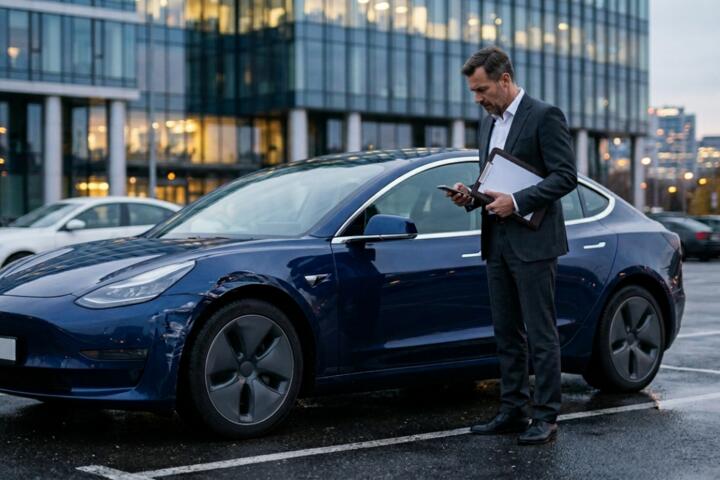
Beyond the Sticker Price: Understanding Asset Protection for High-End Electrics
The luxury EV market operates on a different economic plane than traditional internal combustion engine (ICE) vehicles. When you drive a high-end electric sedan or SUV off the lot, you aren't just fighting the standard "new car" depreciation; you are battling a rapidly evolving tech sector. Batteries become more efficient every 18 months, and manufacturers often slash MSRPs on new models to stay competitive, instantly devaluing existing inventory on the road.
Consider the secondary market for flagship electric SUVs. In 2023 and 2024, some premium models saw a value drop of nearly 40% within the first twelve months of ownership. If you financed $110,000 and the car is totaled a year later when its market value is only $65,000, your standard insurance provider will only cut a check for the $65,000. This leaves a $45,000 "gap" that you are legally obligated to pay your lender out of pocket.
Real-world data from providers like Black Book and Mannheim indicates that while a luxury gas-powered vehicle might retain 60% of its value after three years, certain high-performance electric brands are struggling to hit the 45% mark. This 15% delta represents a massive financial risk for anyone not paying 100% cash upfront.
The Financial Blind Spots of Premium EV Ownership
The most common mistake luxury buyers make is assuming that "Full Coverage" means "Full Debt Replacement." It does not. Standard policies from carriers like State Farm or GEICO typically pay out the Actual Cash Value (ACV). For EVs, the ACV is hyper-sensitive to software updates and federal tax credit fluctuations. When the government offers a $7,500 rebate on new models, the used market value for that same model instantly drops by a similar margin.
The Impact of Manufacturer Price Volatility
In early 2023, Tesla famously aggressive price cuts across its lineup, sometimes dropping the price of a Model X or Model Y by over $10,000 overnight. For existing owners who had financed their vehicles weeks prior, their loan-to-value (LTV) ratio shifted from healthy to "underwater" in 24 hours. Without a specific gap endorsement, these owners were suddenly exposed to thousands of dollars in uncollateralized debt.
Over-Financing and Long-Term Loans
Luxury buyers often opt for 72-month or 84-month financing terms to manage cash flow. Because EVs depreciate fastest in the first 24 months, the loan balance remains high while the car's value plummets. This creates a "scissors effect" where the debt and value move in opposite directions, widening the risk zone for several years.
The Hidden Cost of "New Car Replacement" Add-ons
Many owners rely on "New Car Replacement" riders. However, these often have strict mileage limits (usually under 15,000 miles) and time constraints (one year). If your luxury EV is totaled at month 14 or with 18,000 miles on the odometer, that rider vanishes, leaving you at the mercy of the current, likely depressed, market value.
Ignoring Commercial vs. Private Use
If you use your luxury EV for high-end rideshare (like Uber Black) or as a deductible business asset, standard gap insurance policies may have exclusion clauses. Failing to verify that your protection covers "business use" can result in a denied claim at the most critical moment.
The Technological Obsolescence Factor
Unlike a vintage Porsche or a luxury Mercedes S-Class, which have predictable depreciation curves, an EV is a computer on wheels. A breakthrough in solid-state battery technology or a major leap in autonomous driving hardware can make a two-year-old high-end EV look like a "legacy" device, causing its resale value to crater far faster than an equivalent ICE vehicle.
Strategies for Protecting Your Electric Investment
To navigate these risks, you must look beyond the dealership’s offer. Dealers often charge a flat $800 to $1,200 for gap insurance, which is frequently rolled into the loan—meaning you pay interest on your insurance. Instead, proactive owners should source "GAP" (Guaranteed Asset Protection) through credit unions or as an endorsement on their existing premium auto policy.
Opting for Agreed Value Policies
For ultra-high-end EVs like the Lucid Air Sapphire or the Porsche Taycan Turbo S, consider an "Agreed Value" policy rather than a "Market Value" policy. Companies like Hagerty or Chubb specialize in high-net-worth insurance and allow you to lock in a payout amount at the start of the policy year. This eliminates the uncertainty of market fluctuations entirely.
Credit Union Gap Programs
If you finance through a credit union like Navy Federal or PenFed, they often offer GAP for a one-time fee of $300–$500. This is significantly cheaper than dealership options and often includes a $1,000 credit toward your next vehicle loan if financed through the same institution. This creates a safety net that protects both your current debt and your future purchasing power.
Monitoring Loan-to-Value (LTV) Ratios
Check your vehicle’s trade-in value every six months using tools like Edmunds or Kelley Blue Book. If your loan balance is more than 110% of the car's value, you are in the "Danger Zone." At this point, adding a GAP endorsement to your Progressive or Liberty Mutual policy (which usually costs only $20–$60 per year) is the most cost-effective move you can make.
Understanding the 150% Payout Limit
Most GAP policies have a "limit of liability," often capped at 150% of the vehicle's value at the time of the loss. For a luxury EV that has depreciated rapidly, ensure your policy doesn't have a cap that is too low to cover your specific loan. If you bought a car for $120k that is now worth $50k, but you still owe $85k, a policy with a low cap might leave you stranded.
Utilizing "Lease-End" Protection
If you are leasing your EV—which is highly recommended in the current market to offload the depreciation risk—check your lease contract. Most luxury leases (e.g., Audi Financial Services or BMW Financial) include GAP protection by default. However, some "budget" luxury leases do not. Verifying this in the "Fine Print" section of your contract can save you from buying redundant coverage.
Real-World Scenarios: The Cost of Being Unprotected
To understand the stakes, we can look at two hypothetical but realistic scenarios involving high-performance electric vehicles in the current US market.
Case Study 1: The Luxury Performance Sedan
A buyer purchased a 2023 high-performance electric sedan for $105,000 with a $5,000 down payment. Twelve months later, the manufacturer lowered prices on new models, and the used market followed suit. The car was involved in a highway collision and declared a total loss.
-
Loan Balance: $92,000
-
Insurance Settlement (ACV): $68,000
-
The Gap: $24,000
Because the owner had added a GAP endorsement to their private insurance for $4.00 a month, the $24,000 was fully covered. Without it, the owner would have been writing a check for a car they could no longer drive.
Case Study 2: The Tech-Heavy SUV
An entrepreneur leased a premium electric SUV with a sticker price of $95,000. They did not check if the lease included GAP. Six months in, the vehicle suffered a battery fire (non-fault).
- Lease Payoff Amount: $88,000
- Market Value: $72,000
- The Result: The lessor demanded the $16,000 difference. The owner had to liquidate a portion of their stock portfolio to cover the debt because they assumed "full coverage" meant the lease was fully protected.
Comparison of Asset Protection Methods
| Feature | Insurance Endorsement | Dealership GAP | Credit Union GAP | Agreed Value Policy |
|---|---|---|---|---|
| Typical Cost | $30–$70 per year | $800–$1,200 (flat) | $300–$500 (flat) | High Premium |
| Best For | New cars with small gaps | Convenience buyers | Savvy refinancers | Exotic/Rare EVs |
| Payment Method | Monthly/Semi-annual | Rolled into loan | One-time fee | Annual premium |
| Deductible Cover | Sometimes (up to $500) | Often included | Often included | Not applicable |
| Pros | Very inexpensive | No upfront cash | Fixed cost | Zero depreciation risk |
| Cons | Can be cancelled | High interest cost | Only for members | Expensive monthly |
Common Pitfalls to Avoid
Many owners mistakenly believe that because they put 20% down, they are safe. With some EVs losing 30% of their value in year one, that 20% equity vanishes almost instantly. Never assume your down payment is a permanent shield against an underwater loan.
Another error is failing to update your policy after a "Refinance." If you move your auto loan from a dealer to a private bank to get a better interest rate, your original GAP coverage—if purchased through the dealer—usually terminates. You must secure a new GAP policy to match the new loan.
Lastly, be wary of "Market Volatility" clauses. Some secondary GAP providers have started inserting language that limits payouts if the market value drops due to manufacturer price cuts rather than standard wear and tear. Always read the "Exclusions" section of your policy to ensure "Manufacturer-driven market shifts" are not excluded.
FAQ
Does my credit card provide GAP insurance for EVs?
No. While some premium cards like Amex Platinum or Chase Sapphire Reserve offer rental car collision damage waivers, they do not provide GAP coverage for personal vehicle loans or leases.
Is GAP insurance necessary if I lease my EV?
Check your contract. Most major luxury manufacturers (Mercedes-Benz, BMW, Porsche) include it. However, if you lease through a third-party bank, it may be an optional add-on that you definitely need.
At what point can I cancel my GAP insurance?
You should cancel it once your "Loan-to-Value" ratio is below 80%. Once the car is worth significantly more than what you owe, the "gap" no longer exists, and the insurance provides no benefit.
Does GAP cover my insurance deductible?
It depends on the provider. Many credit union and dealership policies will cover up to $500 or $1,000 of your primary insurance deductible, effectively making the total loss "free" for you.
Will GAP insurance cover engine or battery failure?
No. GAP insurance only triggers during a "Total Loss" event, such as a major accident, theft, or fire. For mechanical or battery issues, you need a manufacturer warranty or an extended service contract.
Author’s Insight
In my years analyzing automotive finance, I’ve seen the EV transition catch many disciplined investors off guard. The "tech-first" nature of these vehicles means they behave more like iPhones than traditional cars on a balance sheet. I personally never finance an EV without GAP unless I’m putting at least 40% down. My best advice: call your current insurer before you leave the dealership; adding the coverage to your existing policy is almost always 80% cheaper than the "protection package" the finance manager is trying to sell you.
Conclusion
Protecting a luxury EV investment requires a shift in mindset from traditional car ownership. The steep depreciation curves driven by rapid innovation and aggressive pricing wars make GAP insurance a mandatory component of a smart financial strategy, rather than an optional luxury. By securing coverage through a private insurer or credit union, and staying vigilant about your loan-to-value ratio, you can enjoy the cutting-edge performance of your vehicle without the looming threat of a five-figure debt if things go wrong on the road. Priority number one for any new owner should be verifying their total loss payout terms today—before the market shifts again.