Predictive Heat Tech
At its core, thermal imaging translates infrared radiation into a visual map of temperature. Unlike visual inspections, a thermographic survey reveals what is happening inside a copper busbar or a bearing housing before smoke appears. In my experience, most catastrophic electrical failures are preceded by a temperature rise that is detectable weeks in advance.
For instance, in a data center environment, a loose lug nut on a 400-amp breaker might only be 5°C warmer than its neighbors. To the naked eye, it looks perfect; through a FLIR T-Series camera, it glows as a clear anomaly. Real-world data from the Hartford Steam Boiler Inspection and Insurance Company suggests that up to 25% of all electrical failures are caused by loose connections or moisture, both of which are easily spotted via thermal scans.
A striking fact: Predictive maintenance (PdM) programs utilizing infrared technology can yield a Return on Investment (ROI) of up to 10 times the initial cost of the hardware and training. This isn't just about "seeing heat"; it’s about quantifying energy loss and risk levels in real-time.
Critical Blind Spots
The most common mistake I see in the field is "drive-by thermography." Technicians often walk through a plant, snap a few photos, and call it a day. This ignores the physics of Emissivity—the measure of how effectively a surface emits thermal radiation. Shiny surfaces like polished copper or aluminum have low emissivity, meaning the camera sees reflections of the technician instead of the actual component temperature.
Ignoring load conditions is another fatal flaw. An electrical panel under 10% load may appear cool even if a connection is failing. If that load jumps to 90% during a night shift, the "small" heat signature escalates exponentially, leading to an arc flash. The consequence is not just a blown fuse; it’s potential litigation, lost production hours, and physical danger to personnel.
I recall a manufacturing plant that skipped their annual survey to save $3,000. Two months later, a primary transformer failed due to a neglected cooling fin blockage. The resulting three-day shutdown cost the company $140,000 in lost throughput. The irony is that a 15-minute thermal scan would have flagged the uneven heat distribution on the transformer skin immediately.
Tactical Implementation
Optimizing Electrical Assets
To prevent electrical fires, implement a quarterly scan of all Main Distribution Boards (MDB) and Sub-Distribution Boards (SDB). Use a high-resolution camera (minimum 320x240 pixels) to ensure you can see small components from a safe distance outside the arc-flash boundary.
Focus on the "Delta T" —the temperature difference between the suspect component and a similar loaded phase. A difference of 1°C to 3°C indicates a starting issue; anything over 15°C is a "Critical" finding requiring immediate shutdown and repair.
Mechanical Friction Analysis
Motors and conveyors fail when lubrication breaks down or bearings misalign. Thermal cameras allow you to inspect these while they are running at full capacity. Look for "hot spots" on bearing housings; a temperature exceeding 80°C usually indicates a lack of grease or internal pitting.
Tools like the Hikmicro G Series provide built-in analyzers that can overlay thermal and visual images (Fusion mode), making it easier to pinpoint exactly which bearing in a long conveyor line is overheating. This precision reduces the "search and replace" time for maintenance crews by 60%.
Refractory Audits
In heavy industry, such as glass or steel production, kiln linings are a massive liability. Thermal imaging detects "hot spots" on the outer shell of a furnace, indicating that the internal refractory brick has thinned or fallen out. By monitoring these spots, plants can schedule relining during planned outages rather than suffering an emergency breakout.
Using Testo 883 thermal imagers, inspectors can create a baseline "thermal signature" of the furnace. Comparing month-to-month images allows for a trend analysis, predicting exactly when the shell temperature will reach a dangerous 300°C threshold.
Building Integrity
Energy loss through poor insulation or air leaks is a silent profit killer. Large commercial buildings use thermal drones (UAVs) equipped with DJI Zenmuse H20T sensors to scan roofs for moisture. Wet insulation retains heat longer than dry insulation; after sunset, these "wet" areas glow on the camera, showing exactly where the roof leaks are located without invasive testing.
Software Integration
Data is useless if it sits on an SD card. Use cloud platforms like FLIR Ignite or Hikmicro Insight to centralize reports. These services allow experts to analyze images taken by junior techs on-site, ensuring that an "Actionable" report is generated within hours of the inspection. Automation here reduces the reporting workload by approximately 40%.
Operational Case Studies
Case 1: Cold Storage
A regional logistics center specializing in frozen foods noticed a 15% spike in energy costs. They suspected the refrigeration compressors but couldn't find the leak. We conducted a thermal audit of the 50,000 sq. ft. facility using a Teledyne FLIR camera. We discovered a failed seal in the loading dock's "thermal envelope" that was invisible to the eye.
The solution was a $500 gasket replacement. The result? Energy bills dropped by $2,200 per month, and the compressor cycle rate decreased by 12%, extending the equipment's lifespan by an estimated three years. The ROI was achieved in less than one week.
Case 2: Mining Gear
A mining firm in Australia used permanent thermal sensors on their primary crushers. The system flagged a 12°C rise in the drive motor over a four-hour period. While still within "operational" limits, the rate of rise was anomalous. Maintenance found a failing cooling fan motor that had been clogged with dust.
By catching this early, they replaced a $400 fan during a scheduled 30-minute break. Had the primary motor seized, the replacement cost would have been $45,000, plus 18 hours of lost production totaling nearly $250,000.
Hardware Selection Guide
| Feature / Need | Entry-Level (Handheld) | Professional (High-Res) | Fixed / Automated |
|---|---|---|---|
| Recommended Model | FLIR C5 / Hikmicro B10 | FLIR T540 / Testo 890 | FLIR A70 / Optris PI Series |
| Best Use Case | Quick spot checks, HVAC | Industrial audits, R&D | 24/7 monitoring, Fire detection |
| Resolution | 160 x 120 pixels | 464 x 348+ pixels | Up to 640 x 480 pixels |
| Key Advantage | Portable, fits in pocket | Rotating lens, high accuracy | Alarms, PLC integration |
Avoiding Common Errors
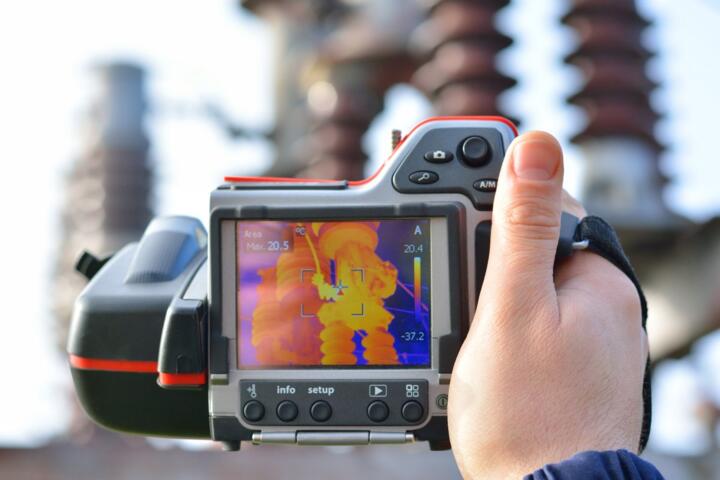
The biggest trap is ignoring Reflected Apparent Temperature. If you are scanning a high-voltage switch in an outdoor substation, the sun can reflect off the porcelain insulators, creating a "false positive" hot spot. Always stand at an angle to the target to ensure you aren't seeing your own thermal reflection or a heat source behind you.
Another error is failing to document "Normal" states. Without a baseline image of a healthy motor, it is difficult to prove that a current image shows an abnormality. I recommend creating a "Thermal Library" for every critical asset. Store these in a CMMS (Computerized Maintenance Management System) like UpKeep or Fiix so that year-over-year comparisons are just a click away.
Lastly, don't forget the "Weather Factor" for outdoor scans. Wind speeds above 10 mph can cool a surface so significantly that a dangerous internal hot spot is masked. This is known as "convective cooling." Only perform outdoor high-voltage scans during calm, overcast conditions for the highest accuracy.
FAQ
Can a thermal camera see through walls?
No, this is a common myth. Thermal cameras only see surface temperatures. However, they can detect what is *behind* a wall (like a hot pipe or missing insulation) because those objects change the temperature of the wall's surface via conduction.
How often should I calibrate my camera?
For industrial insurance compliance, most manufacturers recommend annual calibration. Over time, the internal sensors (microbolometers) can drift, leading to inaccurate temperature readings that might cause you to miss a critical fault.
What is the difference between IR and Thermal?
Infrared (IR) is a broad spectrum. A simple IR thermometer gives you a single point temperature. A thermal camera is a "focal plane array" that provides thousands of temperature points simultaneously, creating a complete visual image.
Does a thermal camera work in total darkness?
Yes. Because it detects heat radiation rather than reflected light, a thermal camera works perfectly in 0.0 lux environments. This makes them ideal for both maintenance and security monitoring.
Is a higher resolution always better?
Generally, yes. Higher resolution allows you to measure smaller targets from a safer distance. If you are inspecting small PCB components or distant power lines, 640x480 resolution is almost mandatory for safety and accuracy.
Author’s Insight
In my fifteen years of industrial consulting, I’ve found that the best thermal camera in the world is useless if the person holding it doesn't understand the equipment's load. I always tell my trainees: "Don't just look at the colors; look at the amps." A hot wire isn't a problem if it's supposed to be hot; it's the unexplained delta that kills your uptime. My advice is to invest as much in a Level I Thermography certification as you do in the hardware itself.
Summary
Thermal camera systems are the ultimate "early warning" sensors for modern industry. By identifying anomalies in electrical, mechanical, and structural systems, they prevent the transition from a minor repair to a catastrophic failure. To get started, establish a baseline for your most expensive assets, use high-resolution hardware like the FLIR T-Series, and never ignore the laws of emissivity. The goal is simple: see the heat before you smell the smoke.