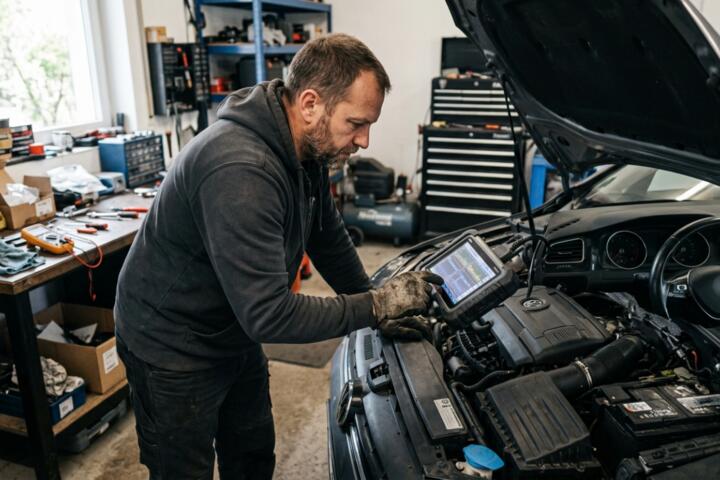
Understanding the Digital Nervous System of Your Car
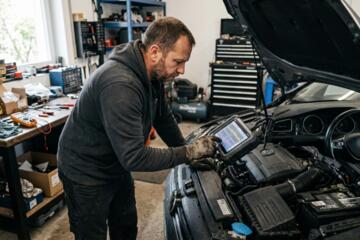
The On-Board Diagnostics (OBD-II) port is the universal gateway to your vehicle’s Engine Control Unit (ECU) and various peripheral modules like the Transmission Control Module (TCM) or the Anti-lock Braking System (ABS). While basic code readers only access "Generic OBD" data—the bare minimum required by law for emissions—professional-grade tools dive into manufacturer-specific protocols. This is where the real diagnostic power lies.
In a professional setting, a technician isn't just looking for a "Check Engine" light. They are looking at "Freeze Frame" data, which captures the exact engine parameters (RPM, coolant temperature, fuel trim) the moment a fault occurred. For example, a $P0171$ (System Too Lean) code could be a vacuum leak, a failing fuel pump, or a contaminated Mass Air Flow (MAF) sensor. A professional tool lets you graph the $O_2$ sensor voltage in real-time to see if it responds to a snap-throttle test.
Statistically, the average diagnostic fee at a US dealership ranges from $150 to $210 per hour. In 2024, data showed that nearly 35% of "Check Engine" lights are triggered by simple issues like a loose gas cap or a faulty sensor that takes ten minutes to replace. Having the right tool moves you from a position of uncertainty to one of informed decision-making.
The Pitfalls of Entry-Level Diagnostics
Many car owners fall into the "parts cannon" trap. They buy a $20 Bluetooth dongle, read a generic code, and immediately buy the part the internet suggests. This is a fundamental misunderstanding of diagnostics. A code for a "Crankshaft Position Sensor Circuit Malfunction" does not always mean the sensor is bad; it could be a frayed wire, a corroded connector, or even a dying battery causing voltage drops during cranking.
Using substandard tools often leads to "blind spots" where the user cannot see proprietary manufacturer codes (often called "U" or "B" codes). These codes govern the body electronics and communication networks. If your windows stop working or your air suspension sags, a basic $30 scanner will likely show "No Codes Found," even though the car is riddled with electronic errors.
The consequence is a cycle of frustration and wasted capital. I have seen enthusiasts replace entire catalytic converters (costing $1,200+) because of an efficiency code, only to realize later that a $50 downstream oxygen sensor was simply sluggish. Without "Live Data" graphing capabilities, you are just guessing.
Strategic Selection of Diagnostic Hardware
Decoding Bi-Directional Control
The hallmark of a professional tool is bi-directional control. This allows you to send commands to the car, not just receive data. If you suspect a cooling fan is dead, you don't need to wait for the engine to overheat to test it. You can use a tool like the Autel MaxiCOM MK808Z-BT to trigger the fan relay manually. If the fan spins, you know the motor is good and the problem lies in the temperature sensor or the wiring logic.
Manufacturer-Specific Software Suites
General-purpose tools are fine for a Toyota, but if you own a BMW, Volkswagen, or Mercedes, you need specialized logic. For instance, VCDS (Ross-Tech) is the gold standard for VW/Audi owners. It provides access to "Long Coding," allowing users to enable hidden features or calibrate new throttle bodies. For BMW owners, the BimmerLink and BimmerCode ecosystem provides dealer-level access for a fraction of the cost of an ICOM interface.
The Importance of CAN-FD and DoIP
As vehicle architecture evolves, older scanners become obsolete. Modern vehicles (especially those produced after 2020 by GM, Ford, and Land Rover) use high-speed communication protocols like CAN-FD or Diagnostics over IP (DoIP). If your tool doesn't support these, it will be painfully slow or fail to communicate with newer modules. Investing in a tool like the Launch X431 V+ ensures compatibility with these high-bandwidth systems, allowing for faster data refresh rates.
Cloud-Based Repair Databases
The best hardware is useless without context. Professional tools often integrate with services like Identifix or Mitchell 1. These databases provide "confirmed fixes" based on millions of real-world repair orders. When you scan a car, the tool cross-references the code with these databases to tell you, "In 85% of cases for this specific year/model, this code was fixed by replacing the EVAP purge valve."
Battery Registration and Maintenance Resets
Modern cars are sensitive to voltage. When you replace a battery in a modern BMW or Audi, you must "register" the new battery to the ECU. The car changes its charging strategy as a battery ages. If you don't tell the car it has a new battery, it will overcharge it, shortening its lifespan by years. Professional-grade home tools allow you to perform these maintenance resets, which would otherwise require a trip to the shop.
Advanced Data Logging for Intermittent Faults
Intermittent stalls are a mechanic's nightmare. A pro-level tool allows for high-speed data logging. You can drive the car with the scanner plugged in, and it will record dozens of parameters per second. When the car stumbles, you hit a marker button. Later, you can review the log on a PC to see if the fuel pressure dipped or the ignition timing pulled back at that exact millisecond.
ECU Coding vs. Programming
It is vital to distinguish between coding and programming. Most home-use "pro" tools allow for coding (changing variables within existing software). Programming (installing new software or "re-flashing") usually requires a J2534 pass-thru device and a subscription to the manufacturer's portal (like ACDelco TDS for GM). Understanding this limit prevents you from "bricking" a module.
Real-World Diagnostic Success Stories
A local independent shop was struggling with a 2018 Ford F-150 that wouldn't engage its 4WD system. The owner had already replaced the transfer case shift motor ($450) to no avail. By switching to a Topdon Phoenix Plus, the technician performed an "Active Test" on the Transfer Case Control Module (TCCM). The tool revealed that the module was receiving the signal from the dash switch but wasn't outputting voltage to the solenoid due to a corroded ground hidden behind the dashboard. Total repair cost after the correct diagnosis: $15 for a new ground terminal and an hour of labor.
In another instance, a DIY enthusiast used FORScan (a specialized software for Ford/Mazda) on a laptop with an OBDLink EX cable. Their vehicle had a "Ghost" battery drain. By monitoring the "Modules Awake" status through the software, they discovered the Telematics Control Unit wasn't entering sleep mode after the ignition was turned off. By simply resetting the module through the software, they saved the $600 cost of a module replacement and the headache of a dead battery every morning.
Tool Comparison: Prosumer vs. Professional
| Feature | Entry-Level ($20-$80) | Prosumer ($300-$800) | Professional ($2,000+) |
|---|---|---|---|
| Code Reading | Generic OBD-II Only | All Modules (ABS, SRS, Body) | Full System + Topology Mapping |
| Live Data | Slow, Text Only | High-Speed Graphing | Multi-Channel Lab Scope Integration |
| Bi-Directional | No | Yes (Most components) | Full Actuation & Calibration |
| Coding | No | Basic (Battery, Oil, Brakes) | Advanced ECU Coding & Adaptation |
| Updates | Limited | 1-2 Years Included | Constant OEM Syncing |
| Connectivity | Bluetooth/Cable | Wi-Fi / VCI Bluetooth | Ruggedized Tablets / J2534 |
Common Diagnostic Mistakes to Avoid
The most frequent error is ignoring the "Freeze Frame" data. If a code sets at -40°C coolant temperature when it's actually 20°C outside, you have a clear indication of a sensor or wiring failure, not a mechanical engine issue. Always look at the environment in which the error occurred.
Another mistake is failing to check for Technical Service Bulletins (TSBs). Manufacturers often release software updates to fix "phantom" codes. Before you replace a sensor, search for TSBs related to that code. You might find that the fix is a free software flash at the dealer rather than a hardware replacement.
Lastly, never clear codes before recording them. Clearing codes also clears the "Readiness Monitors" required for emissions testing. If you clear the codes right before going to an inspection station, you will fail automatically because the car's computer hasn't had enough driving time to verify the systems are working correctly.
FAQ
Can I use a professional scanner to change my odometer?
No. Odometer correction is heavily regulated and usually requires specialized EEPROM programmers, not standard OBD-II diagnostic tools. Professional scanners are designed for repair, not mileage tampering.
Does using a third-party scanner void my warranty?
Simply plugging in a scanner and reading data will not void your warranty. However, using advanced coding features to alter factory engine parameters (tuning) can lead to a warranty claim denial if a failure is linked to those changes.
Why is there a yearly subscription fee for some tools?
Manufacturers like Autel and Launch charge for updates because car companies release new models and updated communication protocols every year. Without the subscription, the tool still works on older cars, but it won't be able to communicate effectively with the latest models.
What is the difference between a "Scan Tool" and a "Code Reader"?
A code reader simply pulls the alphanumeric code (e.g., P0300). A scan tool provides live data streams, graphing, module testing, and the ability to perform service functions like electronic parking brake retraction.
Is a laptop-based setup better than a handheld tablet?
Laptop setups (like Ross-Tech or FORScan) are often more powerful and cheaper for specific brands. Tablets (like those from ThinkCar) are more portable and offer better "all-around" coverage for multi-car households.
Author’s Insight
In my fifteen years of working with automotive electronics, I have found that the hardware is only 20% of the battle; the rest is data interpretation. I always tell beginners to start by watching the "Short Term Fuel Trim" (STFT) and "Long Term Fuel Trim" (LTFT). These numbers are the pulse of your engine. If your total trim is over 10%, your car is compensating for an underlying issue. My best advice: don't just buy a tool to fix a light; buy it to understand how your car "breathes" when it's healthy. This baseline knowledge is what makes an expert.
Conclusion
Transitioning to professional-grade diagnostic tools is a significant investment that pays dividends through accuracy and time saved. By focusing on bi-directional capabilities, manufacturer-specific software, and real-time data graphing, you move beyond the limitations of simple code reading. The goal of using these tools isn't just to clear a dashboard light, but to gain a deep, analytical understanding of your vehicle's health. For the modern car owner, the right scanner is no longer a luxury—it is an essential instrument for maintaining the longevity and safety of a complex machine. Always verify your findings with live data before purchasing replacement parts, and keep your tool's firmware updated to stay ahead of evolving automotive technologies.