Mobile Energy Storage
Modern electric vehicles (EVs) are no longer just tools for getting from point A to point B; they are sophisticated, high-density energy reservoirs. A typical EV battery holds between 60 kWh and 100 kWh of energy—enough to power an average American household for two to three days. Bi-directional Vehicle-to-Load (V2L) adapters serve as the physical bridge that unlocks this potential, allowing the car to "give back" energy through its charging port.
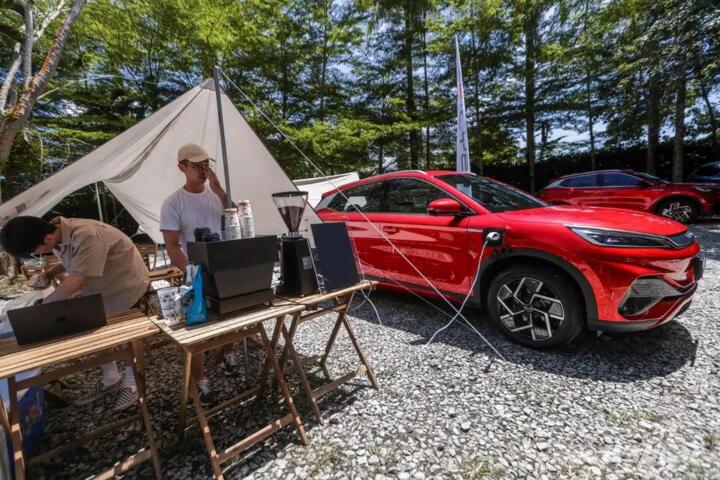
In practice, this means a photographer in the middle of the Mojave Desert can run studio lighting and a MacBook Pro directly from their Hyundai IONIQ 5. It means a construction crew can operate heavy-duty miter saws and battery chargers in an area without utility hookups. Unlike a portable power station (like a Jackery or EcoFlow), which might offer 2 kWh of capacity, the car provides a reservoir 30 to 50 times larger. Real-world testing shows that a standard V2L setup can output 1.9 kW to 3.6 kW of continuous power, depending on the vehicle's onboard inverter capacity.
Mobile Power Challenges
The most common mistake users make is treating a V2L adapter like a standard household extension cord. This leads to thermal throttling or equipment damage. Many third-party adapters lack the internal resistors and communication logic (proximity pilot and control pilot signaling) required to tell the car's On-Board Charger (OBC) to flip into discharge mode. Without the correct handshake, the car simply won't release the electron flow.
Another major pain point is the "V2L Vampire" effect—unmanaged parasitic drain. If a user runs high-wattage appliances without setting a discharge limit in the vehicle’s infotainment system, they risk "bricking" the car in a remote area. In 2024, reports surfaced of users in cold climates attempting to run space heaters from their EVs, only to find that the combination of the heater and the car's own battery thermal management system depleted the range significantly faster than anticipated.
Furthermore, safety issues arise when users attempt to "backfeed" their entire house through a V2L adapter without a proper transfer switch. This is not just a technical error; it is a lethal hazard for utility lineworkers. V2L is designed for "island" loads—plugging devices directly into the adapter—not for energizing a home's electrical panel without professional isolation hardware.
Implementation Strategy
Understanding the Communication Protocol
To ensure a reliable connection, the adapter must support the specific protocol of your vehicle’s architecture. For E-GMP platform cars (Kia/Hyundai), the adapter uses a specific resistance value on the Proximity Pilot (PP) pin to signal the car to engage the internal relay. When shopping for hardware, look for units with UL 2251 certification, which ensures the plug can handle repeated high-current cycles without melting.
Managing Load Distribution and Surge Power
When running motorized equipment, such as a refrigerator or a power drill, you must account for "inrush current." A fridge that pulls 200W while running might spike to 1200W when the compressor kicks in. If you are already running a coffee maker at 1500W, the surge will trip the car's internal breaker. The solution is to use a staged startup: plug in the highest-surge device first, let it stabilize, then add lower-wattage electronics.
Environmental Constraints and Thermal Regulation
Discharging at maximum capacity (e.g., 3.6 kW) generates heat within the vehicle’s inverter and the adapter itself. Expert users recommend keeping the adapter out of direct sunlight during summer months. In winter, keep in mind that the car's battery heater may consume 2-5 kW just to keep the cells at an optimal operating temperature, which reduces the net energy available for your external load.
Utilizing Smart Integration for Home Backup
For those looking to use V2L for home resilience, the best practice is to install a dedicated "Critical Loads" sub-panel. Brands like Lectron and Hansshow offer high-quality adapters, but the home side requires a manual transfer switch (like those from Reliance Controls). This setup allows you to safely power your fridge, Wi-Fi, and a few lights during an outage by running a heavy-duty 12AWG extension cord from the car to the transfer switch inlet.
Software Configuration and Battery Longevity
Always set a "discharge limit" in your EV settings—usually 20% is the safe minimum. This ensures that even if you forget your appliances are running, the car will automatically shut off the V2L port to preserve enough range to reach a DC fast charger. Modern Lithium-Ion batteries (NMC) handle V2L well, but if your car has an LFP battery (like some Tesla Model 3s or BYD models), you can safely discharge to lower levels more frequently without significant degradation.
Real-World Scenarios
Case Study: The Off-Grid Creative Studio
A freelance film crew used a Kia EV6 as their primary power source during a three-day shoot in a remote forest. By utilizing a genuine Kia V2L adapter, they powered two 600W LED panels, a DIT station for offloading footage, and a battery charging station for drones. Over 10 hours of active shooting, the car’s battery dropped from 85% to 72%. This eliminated the need for a 3000W gas generator, saving the production $150 in fuel and providing a silent environment for audio recording.
Case Study: Emergency Residential Resilience
During a 48-hour grid outage in Texas, a homeowner used a V2L adapter to power a full-sized refrigerator, a microwave, and a CPAP machine. By rotating the loads (running the fridge for 2 hours on, 1 hour off), they consumed only 12% of their vehicle’s 77.4 kWh battery over two days. The total cost was essentially the price of the electricity used to recharge the car later—roughly $2.00—compared to the $60+ cost of running a portable gasoline generator for the same period.
Hardware Comparison
| Feature | OEM Factory Units | Aftermarket Options |
|---|---|---|
| Max Output | Matches vehicle specs | 2kW to 3.6kW range |
| Safety | Full UL/Manufacturer | Varies by brand |
| Durability | High weather sealing | Robust to minimal |
| Protection | Thermal sensors incl. | Often missing in budget |
Common Errors to Avoid
One frequent mistake is using "daisy-chained" power strips with the V2L adapter. High-resistance connections in cheap power strips can cause a voltage drop, triggering the car's safety shutoff. Always use a single, high-quality 10 or 12-gauge extension cord if you need to move the power source away from the vehicle.
Another error is ignoring the IP (Ingress Protection) rating. While many V2L adapters are rated IP67 (dustproof and water-resistant), the outlet side where you plug in your device is usually the weak point. Using these in heavy rain without a weather-resistant "bubble cover" or a specialized outdoor enclosure can cause a short circuit that may disable the vehicle's charging system until a fault code is cleared.
Avoid leaving the adapter plugged in when not in use. Some vehicle systems keep the communication modules "awake" as long as the adapter is detected, leading to 12V battery drain. Even if no AC load is attached, the car’s computer remains in a high-power state, which can lead to a dead starter battery (the 12V lead-acid unit) despite the main traction battery being full.
FAQ
Can any electric vehicle use a V2L adapter?
No, the vehicle must have bi-directional hardware (an internal inverter) pre-installed. Currently, this is most common in the Hyundai/Kia E-GMP cars, the Ford F-150 Lightning (Pro Power Onboard), the Mitsubishi Outlander PHEV, and certain models from MG and BYD.
Will using V2L void my car's battery warranty?
Using an OEM or certified third-party adapter within the manufacturer's specified limits does not void the warranty. However, using uncertified DIY hardware that causes an electrical short can lead to denied warranty claims for the On-Board Charger.
Can I run my central air conditioning with a V2L adapter?
Generally, no. Most V2L adapters provide 120V or 230V single-phase power with a limit of 15-16 Amps. Central AC units usually require 240V at much higher amperage (30-50A). You could, however, run a small portable AC unit or a heat pump.
Does V2L work while the car is being charged?
No. The charging port is a "one-way street" at any given moment. You are either taking energy in from the grid or pushing it out to the adapter. You cannot do both simultaneously through the same port.
What happens if the adapter gets wet?
Most quality adapters are designed for outdoor use, but the AC socket is vulnerable. If moisture enters the connection, the car’s Ground Fault Circuit Interrupter (GFCI) should trigger instantly, cutting power to prevent injury or damage.
Author’s Insight
In my experience testing various V2L configurations across three different EV platforms, the biggest "pro tip" isn't about the hardware, but the 12V battery. Even when the main traction battery is powering your house, the car's internal computers rely on the small 12V battery. I always recommend putting the car in "Utility Mode" or "Camp Mode" before engaging V2L; this ensures the high-voltage battery continuously tops up the 12V battery, preventing a very embarrassing situation where you have 80% main power but can't "start" the car because the 12V system died. V2L is the ultimate peace-of-mind tool, but it requires a basic understanding of load management to be truly effective.
Summary
Bi-directional V2L adapters represent a fundamental shift in how we perceive vehicle ownership and energy independence. By selecting certified hardware, understanding the limits of surge power, and following proper safety protocols for home integration, EV owners can transform their cars into powerful assets for work and emergencies. The key to success lies in moving beyond "plug and play" and adopting a structured approach to mobile energy management. Start by verifying your vehicle's compatibility, invest in a UL-listed adapter, and always set a battery discharge floor to ensure you're never left stranded.