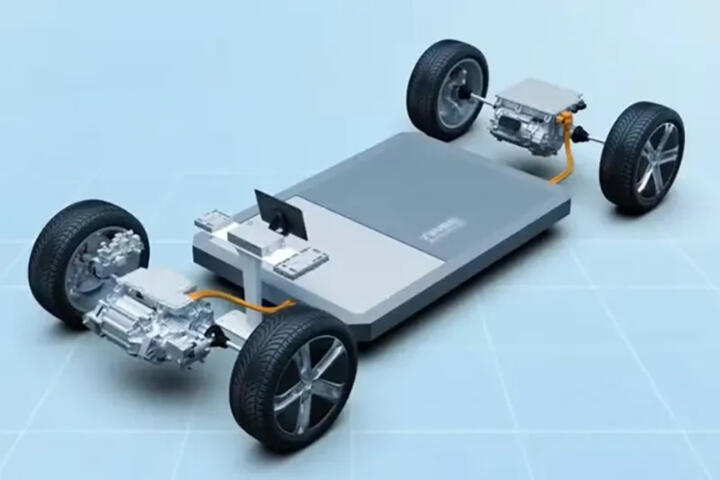
EV Platforms Vs Conversions
“Converted” EVs start with a vehicle architecture designed around an internal-combustion engine, then replace the engine and drivetrain with electric components. A purpose-built EV platform begins with electric packaging constraints, high-voltage safety rules, and software-driven vehicle control from the first design phase. That difference shows up in where the battery sits, how the front and rear structures are shaped, and how the vehicle’s electrical system is laid out.
Battery placement is the most visible change. Many conversions keep the original engine bay geometry, so the battery may end up smaller, higher, or more constrained by existing subframes. Purpose-built platforms often place the battery low and wide under the floor, which changes center of gravity and can improve stability without relying on heavy ballast. The tradeoff is that floor-integrated packs require careful thermal management and crash-load paths, so the platform’s structure and service procedures become tightly coupled to the pack design.
Electrical architecture also diverges. Conversions frequently retain legacy wiring harness routes and control modules, then add high-voltage components and new controllers. Purpose-built EVs typically design the low-voltage network, high-voltage distribution, and power electronics around predictable loads like inverter duty cycles, DC fast-charging currents, and regenerative braking torque requests. When the architecture is planned end-to-end, the vehicle can coordinate traction control, battery protection, and charging behavior with fewer “adapter layers,” which reduces the number of edge cases that show up during software updates.
One incidental detail that illustrates the difference: many modern EVs expose diagnostic trouble codes through standardized OBD-II interfaces, but the underlying module layout differs. A conversion may route signals through legacy body controllers that were never meant to arbitrate high-voltage interlocks, while a purpose-built EV often uses dedicated vehicle control units for powertrain safety logic. That affects how quickly a technician can isolate faults and how consistently the car logs events after a charging interruption.
Common Misconceptions And Dependencies
People often assume that replacing the engine with an electric motor automatically yields the same driving feel and efficiency as a purpose-built EV. In practice, conversions can inherit weight distribution, cooling airflow paths, and suspension geometry from the original platform. Even if the motor and battery are modern, the vehicle’s aerodynamics and thermal packaging may remain closer to the donor design, which changes real-world range at highway speeds.
Another misconception is that “EV platform” only refers to the battery. The platform includes crash structures, mounting points, brake system design, HVAC layout, and the routing of high-voltage cables with proper separation from low-voltage circuits. High-voltage safety depends on insulation monitoring, contactor logic, and interlock switches at service disconnects and charging ports. Conversions can work, but they must map those safety functions onto structures that were not originally designed for them, which can increase complexity in the wiring and service access.
Charging behavior is also tied to platform design. DC fast charging requires the battery management system to manage cell temperatures, limit current based on state of charge and temperature, and coordinate with the vehicle’s power electronics. If a conversion’s thermal system was sized for a different duty cycle, the battery may reach current limits sooner on repeated fast-charge sessions. The result can look like “the battery is smaller,” when the real issue is thermal headroom and control strategy.
Supporting technologies matter because they determine how the car behaves under constraints. Battery management relies on sensors, calibration data, and thermal models. Regenerative braking depends on inverter control, traction estimation, and brake blending logic. Heat pumps and resistive heaters depend on refrigerant circuit design and packaging. When these systems are integrated from the start, the platform can tune them together; when they are added later, the tuning often has to respect legacy constraints, which can leave performance on the table.
What To Check Before You Buy
Inspect Battery And Structure
Look for evidence that the battery is designed as a floor-integrated pack rather than a retrofit module. In listings and owner manuals, scan for language about “underfloor” or “skid-plate” protection, battery cooling type (liquid cooling is common), and service access points. If the vehicle’s documentation describes unusual battery mounting or limited serviceability, treat that as a sign the pack had to fit around donor structures.
Also check weight distribution and curb weight. Purpose-built EVs often advertise a low center of gravity and balanced axle loads, but conversions can vary widely. A practical approach is to compare the vehicle’s curb weight and published axle loads with similar-size EVs, then ask whether the battery’s placement likely drives those numbers. If you see a conversion with a high curb weight for its battery capacity, it may reflect structural reinforcement and added packaging compromises.
As a small aside, some EV manuals include a “high-voltage system” section with diagrams of service disconnect locations. Reading that section takes a few minutes and often reveals whether the pack and cable routing were designed as a unified system or adapted into an older layout.
Compare Charging And Thermal Limits
Use the charging curve, not just the peak DC fast-charging rate. Many manufacturers publish maximum charge power at specific state-of-charge windows, and the curve shape matters for real trips. A conversion may advertise a high peak rate, then taper quickly if thermal management was sized for a different baseline. If the documentation includes battery temperature management details or heat-pump availability, those clues help interpret why the taper happens.
Check whether the vehicle supports preconditioning for fast charging. Preconditioning warms or cools the battery before arrival, which can reduce the time spent at low current. If preconditioning requires navigation-based routing or a specific charging network profile, the platform’s software integration is doing more work; that integration is usually smoother in purpose-built EVs, though it still depends on the specific model year. I’ve seen owners complain about preconditioning not triggering when the route guidance is off, and the fix often lives in the infotainment settings rather than the charging hardware.
For a realistic outcome, compare “time to 80%” claims only when they match the same test conditions. If a conversion’s published test uses a narrow temperature range, the real-world taper can be worse on cold mornings.
Evaluate Software And Safety Logic
Platform differences show up in how the vehicle coordinates traction control, battery protection, and charging interlocks. In practice, that means how the car responds to faults during charging, how it logs events, and how consistently it recovers after a power interruption. Purpose-built EVs often have more cohesive module boundaries, so diagnostics can point to the right subsystem faster.
Look for update policies and release notes that mention powertrain or charging modules. If the manufacturer publishes software update notes with references to “battery management,” “inverter,” or “charging control,” you can infer that the platform’s software stack is actively maintained. Conversions may still receive updates, but the scope can be narrower if legacy controllers constrain what can change safely.
One incidental detail: some vehicles expose firmware versions in the settings menu. If you can find a “vehicle control unit” version number and a “battery management” version number, you can track whether updates actually touch the powertrain domain, not just infotainment.
Plan For Service And Parts
Service implications differ because high-voltage components and structural reinforcements are integrated differently. Purpose-built platforms typically use standardized pack designs and cable routing conventions across models, which can reduce variation in repair procedures. Conversions may require more bespoke parts or harness modifications because the donor body and subframes were never meant for that battery layout.
Ask about repair procedures for battery replacement and high-voltage cable damage. Even without pricing, you can learn whether the pack is designed for modular replacement, whether the vehicle uses a service disconnect accessible without removing major structural components, and whether the manufacturer specifies training requirements for technicians. In many regions, high-voltage work is restricted to trained personnel under electrical safety rules, so the practical availability of trained service matters.
Realistic outcome: a conversion can still be serviceable, but the repair time may vary more because the parts and procedures may be less standardized across the model line.
Case Examples From Realistic Scenarios
Scenario 1: Fast-Charge Taper on a Converted EV. A commuter buys a compact EV conversion advertised at a high DC peak rate. On the first fast-charge stop, the car reaches near-peak power, then drops quickly after 15–20 minutes. The owner later learns the battery temperature never reached the preconditioning target because the vehicle’s route guidance was disabled. The car still charges, but repeated sessions show a longer time to reach 80% than expected from the peak-rate marketing figure.
Scenario 2: Diagnostic Clarity After a Charging Fault. Another owner experiences a charging interruption at a public station. The vehicle logs a charging-related fault code, but the service center needs extra time to interpret whether the issue is in the onboard charger, the battery management system, or a contactor interlock. A purpose-built EV with a more integrated control architecture often produces fault logs that map more directly to the powertrain modules, which can shorten troubleshooting. In both cases, the key difference is how the platform’s safety logic and diagnostics are mapped to serviceable components.
Platform Comparison Checklist
| Check | Purpose-Built EV Platform | Converted EV | What To Look For In Docs |
|---|---|---|---|
| Battery Packaging | Often underfloor, low and wide | May be constrained by donor engine bay | Underfloor references, cooling type, service access |
| High-Voltage Safety | Interlocks and routing designed together | Interlocks mapped onto legacy structures | High-voltage system diagrams, service disconnect locations |
| DC Fast-Charge Behavior | Thermal system tuned for EV duty cycles | Thermal headroom may differ from EV baseline | Charge curve, preconditioning support, “time to 80%” conditions |
| Software Integration | Coordinated powertrain control modules | More adapters between legacy and EV controllers | Update notes mentioning battery/inverter/charging control |
| Service Predictability | More standardized pack and repair procedures | More model-specific parts and procedures | Battery replacement procedure, technician training requirements |
Step-by-step checklist for a buyer:
- Read the owner manual sections on high-voltage safety and charging behavior, then note where the service disconnect is located.
- Compare published DC fast-charge curves and “time to 80%” claims under matching temperature assumptions.
- Confirm whether preconditioning exists and how it triggers (navigation-based, manual schedule, or both).
- Check firmware or software version visibility in the infotainment settings; track whether updates touch powertrain modules.
- Ask the service center about typical repair timelines for high-voltage components, not just battery replacement.
Common Mistakes That Skew Judgement
One mistake is using only battery capacity to predict range and charging performance. Capacity ignores thermal design, inverter limits, and how the vehicle blends regenerative braking with friction brakes. A conversion with a similar battery size can still taper faster if its cooling system reaches limits sooner.
Another mistake is treating peak DC charging power as a practical metric. Peak power often occurs at a narrow state-of-charge window and specific battery temperatures. If you plan trips with repeated charging stops, you need to understand how the vehicle behaves after the first session, which depends on thermal recovery and charge control strategy.
People also misread “platform” claims in marketing materials. A vehicle may share some components with an EV platform while still using a converted body structure. The practical question is whether the battery, high-voltage routing, and crash structures were designed together, which you can infer from service diagrams and high-voltage safety documentation.
Finally, buyers sometimes skip software update policy checks. A platform’s ability to correct charging edge cases depends on how the powertrain software is structured. If updates rarely touch charging or battery management, the platform may remain stuck with conservative limits that were set during initial calibration.
FAQ
Do Converted EVs Always Have Less Range?
Not always. Range depends on battery capacity, aerodynamics, rolling resistance, thermal management, and control strategy. Conversions can match or exceed expectations in some conditions, but they often show different fast-charge taper behavior due to thermal packaging.
Are Purpose-Built EV Platforms Safer?
Safety depends on crash structure design, high-voltage isolation, and validation testing, not only on whether the platform is purpose-built. Purpose-built designs often integrate interlocks and cable routing from the start, which can reduce adaptation complexity, but both approaches can meet safety requirements when engineered and tested properly.
Why Does DC Fast Charging Taper So Much?
Battery management limits current based on state of charge, battery temperature, and cell balancing needs. Thermal recovery time between sessions also matters, so repeated charging can show a slower rise to higher power levels.
Can Software Updates Fix Charging Limits?
Updates can adjust charge control parameters and preconditioning logic, but they cannot override hardware limits like cooling capacity or maximum inverter current. If a platform’s thermal headroom is constrained, software changes usually shift behavior within those physical boundaries.
What Should I Ask a Service Center?
Ask about typical repair timelines for high-voltage components, battery replacement procedure details, and whether technicians require specific high-voltage training. You can also ask how the vehicle logs charging faults and which modules are most commonly implicated.
Author's Insight
Purpose-built EV platforms tend to integrate battery placement, high-voltage safety routing, thermal systems, and powertrain software as one design problem. Converted cars often succeed when the donor architecture still offers enough space and structural compatibility for low, protected battery placement and well-separated high-voltage wiring. The practical differences show up most clearly in charging curves, diagnostic clarity, and service procedures rather than in headline battery capacity alone.
When evidence is limited to marketing specs, the most reliable approach is to read the owner manual sections on high-voltage safety and charging, then compare published charge curves under stated conditions. If you want a quick sanity check, track whether preconditioning exists and whether update notes mention battery management or charging control. That combination usually reveals how tightly the platform’s systems were engineered together.
Key Takeaways
- Converted EVs replace powertrains inside a legacy body architecture, while purpose-built platforms design battery, safety, and software together.
- Battery placement and thermal packaging drive real-world range and fast-charging taper more than peak DC power numbers.
- High-voltage safety documentation and service disconnect diagrams help you judge how integrated the design is.
- Software updates can adjust charging behavior within hardware limits, so update notes and preconditioning support matter.
- A practical comparison uses charge curves, fault logging behavior, and service predictability, not only battery capacity and motor output.