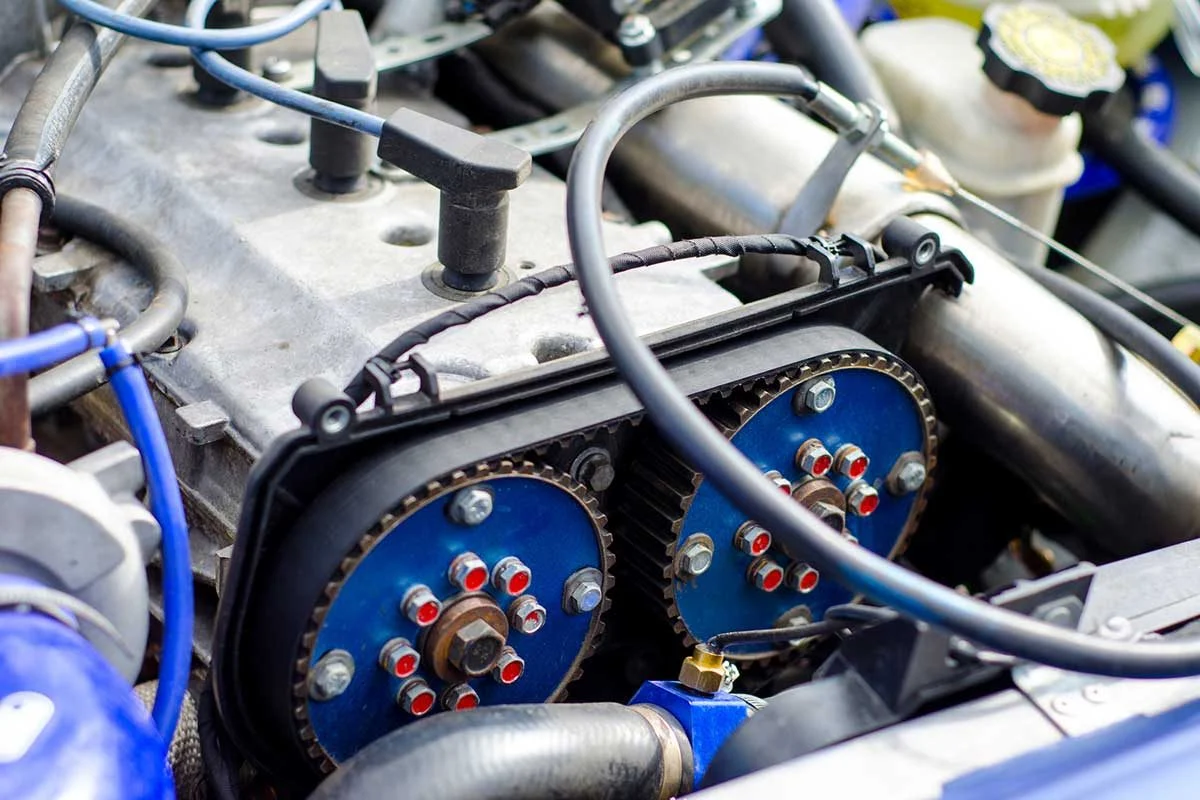
Why timing belts fail
A timing belt keeps the crankshaft and camshafts in sync so valves open at the right time. If the belt slips or breaks, valve timing goes out of phase, and many interference engines can suffer bent valves. The risk is not theoretical; timing-belt failures are a common cause of sudden engine teardown on older designs.
Most manufacturers specify replacement intervals around 60,000–105,000 miles, depending on engine family and model year. Some engines use a chain instead, but belt-driven engines still dominate many compact cars and crossovers. Vehicle type matters because stop-and-go driving, heat cycles, and oil quality affect belt wear and tensioner life.
Skip the interval. It saves money later.
For example, a 2.0L inline-4 with an interference design can require cylinder-head work if the belt fails at highway speed. A 3.5L V6 with multiple camshafts can be even more expensive because more valve trains are involved. Fuel economy also changes the cost picture: a belt replacement might cost less than a single tow plus a head rebuild, even if the car still averages 25–30 mpg.
Industry data on belt failure rates varies by study and engine population. What is consistent across service literature is the failure mode: belt deterioration and tensioner wear lead to loss of synchronization. That is why the service is scheduled, not reactive.
What owners get wrong
People often treat timing-belt service like a “watch it” item. They wait for symptoms such as squealing, misfires, or rough idle, but belt failure can occur without warning. A belt can look fine while the tensioner bearings or internal cords are already deteriorating.
Skip the warning lights. They rarely predict belt breakage.
Another common mistake is assuming mileage alone is the trigger. Heat cycles and age matter because belts age even when mileage is low. A car that sits for months can still develop cracks, and a car that runs hot can accelerate wear.
Financial consequences show up fast. If the belt breaks on an interference engine, repair often turns into a cylinder-head job, and sometimes a full engine replacement. Even when the car is drivable after a failure, the engine may run poorly due to valve damage, which can raise fuel consumption and shorten catalytic converter life.
Real-world situations look like this: a commuter car hits 90,000 miles, the owner delays service by 20,000 miles, and the belt snaps during a cold start. The tow bill is only the first line item. The second line item is labor-heavy disassembly because the front cover must come off to access the belt, tensioner, and related components.
Service steps that prevent damage
Replace belt and tensioner
Replace the timing belt and the tensioner as a matched set. This works because the tensioner controls belt slack and maintains correct tooth engagement under load. In practice, the shop locks the crank and cam positions, removes the belt, then installs a new belt with the tensioner set to spec.
Most jobs also replace the idler pulley. It reduces the chance of uneven belt tracking. Expect labor to be front-cover heavy; many shops quote several hours because access varies by engine layout.
Use the spec sheet. It prevents mis-timing.
For a typical 4-cylinder, the parts cost is often a few hundred dollars, while labor can push the total higher. On a V6, parts and labor both rise because more covers and timing components are involved. The outcome is fewer belt-related failures and more predictable engine longevity.
Inspect water pump and seals
Inspect the water pump and replace it when the design places it behind the timing belt. This works because a leaking pump can contaminate the belt area with coolant, which degrades belt materials. In practice, you can see crusting around the pump outlet or wetness around the seal.
Many service schedules recommend replacing the pump at the same time. That is not automatic for every engine, but it is common when the pump is belt-driven. A pump failure can overheat the engine, and overheating can warp components even if the belt survives.
Coolant leaks are sneaky. They ruin belts quietly.
On some engines, the pump replacement adds less than the cost of repeating the labor later. If the pump is not replaced and it fails at 110,000 miles, the owner may pay for a second front-end teardown.
Check cam/crank timing marks
Verify camshaft and crankshaft alignment marks during installation. This works because correct tooth alignment prevents valve timing errors that can cause hard starts, misfires, or reduced power. In practice, the shop uses locking tools or alignment pins to hold positions while the belt is tensioned.
Skip “eyeballing” marks. It invites off-by-one timing.
Some engines require special tools to lock the cam sprockets. A shop that uses the correct tool set reduces the chance of a one-tooth error. That error can be subtle at first, then shows up as poor fuel economy, rough idle, or diagnostic trouble codes.
On a 2.4L or 3.0L engine, the difference between correct and incorrect timing can be dramatic under load. Owners may notice hesitation around 2,000–3,000 rpm, which is when valve timing errors often show up most clearly.
Set tension with gauge
Set belt tension using the manufacturer method, often a gauge or dial indicator. This works because too much tension loads bearings, while too little tension increases tooth jump risk. In practice, the tensioner is adjusted to a specific reading, then locked.
Over-tensioning shortens bearing life. Under-tensioning risks slip.
Many tensioner designs include a calibrated pointer or scale. Some shops also check belt deflection at a specified span, but the gauge method is more repeatable. If the tension is wrong, the belt can wear faster and the idler bearings can develop noise within 10,000–20,000 miles.
For owners, the practical outcome is fewer repeat repairs. For shops, it’s a measurable setup step, not a guess.
Replace related seals and covers
Replace crankshaft and camshaft seals when the job requires removing components that expose them. This works because seals age and can leak after years of heat and vibration. In practice, the shop checks for oil seepage around the front cover and around the cam seal area.
Oil on the belt is a problem. It swells rubber and attracts debris.
Some engines also use front cover gaskets that harden over time. If the shop reuses old gaskets, leaks can appear later. A small oil leak can contaminate the belt area, which can lead to premature belt replacement again.
On a 1.8L or 2.0L engine, a seal replacement might add modest parts cost but saves labor later if the leak would otherwise return.
Confirm with scan data
Confirm engine operation after service using scan tool data and a road test. This works because timing errors can trigger misfire counts, cam correlation codes, or idle instability. In practice, the technician clears codes, then checks for pending misfires and verifies smooth idle and throttle response.
Skip the “it starts, so it’s fine” logic. Correlation issues can wait.
Some vehicles use cam/crank correlation monitoring, which can detect timing deviations even if the engine runs. A scan tool readout can show misfire counters and fuel trims, which often drift when timing is off. If the car uses a 10–15 minute drive cycle to set readiness monitors, the shop may run a longer test route.
For example, a 2.5L engine might show increased fuel trims at steady cruise if timing is slightly off. That is not always immediate, and it rarely fixes itself without correction.
Document interval and parts used
Document the mileage, date, and parts numbers used in the service. This works because timing belt jobs are easy to forget, and documentation helps future owners and service departments. In practice, the invoice should list the belt, tensioner, idler, water pump (if replaced), and any seals.
Keep the invoice. It matters at resale.
Resale value often depends on maintenance history, and a documented belt service can reduce buyer uncertainty. It also helps if the next owner needs warranty coverage on related work. Warranty coverage varies by region and by parts supplier, but a complete invoice usually supports claims better than a vague receipt.
For fleet managers, documentation also supports downtime planning because timing belt jobs are scheduled events, not surprise repairs.
Mini case: commuter delay
A small fleet ran a 1.8L turbocharged hatchback on a 75,000-mile belt interval. The company delayed service by about 12,000 miles due to scheduling gaps, which, frankly, happens when routes change. At 87,000 miles, the belt failed during a cold morning start.
The repair required cylinder-head work and new valve components. The total bill landed around $3,800, including towing and labor. The fleet also lost two days of vehicle availability, which added a rental cost of roughly $180 per day.
They switched to a calendar-based reminder and replaced the water pump at the same time. In the next cycle, the vehicle reached 90,000 miles without belt-related issues. The company’s direct savings came from avoiding a head job, and the indirect savings came from fewer downtime events.
Mini case: scheduled belt swap
A dealership service department handled a 3.0L V6 sedan at 95,000 miles. The owner had a history of oil changes, but the belt service was overdue by about 5,000 miles. The shop replaced the belt, tensioner, idler pulley, and the belt-driven water pump.
The parts and labor totaled about $1,250. After installation, the technician verified cam/crank correlation with a scan tool and performed a 20-mile test drive. The car returned to normal idle quality and stable fuel trims, with no misfire codes.
Later, the owner reported that the car’s highway fuel economy stayed near 27–28 mpg. That matters because misfires and timing issues can raise fuel consumption and shorten catalyst life. The owner also kept the invoice for resale, which reduced buyer questions during trade-in.
Checklist: what to confirm
| Item to confirm | What you’re checking | Why it prevents failure | What “good” looks like |
|---|---|---|---|
| Replacement interval | Mileage and age guidance | Belt aging and tensioner wear | Invoice matches spec for engine |
| Parts set | Belt, tensioner, idler | Reduces tooth jump risk | All listed with part numbers |
| Water pump | Replaced if belt-driven | Prevents coolant contamination | No seepage after test drive |
| Timing verification | Lock tools and marks | Prevents off-by-one timing | No correlation codes |
| Post-service scan | Misfire and trims | Catches timing issues early | Stable idle and trims |
Common mistakes and fixes
Skipping the interval happens when the car “feels fine.” Belt failure can occur without a long warning period, especially on interference engines. Avoid it by using the manufacturer interval for your exact engine code and by tracking both mileage and years.
Skip the interval. It saves money later.
Another mistake is choosing a cheaper job that replaces only the belt. This fails because tensioners and idlers wear too, and many water pumps sit behind the same covers. Avoid it by asking for the full parts list and confirming whether the pump and seals are included for your engine layout.
Some owners reuse old bolts or gaskets. That can lead to leaks after the job, which then contaminates the belt area. Avoid it by insisting on new hardware where the service manual calls for it, and by checking for oil seepage after the first few days.
Timing mistakes also happen after a belt job. A one-tooth error can cause misfires that show up under load, and it can trigger cam correlation codes later. Avoid it by requesting a post-install scan check and a test drive, not just a start-up.
Finally, people ignore age-based wear. A belt that sits can crack, and a belt that runs hot can degrade faster than the mileage suggests. Avoid it by following the “miles or years” rule in the service schedule, even if the odometer looks low.
FAQ
How do I know my engine uses a belt?
Check the engine description in your owner’s manual or look for the timing belt wording in the maintenance schedule. Many manufacturers list “timing belt” and a mileage/years interval, while others list “timing chain” with no replacement interval. If the manual is unclear, a shop can confirm by inspecting the front timing cover area, but that requires partial disassembly. For accuracy, match the engine size and configuration, such as a 2.0L inline-4 or a 3.5L V6, because belt use varies by engine family even within the same model line.
What symptoms mean the belt is failing?
Symptoms can include squealing from the belt area, rough idle, misfires, or difficulty starting. Some vehicles also show cam/crank correlation codes. The limitation is that belt failure can occur without obvious symptoms, especially if the belt breaks suddenly or the tensioner bearing seizes. A visual inspection through access points may show cracks or fraying, but many belts are hard to see without removing covers. For that reason, scheduled service based on mileage and age is the practical safeguard.
Does replacing the belt prevent overheating?
A belt service prevents belt-related timing failures, but overheating prevention depends on whether the water pump is belt-driven and replaced. If the water pump sits behind the belt, a failing pump can leak coolant and overheat the engine even after a fresh belt. Many service plans recommend replacing the pump at the same time because the labor to access it is already paid. If the pump is not replaced, monitor for coolant seepage and temperature spikes, and expect the job to be repeated if the pump fails later.
What does a timing belt service cost?
Costs vary by engine layout, labor time, and parts pricing. A typical belt job on a 4-cylinder can land around $800–$1,500 in many markets, while V6 jobs often run higher due to more labor and more components. The range widens when seals, water pumps, or additional parts are included. Ask for an itemized quote that lists the belt, tensioner, idler, pump (if applicable), and seals. If the quote is unusually low, it may omit parts that are commonly replaced during the same teardown.
Can I delay service if the mileage is close?
Delaying increases risk because belt aging and tensioner wear continue even when mileage is near the interval. A belt can fail at 90,000 miles on one engine family and at 70,000 miles on another, depending on heat cycles and design tolerances. If the car is already past the recommended mileage or years, the risk rises further. The practical next step is to schedule the service soon and ask the shop to inspect tensioner condition and front seals during the job planning phase.
Author's Insight
Timing belt service prevents a specific failure mode: loss of cam-crank synchronization on interference engines. The most expensive outcomes usually come from valve damage, not from the belt “stretching” gradually. In practice, the job’s reliability depends on tensioner setup, correct alignment tools, and replacing belt-adjacent wear items like idlers and belt-driven water pumps. I’ve seen invoices where the belt was replaced but the tensioner or pump was deferred, and the repeat labor cost erased the initial savings.
For planning, treat the belt interval as a maintenance event, not a diagnostic outcome. A scan tool check after the job catches timing correlation issues that a quick start-up cannot. If you’re budgeting, ask for the parts list and labor time for your engine size, such as a 2.0L inline-4 versus a 3.0L V6, because access differences drive cost.
Key takeaways
Timing belt service prevents sudden valve timing loss, often on interference engines where belt breakage can bend valves. The service also reduces secondary risks like coolant contamination when the water pump is belt-driven. Next step: confirm your exact engine’s belt interval from the owner’s manual, then schedule the job with a parts list that matches the engine layout.
Benefits include fewer catastrophic repairs, better predictability for ownership costs, and cleaner maintenance records for resale. Limits exist: a belt service does not fix unrelated causes of misfires, and it cannot reverse damage if the belt already failed. Seek professional help immediately if the engine stalls, won’t start after a belt-related noise, or shows repeated cam/crank correlation codes.